UV Curing Adhesives: How to Avoid Cure Shadow Defects
by
Published
Views:
Why cure shadow defects matter in real UV curing adhesives production
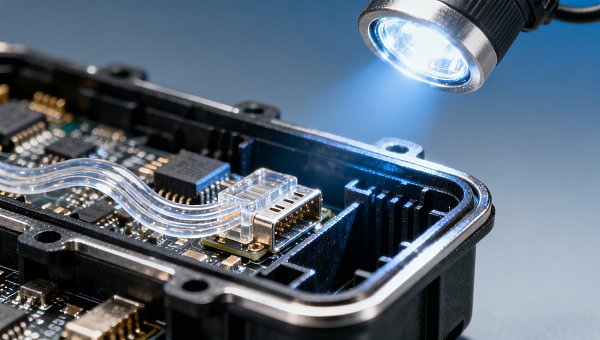
UV curing adhesives are chosen for speed, clean processing, and precise assembly.
Yet cure shadow defects often appear where light cannot fully reach the adhesive line.
The result is not always obvious at first.
A part may pass visual inspection, then fail after thermal cycling, vibration, humidity exposure, or rework.
In fast-moving assembly environments, that hidden risk is more serious than a visible cosmetic flaw.
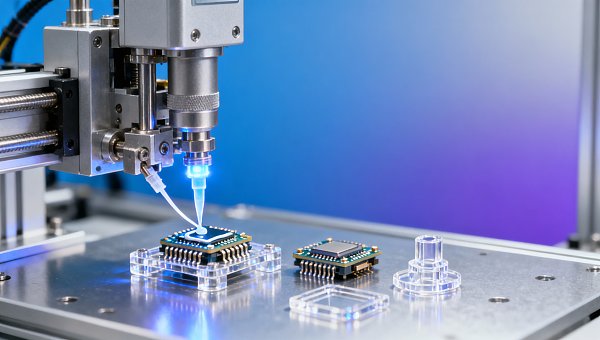
This is especially true in sectors followed closely by IADS, where polymer cross-linking and micro-dispensing precision directly affect structural integrity and electronic reliability.
For UV curing adhesives, cure shadow is rarely caused by one factor alone.
Geometry, substrate opacity, adhesive depth, lamp angle, wavelength, dosage, and dispensing shape all interact.
That is why one stable process in a bezel assembly can fail completely in a camera module or connector corner.
Different assemblies create different shadow risks
In practical use, the first judgment is not adhesive brand.
It is the optical accessibility of the bond line.
Open surfaces behave very differently from enclosed joints.
Transparent plastics also behave differently from black housings, metal frames, or plated components.
A shallow fillet around a sensor window may cure quickly.
A deep bond under a shielding wall may trap uncured material even when surface tack seems acceptable.
For that reason, UV curing adhesives should be assessed by joint architecture before line speed targets are finalized.
3C electronics: speed is high, tolerance is low
In smartphone, wearable, and camera assemblies, UV curing adhesives support very short takt times.
However, these products contain stepped surfaces, tiny brackets, reflective metals, and dark plastics.
Shadows often form beside lens barrels, VCM structures, FPC edges, and frame corners.
Here, the main concern is not bulk bond thickness.
It is whether the shaded interface reaches enough conversion for long-term adhesion and low outgassing.
Industrial devices: larger parts, deeper joints
In sensors, housings, and compact electromechanical products, joints are often deeper and less accessible.
The cure shadow problem becomes a volume issue, not only a surface issue.
UV curing adhesives may skin over at the top while the lower section stays soft.
That creates creep, seal leakage, or contamination during later temperature exposure.
Where cure shadow starts: the most common process triggers
Most shadow defects come from a mismatch between adhesive chemistry and assembly geometry.
The mismatch is often amplified by dispensing and lamp setup.
- Opaque or filled substrates block 365 nm or 395 nm light paths.
- Bond lines are too thick for the selected UV curing adhesives.
- Dispensing creates tall beads instead of low, wide profiles.
- Lamp angle leaves one side underexposed.
- Fixture walls, connectors, or clips cast local shadows.
- Exposure time is based on surface appearance rather than measured dosage.
- Process changes raise line speed without revalidating cure depth.
In high-frequency dispensing lines, even bead placement matters.
A micro-shift from a jet valve can move adhesive behind a wall feature.
Then the same UV dose produces different results lot to lot.
The judgment points are not the same in every application
A useful way to compare UV curing adhesives is to map the joint condition against the cure pathway.
The table below shows where evaluation priorities shift.
This is where IADS-style process thinking becomes useful.
UV curing adhesives do not perform alone.
Their reliability depends on the link between fluid behavior, dispensing precision, and cross-linking energy.
How to prevent cure shadow before defects reach the line
Prevention usually starts with design and process layout, not with extra UV time.
Adding exposure can help, but only if light can reach the target area.
Choose chemistry that matches the hidden zone
For joints with unavoidable shadows, dual-cure UV curing adhesives are often a better fit.
These systems combine UV cure with moisture, thermal, or anaerobic secondary curing.
That does not remove the need for UV optimization.
It reduces the risk of hidden uncured pockets in blocked regions.
Control bead geometry, not only volume
A flatter bond line often cures more completely than a tall narrow bead of the same volume.
In many assemblies, dispensing path redesign solves more than lamp upgrades.
Short segmented beads can also reduce trapped shadow zones.
Validate the lamp system as part of the process
UV intensity alone is not enough.
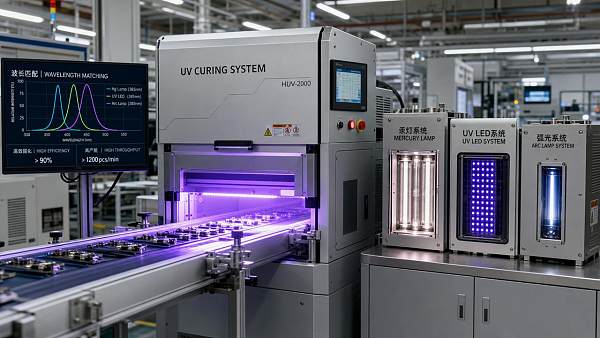
Check wavelength match, working distance, angle, uniformity, and fixture obstruction.
For complex parts, multi-angle exposure is often more effective than higher single-point power.
In precision lines, AI vision-guided positioning can also reduce variation between parts.
The mistakes that cause repeated shadow defects
One common mistake is trusting datasheet cure speed without checking the real joint.
Datasheets usually describe ideal exposure conditions.
Actual assemblies rarely match those conditions.
Another mistake is judging cure by dry surface feel alone.
UV curing adhesives can look acceptable while still lacking internal conversion.
A third issue appears after equipment upgrades.
When dispensing frequency increases, bead shape and placement may change subtly.
That shifts the shadow profile, even if adhesive formulation stays unchanged.
- Do not treat similar black plastics as optically identical.
- Do not assume more lamp power fixes blocked geometry.
- Do not validate only at room temperature if field use is thermal.
- Do not separate adhesive review from dispensing review.
A practical path for correcting cure shadow in UV curing adhesives processes
When cure shadow defects already exist, correction should be staged.
Changing everything at once hides the real cause.
- Map the exact defect location with cross-sections or destructive teardown.
- Compare failed zones with lamp direction, fixture geometry, and bead profile.
- Measure delivered UV energy at the real part position.
- Test lower bead height, different dispense path, or dual-side exposure.
- If shadows are structural, evaluate dual-cure UV curing adhesives.
- Recheck reliability after humidity, heat, vibration, and aging.
In advanced assembly environments, this workflow often saves more time than repeated trial-and-error lamp adjustments.
What stable decision-making looks like before the next validation run
Avoiding cure shadow defects in UV curing adhesives is really about matching three things.
Those three things are adhesive chemistry, dispense geometry, and usable light access.
When one of them is ignored, short-cycle gains can become long-cycle reliability losses.
Before the next process review, it helps to sort assemblies by shadow sensitivity.
Then confirm actual bond depth, substrate transparency, fixture interference, and post-cure service conditions.
That creates a more realistic selection standard for UV curing adhesives.
It also makes line optimization more consistent with the precision assembly logic that defines modern lightweighting and chip-level packaging.
Recommended News
 Jun 11, 2026Henkel Forum Signals UV Hot Melt Shift in ExportsHenkel Forum highlights UV hot melt shift in exports, showing how faster bonding, ISO 10993 medical labels, and EU Eco-design energy compliance can reshape electronics, wearables, and global supply chains.
 Jun 11, 2026China UV Hot Melt Adhesive Exports Face VOCs Compliance ShiftChina UV Hot Melt Adhesive exports face a VOCs compliance shift from June 2026. Learn how REACH, RoHS, and shipment documentation changes may impact EU trade and supplier readiness.
 Jun 11, 2026UV Curing Equipment Selection Guide: Lamp Type, Wavelength, and ThroughputUV curing equipment selection made practical: compare lamp types, wavelengths, and throughput to improve cure quality, reduce energy waste, and choose the right system with confidence.
 Jun 04, 2026UV Curing Adhesives in 2026: Faster Cycles, New LimitsUV curing adhesives in 2026 go beyond fast cure speeds. Explore tighter process windows, precision assembly demands, and how to choose solutions that improve yield, reliability, and throughput.
 Jun 04, 2026UV Curing Adhesives: How to Avoid Cure Shadow DefectsUV curing adhesives guide: learn how to avoid cure shadow defects by optimizing joint design, bead geometry, lamp setup, and dual-cure options for more reliable assembly results.
Editor's Selection
The Archive Newsletter
Critical industrial intelligence delivered every Tuesday. Peer-reviewed summaries of the week's most impactful logistics and market shifts.