Dispensing Systems Upgrade Paths Without Full Line Rebuilds
by
Published
Views:
Dispensing systems upgrades often start with bottlenecks, not with the whole line
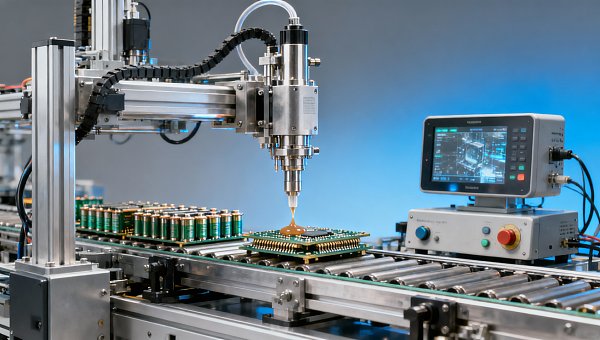
A full rebuild is rarely the only path when dispensing systems begin limiting yield, takt time, or material consistency.
In many plants, the frame, conveyor, fixtures, and curing stations still work well. The weak link is usually narrower.
It may be a valve struggling with viscosity drift, a controller lacking closed-loop feedback, or motion that cannot hold repeatability.
That matters across industrial adhesives, UV assembly, EV battery potting, and high-frequency micro-dispensing.
IADS tracks this intersection closely because dispensing systems are where polymer behavior meets production economics in real time.
The practical question is not whether to upgrade. It is which layer to upgrade first without disturbing validated output.
Why the right upgrade path changes from one application to another
Two lines may both use dispensing systems, yet demand completely different upgrade logic.
A smartphone camera module line fights tiny shot volumes, UV cure timing, and no-contact placement.
An EV battery pack line cares more about bead continuity, thermal interface filling, void control, and heavy material handling.
Structural adhesive cells add another variable: mixed ratio stability over long runs and sensitivity to ambient conditions.
That is why dispensing systems should be judged by fluid behavior, geometry, cure window, and downstream quality risk.
In actual use, similar defects often come from different causes. Stringing, splashing, bubbles, and underfill gaps are not the same problem.
A useful way to segment upgrade decisions
When micro-volume accuracy is the issue, valves and vision usually move first
Electronics assembly is where dispensing systems often reveal hidden limits fastest.
UV adhesives, underfill, silver paste, and edge bonding all punish unstable droplets.
If placement tolerance tightens while board layouts stay unchanged, a new frame may be unnecessary.
A piezo jet valve upgrade can improve non-contact deposition without touching the transport section.
More important, vision integration often delivers value only when linked to offset correction and recipe switching.
Standalone cameras look impressive, but they do not fix poor dispensing systems if latency remains high.
For chip-level packaging, it is also worth checking whether fluid warming, nozzle maintenance, and UV shielding are causing variation.
What usually matters more than headline speed
- Repeatable shot mass across a full shift, not only at startup
- Needle or jet stability with changing adhesive lot behavior
- Camera-to-dispense timing under real conveyor vibration
- Cleanability when switching between UV chemistries
Potting and thermal materials usually reward controller and process upgrades before mechanical replacement
Battery and power electronics lines present a different picture for dispensing systems.
The material is heavier, more shear-sensitive, and less forgiving when trapped air becomes part of the process.
In this setting, replacing a valve alone may not solve bead collapse or uneven thermal transfer.
A better path often starts with pressure profiling, mix ratio verification, reservoir conditioning, and path optimization.
Many dispensing systems in EV workcells can be modernized by adding sensors, data logging, and tighter PLC communication.
That keeps existing gantries useful while reducing scrap tied to voids or incomplete fill.
IADS frequently highlights this point because thermal management materials behave differently from standard sealants, even when viscosities appear comparable.
For structural adhesives, traceability can be a bigger upgrade than speed
Not every dispensing systems upgrade is about faster takt time.
In rail, wind, appliance, and lightweight assembly, the stronger driver may be auditability.
A 2K epoxy process can look stable while ratio drift slowly weakens bond performance.
Here, digital ratio monitoring, mix life alarms, and batch-linked traceability can outperform a broad equipment replacement.
This is especially relevant where REACH, RoHS, halogen-free, or customer-specific validation standards shape process control.
An upgraded controller that records pressure, temperature, and dispense events may unlock qualification confidence faster than a new cell.
The difference between acceptable and robust often comes from data
Robust dispensing systems do more than dispense. They create evidence.
That evidence supports root-cause analysis when bond failures appear weeks after assembly.
Different upgrade paths make sense depending on where the constraint really sits
A useful mistake to avoid is treating all dispensing systems as valve problems.
In practice, the highest return comes from matching the upgrade layer to the actual process constraint.
Where upgrade projects often go wrong
One common misread is focusing on catalog precision while ignoring plant conditions.
Dispensing systems react strongly to temperature swing, humidity, compressed air quality, and fluid age.
Another mistake is comparing only capital cost. Retrofit wiring, validation downtime, spare strategy, and operator retraining matter too.
It is also risky to assume one successful adhesive transfer means all chemistries will behave similarly.
Underfill, silicone TIM, UV glue, and 2K epoxy impose different stress on dispensing systems, even on the same platform.
More subtle problems appear when old motion control remains incompatible with new high-response valves.
That mismatch can create expensive upgrades that still leave accuracy unstable.
A practical sequence for upgrading dispensing systems without a line rebuild
The most reliable path is phased, measurable, and tied to defect economics.
- Map the defect to a process layer: fluid, valve, control, motion, or inspection
- Confirm current material behavior across shift length, lot changes, and ambient variation
- Upgrade the narrowest bottleneck first and preserve validated mechanical assets where possible
- Run side-by-side trials using real production recipes, not demo fluids
- Add traceability and process data before scaling the retrofit across lines
This approach fits the IADS view that precision assembly depends on both chemistry discipline and micro-fluid control.
When upgrade priorities are linked to actual application conditions, dispensing systems can evolve quickly without destroying useful infrastructure.
The next step is to define the exact process window, failure mode, compatibility limit, and data requirement before choosing hardware.
That usually leads to a clearer retrofit roadmap, lower disruption, and faster return than a full line rebuild.
Recommended News
 Jul 26, 2026How AI Vision Guided Dispensing Speed Impacts Accuracy and ThroughputAI vision guided dispensing speed affects more than cycle time. Learn how to evaluate accuracy, latency, fluid behavior, and defect control before trusting high-speed dispensing claims.
 Jul 13, 20265-Axis Dispensing Robot Orders Rise 37% on EV Battery Demand5-axis dispensing robot orders rise 37% as EV battery demand tightens precision standards. Learn how lead times, AI vision platforms, and sourcing risks are reshaping procurement.
 Jul 09, 2026AI Vision Guided Dispensing Supplier Checklist for High-Mix Production LinesAI vision guided dispensing supplier checklist for high-mix lines: compare vision accuracy, fluid control, integration strength, and changeover speed to cut risk and boost yields.
 Jul 03, 2026AI Vision Fluid Control Systems: When They Reduce Dispensing Defects and ReworkAI vision fluid control systems cut dispensing defects, scrap, and rework with real-time inspection and closed-loop correction. See when they deliver the best ROI.
 Jul 02, 2026AI Guided Dispensing Equipment: Accuracy, Throughput, and ROI ComparedAI guided dispensing equipment compared for accuracy, throughput, and ROI. Learn how smarter dispensing cuts scrap, improves yield, and speeds payback in modern production.
 Jun 28, 2026When a 5-Axis Glue Dispensing Robot Improves Cycle Time5-axis glue dispensing robot boosts cycle time by improving path control, bead consistency, and throughput on complex parts. Learn where it delivers ROI and how to reduce rework.
 Jun 28, 2026How to Compare 5-Axis Dispensing Systems for Precision Assembly5-axis dispensing systems compared for precision assembly: learn how to evaluate motion stability, fluid control, software, vision, and lifecycle support to choose the right platform.
 Jun 27, 2026How to Evaluate an Automated Dispensing SupplierAutomated dispensing supplier selection starts with process fit, precision, integration, and service. Learn how to compare vendors, reduce risk, and choose a partner that improves yield and uptime.
 Jun 17, 2026Vision Guided Dispensing Integration: Accuracy Gains vs Setup CostVision guided dispensing integration improves alignment, bead accuracy, and material control. Compare measurable accuracy gains, ROI factors, and setup costs before investing.
 Jun 04, 2026Dispensing Systems Upgrade Paths Without Full Line RebuildsDispensing systems upgrade paths that cut defects, improve accuracy, and boost throughput—learn how to retrofit valves, controls, motion, and traceability without a full line rebuild.



Editor's Selection
The Archive Newsletter
Critical industrial intelligence delivered every Tuesday. Peer-reviewed summaries of the week's most impactful logistics and market shifts.