
ECHA Adds TBBPA Derivatives to REACH Limits
by
Published
Views:
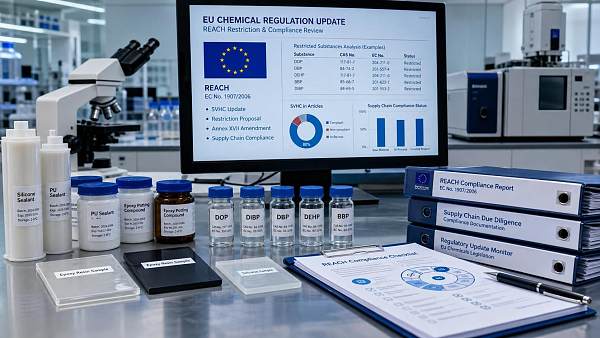
On August 8, 2026, the European Chemicals Agency (ECHA) issued an urgent revision affecting REACH Annex XVII by bringing two TBBPA derivatives into the scope of Entry 68 and setting a 100 ppm migration limit. For exporters and importers involved in halogen flame-retardant PU potting materials, epoxy potting compounds, and related flame-retardant PU potting products, this is a compliance development that deserves immediate attention because the rule will apply to finished products placed on the EU market from February 2027.
What the revision confirms
According to the information provided, ECHA formally added TBBPA-Bisphenol A diglycidyl ether and TBBPA-epichlorohydrin adduct to Entry 68 of REACH Annex XVII. The urgent revision sets a migration limit of 100 ppm for these substances. The measure directly constrains polyurethane potting materials containing halogen flame retardants, epoxy potting adhesives, and flame-retardant PU potting products. The compliance requirement applies to finished products placed on the EU market from February 2027. Overseas importers are advised to immediately review the halogen content of potting materials in their current supply chains and the completeness of related SVHC declarations.
Where the pressure is likely to appear first
Export-facing suppliers of potting materials
From an industry perspective, suppliers selling halogen flame-retardant PU potting materials and epoxy potting compounds into EU-linked business will likely face the earliest operational pressure. The main issue is whether existing formulations and supporting documentation can satisfy the new migration limit and related declaration expectations before the February 2027 enforcement point.
Importers and distributors serving the EU market
Importers are directly named in the provided information as parties that need to assess current supply chains. Analysis shows that their risk is concentrated in supplier screening, product file review, and confirmation of whether existing SVHC declarations are complete enough for downstream placement on the EU market.
Manufacturers shipping finished products into Europe
For manufacturers using these potting materials in finished goods, the impact is not limited to raw material selection. Observably, the compliance point attaches to finished products placed on the EU market, which means purchasing, material approval, and final product release processes may all require closer coordination.
Supply chain and compliance service functions
What deserves closer attention is the documentation side of compliance. Service teams involved in regulatory review, technical documentation, and customer communication may need to verify whether material composition records, SVHC-related statements, and supplier declarations remain aligned with the revised Annex XVII requirement.
Practical priorities before the deadline
Check whether affected materials are already in active supply
Companies should first identify whether TBBPA-related halogen flame-retardant PU potting materials, epoxy potting adhesives, or flame-retardant PU potting products are present in current EU-facing orders, approved vendor lists, or existing inventory pipelines. This is a practical screening step tied directly to the categories named in the revision summary.
Review the completeness of supplier declarations
The provided information highlights SVHC declaration completeness as an immediate concern. In practice, that means companies should verify whether supplier documentation is current, internally consistent, and matched to the exact materials being shipped or incorporated into finished products for the EU market.
Separate rule text from execution risk
Analysis shows that the formal inclusion of the two derivatives and the 100 ppm migration limit is the confirmed regulatory fact. A separate business question is how quickly each company can translate that rule into procurement controls, shipment checks, and customer-facing compliance files before February 2027.
Prepare for customer and importer inquiries
Because overseas importers are specifically expected to review halogen content and declaration completeness, exporters and manufacturers should expect more detailed upstream information requests. A practical focus now is response readiness: product scope, substance identification, and documentation traceability.
Why this looks like more than a routine update
Observably, this development should not be read only as a narrow wording change. It introduces a defined migration limit and a clear compliance date for products entering the EU market, which gives it immediate operational relevance. At the same time, based on the information provided, it is more appropriate to understand this as a regulatory signal with direct short-term compliance consequences rather than as proof of wider market restructuring or broader material substitution outcomes.
Analysis shows that the most meaningful near-term issue is not abstract policy direction but execution: identifying affected potting materials, verifying supply chain declarations, and preventing a mismatch between material approvals and EU market access requirements.
How the market should read this now
This update is best understood as a concrete compliance change with a defined implementation horizon, especially for companies dealing in halogen flame-retardant PU potting materials and related encapsulation products. It does not, on the basis of the provided information, establish broader conclusions about all flame-retardant systems or long-term market outcomes. For now, a neutral reading is that the revision creates an immediate review task for cross-border supply chains and a clear need for closer documentation control ahead of February 2027.
Basis of this article
This article is based on the user-provided news title, event date, and summary concerning ECHA's urgent August 8, 2026 revision to REACH Annex XVII. No specific official source link was provided in the input, so the exact official link remains to be verified on an ongoing basis. For this type of development, source categories that are usually relevant include official regulatory announcements, company disclosures, industry association updates, authoritative media reporting, and standard-setting or compliance-related documents. Continued attention should be paid to any further official wording, implementation guidance, and market-facing compliance clarifications related to the February 2027 application point.
Recommended News
 Sep 16, 2026How to assess a battery safety encapsulation supplier’s fire performanceBattery safety encapsulation supplier evaluation guide: compare fire ratings, smoke, dielectric retention, curing controls, and proof-based support.
 Sep 13, 2026How flame-retardant PU potting improves battery safetyExplore how battery safety encapsulation materials, including flame-retardant PU potting, improve insulation, fault containment, vibration resistance, and battery pack reliability.
 Sep 16, 2026Is flame-retardant polyurethane potting suitable for under-hood automotive electronics?Is polyurethane potting suitable for automotive electronics? Discover why flame-retardant PU works *only* under strict thermal, chemical & process conditions—key insights for under-hood reliability.
 Sep 07, 2026How to choose encapsulation materials for flame-sensitive electronicsEncapsulation materials guide for flame-sensitive electronics: compare fire safety, thermal control, insulation, adhesion, and processing to choose reliable protection.
 Aug 09, 2026ECHA Adds TBBPA Derivatives to REACH LimitsECHA Adds TBBPA Derivatives to REACH Limits: learn how the new 100 ppm rule affects EU-bound products, supply chains, and compliance planning before the February 2027 deadline.
 Aug 08, 2026ECHA Adds New SVHCs, Raising EU Compliance Bar for Potting MaterialsECHA Adds New SVHCs and raises EU compliance pressure for potting materials. Learn how the latest REACH update affects adhesives, encapsulants, and export documentation.
 Aug 07, 2026ECHA Adds TDBPT to Q3 2026 SVHC Candidate ListECHA adds TDBPT to the Q3 2026 SVHC Candidate List, impacting REACH compliance for EU-bound PU potting and silicone encapsulants. See what exporters must review now.
 Aug 06, 2026ECHA SVHC Update Triggers Review of FR Potting ExportsECHA SVHC update puts FR potting exports under urgent review. Learn how TBBPA derivatives, DBDPE, and EH-TBB may affect EU customs, SCIP updates, and market access.
 Aug 05, 2026ECHA Adds 3 SVHCs, Triggering Export ReviewECHA adds 3 SVHCs and triggers export review for EU-bound manufacturers. Learn how TCEP, decaBDE, and HBCDD affect SDS updates, notification, and supply-chain compliance before October 2026.
 Aug 04, 2026How to Choose Polyurethane Potting Compounds for Electronics in High-Heat ApplicationsPolyurethane potting compounds for electronics in high-heat applications: learn how to compare thermal stability, adhesion, moisture resistance, and process fit for longer-lasting performance.
 Aug 04, 2026ECHA Adds 3 SVHCs, Prompting Export ReviewECHA adds 3 SVHCs, triggering export review for EU-bound flame-retardant PU potting and silicone encapsulants. Check SCIP, REACH, SDS and CoC risks before November 2026.
 Aug 03, 2026How to Evaluate Thermal Runaway Protection for Battery ModulesThermal runaway protection for battery modules starts with mapping failure paths, heat, gas, and insulation risks. Learn how to compare materials and designs for safer, scalable modules.
 Aug 03, 2026ECHA Adds 3 SVHC Entries, Forcing Immediate Review of Brominated Flame-Retardant Potting and Encapsulation ExportsECHA adds 3 SVHC entries, forcing urgent REACH and SCIP review for brominated flame-retardant potting and encapsulation exports. See key risks, deadlines, and supplier checks.
 Aug 02, 2026ECHA Adds 3 SVHCs, Triggering Export ReviewECHA adds 3 SVHCs, triggering urgent export review for EU-bound materials. Learn how SCIP, 0.1% thresholds, and buyer declarations impact compliance now.
 Aug 01, 2026ECHA Adds 3 SVHCs, Prompting Review of FR Potting ExportsECHA adds 3 SVHCs to the Candidate List, raising urgent SCIP and compliance checks for flame-retardant PU potting and silicone encapsulant exports to the EU. See key risks now.
 Jul 31, 2026ECHA Adds 3 SVHCs, Prompting Export Compliance ReviewECHA adds 3 SVHCs, triggering urgent export compliance review for EU shipments. Learn REACH, SCIP, and supplier declaration risks before the October 31, 2026 deadline.
 Jul 30, 2026ECHA Adds DBDPE and BTBPE to SVHC ListECHA Adds DBDPE and BTBPE to SVHC List, raising urgent REACH and SCIP compliance questions for EU exporters. Learn the supply-chain risks, documentation impacts, and practical next steps.
 Jul 29, 2026ECHA Adds DBDPE and BTBPE to SVHC ListECHA Adds DBDPE and BTBPE to SVHC List: learn how this REACH update affects EU exports, SDS updates, supplier declarations, and delivery timelines for affected materials.
 Jul 28, 2026ECHA Adds DBDPE and BTBPE to SVHC ListECHA Adds DBDPE and BTBPE to SVHC List—learn how this REACH update impacts EU exports, SDS updates, SVHC declarations, and compliance for PU potting materials and silicone encapsulants.
 Jul 27, 2026ECHA Adds DBDPE and BTBPE to SVHC ListECHA Adds DBDPE and BTBPE to SVHC List: learn how the new REACH update impacts EU exports, CE marking, and compliance for adhesives, potting compounds, and electronic materials.
 Jul 20, 2026How to Evaluate a Battery Potting Compounds Supplier for Thermal and Fire SafetyBattery potting compounds supplier selection affects thermal control and fire safety. Learn how to compare test data, process stability, compliance, and support before qualifying.
 Jul 10, 2026Battery Safety Encapsulation for EV Packs: Fire Risk vs WeightBattery safety encapsulation for EV packs: compare fire containment, thermal control, process fit, and weight trade-offs to choose safer, lighter EV battery designs.
 Jul 08, 2026How to Choose Battery Pack Potting Materials for Heat and Fire RiskBattery pack potting materials guide: learn how to balance thermal control, flame resistance, insulation, processability, and cost for safer battery pack design.
 Jul 08, 2026UL 746C Update Raises Bar for Flame-Retardant PU PottingUL 746C update raises the bar for flame-retardant PU potting with new aging and UV tests. Learn how it impacts UL certification, costs, lead times, and 2027 compliance planning.












Editor's Selection
The Archive Newsletter
Critical industrial intelligence delivered every Tuesday. Peer-reviewed summaries of the week's most impactful logistics and market shifts.