
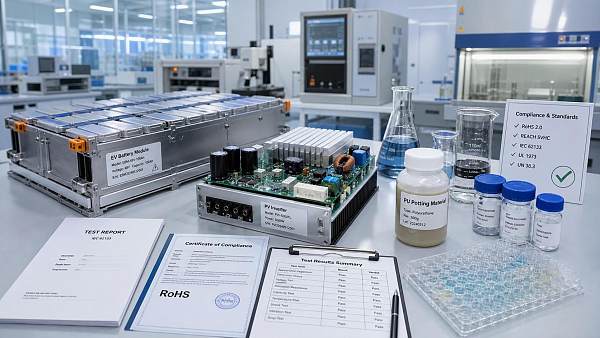
How flame-retardant PU potting improves battery safety
by
Published
Views:
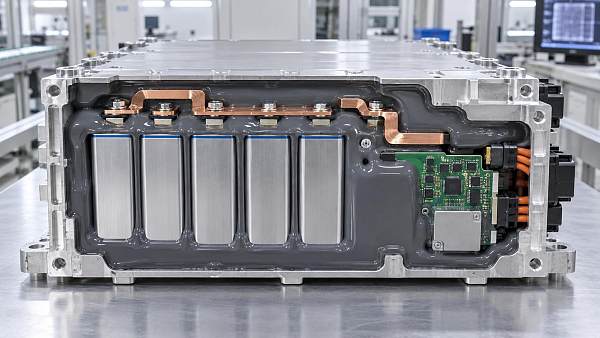
Flame-retardant polyurethane (PU) potting improves battery safety by creating a protective, electrically insulating barrier around cells, busbars, sensing boards, connectors, or localized electronic assemblies. During an abnormal thermal event, the cured material can slow direct flame exposure, limit the movement of molten or burning debris, and reduce the chance that heat or an electrical fault reaches adjacent components immediately. Its value comes from this combined barrier function rather than from flame resistance alone.
For battery systems, the relevant question is rarely whether a potting compound is simply described as flame retardant. The more useful question is how the material behaves after it has been cured in the actual geometry of the pack: around narrow gaps, high-voltage conductors, heat-generating components, vent paths, and mechanically loaded interfaces. A formulation that performs well in a thin laboratory specimen can behave differently when poured into a deep cavity, applied around dissimilar materials, or exposed to repeated thermal cycling.
Containment begins with local fault control
A battery pack contains potential sources of heat, electrical arcing, and mechanical damage. Cell-level events are not the only concern. Loose busbar connections, damaged insulation, conductor abrasion, failed contactors, and short circuits in low-voltage monitoring hardware can also generate localized heat. Flame-retardant PU potting adds separation between these fault sources and neighboring materials.
Once cured, PU fills voids that would otherwise leave exposed conductor edges, unsupported terminals, or pathways for moisture and conductive contamination. The material holds components in position and makes it harder for vibration to wear through insulation over time. When a local overheating event occurs, the potting compound can form a physical buffer around the affected zone. This does not replace pack venting, electrical protection, cell design, or thermal propagation measures. It reduces the number of unprotected interfaces through which a localized failure can spread.
The distinction matters because a potting compound cannot safely be treated as a universal thermal-runaway barrier. A severe cell event can generate hot gases, pressure, and heat loads beyond the intended capability of an encapsulant. The material should instead be assessed as one layer within a coordinated safety design that includes cell spacing, vent direction, enclosure construction, electrical isolation, sensing, shutdown behavior, and fault containment.
Why polyurethane is used where mechanical compliance matters
Compared with a rigid encapsulant, polyurethane often provides useful elasticity after cure. Battery assemblies experience vibration, acceleration, dimensional movement, and changing internal stress as temperatures rise and fall. A compliant cured material can absorb some of that movement rather than transferring it directly to solder joints, terminals, thin circuit boards, and wire bonds.
This mechanical behavior is especially relevant at the boundary between materials with different coefficients of thermal expansion. Aluminum housings, copper conductors, plastics, cell sleeves, and electronic substrates do not expand at the same rate. If a very rigid compound locks these parts together, repeated cycling can concentrate stress at the interface. A PU system with an appropriate modulus can relieve part of that stress while still securing the assembly.
Excessive softness is not automatically beneficial. A low-modulus compound may damp vibration well but provide insufficient support for heavy components or allow movement near a sensitive connection. It may also have limited resistance to damage from service handling. Conversely, raising hardness to improve support can increase stress transfer and reduce crack tolerance. The desired balance depends on component mass, potting thickness, assembly geometry, anticipated temperature range, and the amount of movement that must be controlled.
Flame retardancy must be interpreted in the installed condition
Flame-retardant behavior is often discussed through material classifications or small-scale test results. Such information is useful for screening, but it does not by itself establish pack-level protection. Test specimen thickness, orientation, cure condition, and whether the material is free-standing or bonded to a substrate can all affect observed behavior. Battery cavities introduce additional variables: thick pours generate more cure heat, narrow channels may retain volatiles, and adjacent plastics or foams can influence the way a flame develops.
A useful evaluation separates several related but different properties:
- Resistance to ignition: whether the cured material ignites readily when exposed to a defined heat or flame source.
- Self-extinguishing behavior: whether burning continues after the ignition source is removed, and whether burning material drips or transfers fire to nearby parts.
- Char formation and integrity: whether the material forms a protective residue or cracks away from the surface under heat.
- Smoke and decomposition products: whether the thermal degradation profile is compatible with the enclosure, service environment, and applicable internal safety requirements.
These characteristics do not necessarily improve together. A formulation can resist flame spread yet produce a brittle residue that opens gaps around conductors. Another may remain mechanically cohesive but have lower resistance to direct flame. The decision should be based on the anticipated fault mechanism, not on a single label in a data sheet.
Electrical insulation is a safety function, not a secondary feature
PU potting is frequently selected to isolate high-voltage and low-voltage areas from moisture, dust, condensation, and conductive debris. By covering exposed terminals and filling paths between conductive features, it can support dielectric separation where air gaps alone are vulnerable to contamination. The cured compound also reduces the possibility that vibration causes a wire or terminal to contact a neighboring conductive surface.
Electrical properties need to be reviewed alongside the physical assembly. Dielectric strength measured on a uniform test plaque does not fully represent a sharp busbar edge, a void at the base of a terminal, or a thin section created by poor flow around a component. Local thickness is often more significant than nominal fill depth. Areas beneath connectors, around corners, and near the wall of a housing deserve close attention because these are common locations for incomplete wet-out and trapped air.
Moisture resistance should also be considered as a system property. A material may provide good insulation once cured, yet poor surface preparation, residual moisture, or contamination can weaken adhesion at the interface. A gap that develops between potting and substrate can become a route for moisture ingress. Cleaning, drying, and compatible primer selection can therefore have as much influence on long-term insulation stability as the bulk dielectric value.
Thermal management requires a separate decision
Flame retardancy and thermal conductivity are often discussed together in battery safety encapsulation materials, but they address different mechanisms. Flame retardancy concerns reaction to heat and flame exposure. Thermal conductivity concerns the rate at which heat moves through the cured material during normal operation or a controlled overload. A potting material that slows flame spread is not necessarily effective at transferring heat away from power electronics or densely packed conductors.
Higher thermal conductivity is frequently achieved through mineral fillers. Those fillers can change viscosity, density, flow behavior, hardness, and adhesion. A highly filled compound may be suitable for a shallow power-electronics cavity but difficult to dispense into narrow cell-adjacent features. It can also settle or require controlled mixing if storage and handling are not managed correctly. Greater conductivity may be useful where heat must move toward a cooled housing, but it may be less desirable if the design objective is to limit heat transfer from a faulted component to a vulnerable neighboring area.
Voids can defeat several intended protections at once
Entrapped air is one of the most consequential defects in a potted battery assembly. A void can reduce local electrical insulation, interrupt a thermal path, create a weak mechanical support zone, and allow moisture to collect. The same visible bubble may have different causes. It can result from inadequate degassing, moisture reacting during cure, air drawn in through poor mixing, a dispensing nozzle that loses contact with the fill surface, or a cavity design that prevents air from escaping.
Two-component PU systems require controlled proportioning and mixing. An off-ratio mix may still appear to cure but can deliver altered hardness, adhesion, flame behavior, or electrical properties. Static mixers are effective only when feed volumes remain within their intended operating range and the material has not begun reacting before entering the mixer. Material temperature also affects viscosity and dispense consistency. Cold material may fill poorly around complex features, while excessive warming can shorten workable time and make the cure profile harder to control.
Deep-pour geometry deserves separate review. The exotherm produced during cure can be higher in a thick mass than in a thin test sample. Elevated internal temperature can affect the PU network, stress nearby components, or create shrinkage patterns that are not visible at the surface. A staged fill, modified formulation, or revised cavity geometry may be needed where the required potting depth is substantial.
Adhesion should be selective and durable
Strong adhesion to every surface is not always the correct target. Permanent adhesion to an aluminum housing may improve sealing and vibration resistance, while adhesion to a component intended for service replacement can make repair impractical. Some battery designs use barriers, release-treated regions, removable lids, or localized potting zones to preserve access to fuses, connectors, or monitoring electronics.
Surface condition controls much of this behavior. Oils from stamping, residual coolant, mold release, oxidation, dust, and fingerprints can reduce bond reliability even when a laboratory coupon result is favorable. Substrate preparation should represent the production route, including cleaning sequence, drying time, handling interval, and any plasma or primer treatment. Evaluating adhesion only on freshly prepared flat panels can conceal failures caused by actual parts with seams, coatings, textured surfaces, and inaccessible corners.
Compatibility also extends to the components inside the cavity. Some plastics, wire jackets, labels, conformal coatings, foams, seals, and cell wrap materials can soften, discolor, swell, or lose adhesion after contact with uncured constituents or prolonged heat exposure. The cured potting compound may be compatible while the mixed liquid is not. Both states should be included in the review.
Assessment should follow the failure path
A credible material selection begins by mapping what the potting is expected to protect and what it must not obstruct. For a busbar region, insulation coverage and resistance to vibration-induced movement may dominate. Around a battery management board, moisture exclusion, low stress on components, and rework boundaries may be more important. Near a heat-generating power device, thermal transfer and controlled fill thickness can take priority. One PU formulation rarely performs identically across all these locations.
Representative assemblies reveal problems that isolated material tests cannot. They show whether the compound flows below components, whether vents remain open, whether connectors stay usable, and whether cure shrinkage pulls away from vertical walls. They also expose dispensing variation between the first and last unit in a production run. Visual inspection should be paired with methods suited to hidden defects, such as sectioning trial parts or non-destructive inspection where appropriate, because a smooth top surface does not confirm complete encapsulation beneath it.
Flame-retardant PU potting improves battery safety when its flame response, insulation performance, mechanical compliance, thermal behavior, and processing window are treated as connected design variables. The most reliable result comes from matching the compound to a defined fault path and installed geometry, then verifying the cured assembly rather than relying on a single material property in isolation.
Recommended News
 Sep 13, 2026How flame-retardant PU potting improves battery safetyExplore how battery safety encapsulation materials, including flame-retardant PU potting, improve insulation, fault containment, vibration resistance, and battery pack reliability.
 Sep 07, 2026How to choose encapsulation materials for flame-sensitive electronicsEncapsulation materials guide for flame-sensitive electronics: compare fire safety, thermal control, insulation, adhesion, and processing to choose reliable protection.
 Aug 09, 2026ECHA Adds TBBPA Derivatives to REACH LimitsECHA Adds TBBPA Derivatives to REACH Limits: learn how the new 100 ppm rule affects EU-bound products, supply chains, and compliance planning before the February 2027 deadline.
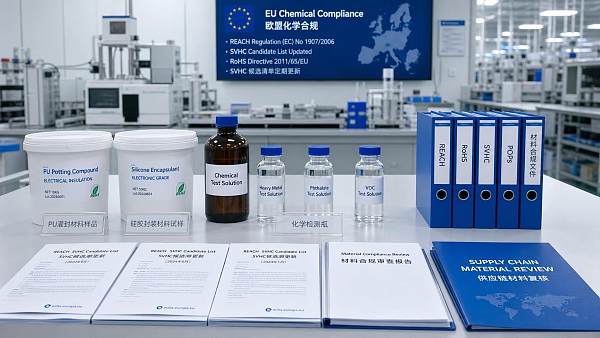
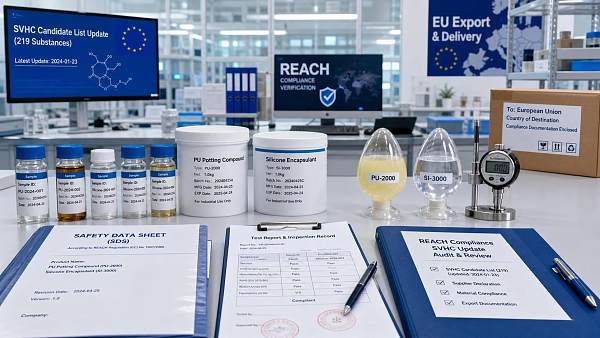
 Aug 08, 2026ECHA Adds New SVHCs, Raising EU Compliance Bar for Potting MaterialsECHA Adds New SVHCs and raises EU compliance pressure for potting materials. Learn how the latest REACH update affects adhesives, encapsulants, and export documentation.
 Aug 07, 2026ECHA Adds TDBPT to Q3 2026 SVHC Candidate ListECHA adds TDBPT to the Q3 2026 SVHC Candidate List, impacting REACH compliance for EU-bound PU potting and silicone encapsulants. See what exporters must review now.
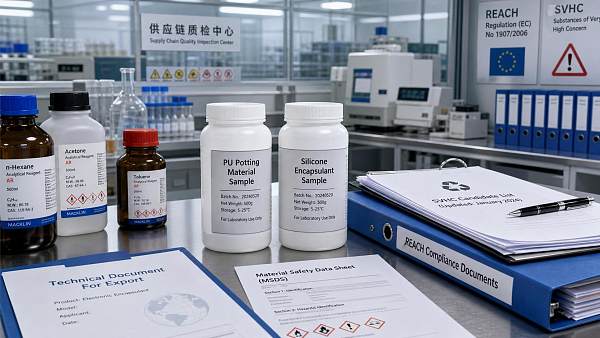
 Aug 06, 2026ECHA SVHC Update Triggers Review of FR Potting ExportsECHA SVHC update puts FR potting exports under urgent review. Learn how TBBPA derivatives, DBDPE, and EH-TBB may affect EU customs, SCIP updates, and market access.
 Aug 05, 2026ECHA Adds 3 SVHCs, Triggering Export ReviewECHA adds 3 SVHCs and triggers export review for EU-bound manufacturers. Learn how TCEP, decaBDE, and HBCDD affect SDS updates, notification, and supply-chain compliance before October 2026.
 Aug 04, 2026How to Choose Polyurethane Potting Compounds for Electronics in High-Heat ApplicationsPolyurethane potting compounds for electronics in high-heat applications: learn how to compare thermal stability, adhesion, moisture resistance, and process fit for longer-lasting performance.
 Aug 04, 2026ECHA Adds 3 SVHCs, Prompting Export ReviewECHA adds 3 SVHCs, triggering export review for EU-bound flame-retardant PU potting and silicone encapsulants. Check SCIP, REACH, SDS and CoC risks before November 2026.
 Aug 03, 2026How to Evaluate Thermal Runaway Protection for Battery ModulesThermal runaway protection for battery modules starts with mapping failure paths, heat, gas, and insulation risks. Learn how to compare materials and designs for safer, scalable modules.
 Aug 03, 2026ECHA Adds 3 SVHC Entries, Forcing Immediate Review of Brominated Flame-Retardant Potting and Encapsulation ExportsECHA adds 3 SVHC entries, forcing urgent REACH and SCIP review for brominated flame-retardant potting and encapsulation exports. See key risks, deadlines, and supplier checks.
 Aug 02, 2026ECHA Adds 3 SVHCs, Triggering Export ReviewECHA adds 3 SVHCs, triggering urgent export review for EU-bound materials. Learn how SCIP, 0.1% thresholds, and buyer declarations impact compliance now.
 Aug 01, 2026ECHA Adds 3 SVHCs, Prompting Review of FR Potting ExportsECHA adds 3 SVHCs to the Candidate List, raising urgent SCIP and compliance checks for flame-retardant PU potting and silicone encapsulant exports to the EU. See key risks now.
 Jul 31, 2026ECHA Adds 3 SVHCs, Prompting Export Compliance ReviewECHA adds 3 SVHCs, triggering urgent export compliance review for EU shipments. Learn REACH, SCIP, and supplier declaration risks before the October 31, 2026 deadline.
 Jul 30, 2026ECHA Adds DBDPE and BTBPE to SVHC ListECHA Adds DBDPE and BTBPE to SVHC List, raising urgent REACH and SCIP compliance questions for EU exporters. Learn the supply-chain risks, documentation impacts, and practical next steps.
 Jul 29, 2026ECHA Adds DBDPE and BTBPE to SVHC ListECHA Adds DBDPE and BTBPE to SVHC List: learn how this REACH update affects EU exports, SDS updates, supplier declarations, and delivery timelines for affected materials.
 Jul 28, 2026ECHA Adds DBDPE and BTBPE to SVHC ListECHA Adds DBDPE and BTBPE to SVHC List—learn how this REACH update impacts EU exports, SDS updates, SVHC declarations, and compliance for PU potting materials and silicone encapsulants.
 Jul 27, 2026ECHA Adds DBDPE and BTBPE to SVHC ListECHA Adds DBDPE and BTBPE to SVHC List: learn how the new REACH update impacts EU exports, CE marking, and compliance for adhesives, potting compounds, and electronic materials.
 Jul 20, 2026How to Evaluate a Battery Potting Compounds Supplier for Thermal and Fire SafetyBattery potting compounds supplier selection affects thermal control and fire safety. Learn how to compare test data, process stability, compliance, and support before qualifying.
 Jul 10, 2026Battery Safety Encapsulation for EV Packs: Fire Risk vs WeightBattery safety encapsulation for EV packs: compare fire containment, thermal control, process fit, and weight trade-offs to choose safer, lighter EV battery designs.
 Jul 08, 2026How to Choose Battery Pack Potting Materials for Heat and Fire RiskBattery pack potting materials guide: learn how to balance thermal control, flame resistance, insulation, processability, and cost for safer battery pack design.
 Jul 08, 2026UL 746C Update Raises Bar for Flame-Retardant PU PottingUL 746C update raises the bar for flame-retardant PU potting with new aging and UV tests. Learn how it impacts UL certification, costs, lead times, and 2027 compliance planning.
 Jul 05, 2026Flame Retardant Potting and Sealing Solutions for Safer Power ElectronicsFlame retardant potting and sealing solutions for safer power electronics: compare epoxy, silicone, and polyurethane options to improve fire safety, reliability, and production performance.
 Jul 05, 2026ECHA SVHC Update Pressures EU-Bound PU Potting ComplianceECHA SVHC update raises new REACH risks for EU-bound Flame-retardant PU Potting. Learn how halogen-containing PU potting suppliers can protect compliance, customs clearance, and buyer approval.


Editor's Selection
The Archive Newsletter
Critical industrial intelligence delivered every Tuesday. Peer-reviewed summaries of the week's most impactful logistics and market shifts.