Non Contact Micro Dispensing Applications in Camera Module Assembly
by
Published
Views:
Why non contact micro dispensing applications matter more in camera modules
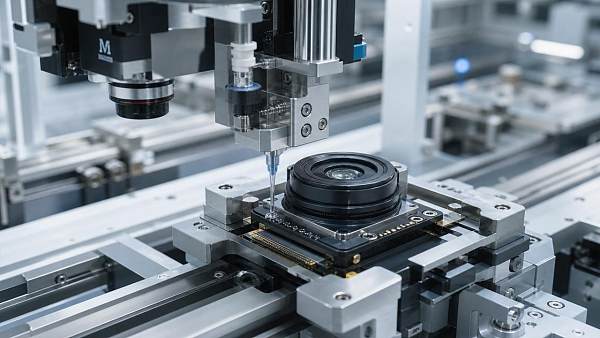
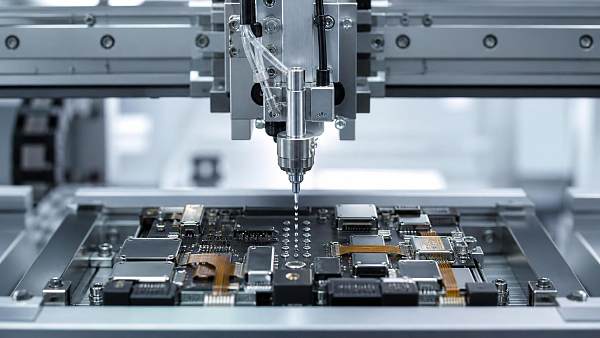
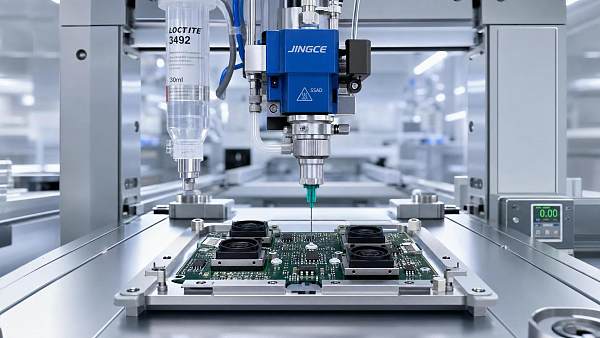
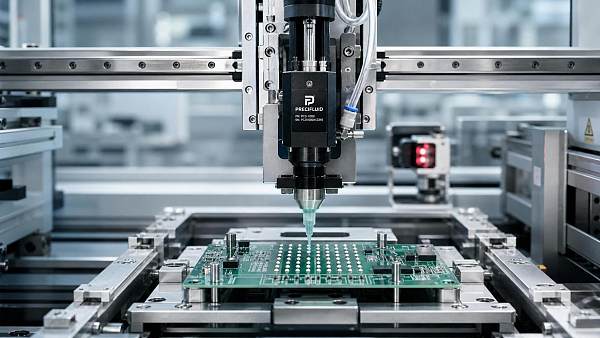
Non contact micro dispensing applications have moved from a niche process to a core assembly decision in camera modules.
The reason is simple.
Optical stacks are smaller, adhesive windows are tighter, and rework risks are more expensive than before.
In practical production, a few microliters placed incorrectly can affect focus stability, sensor cleanliness, and long-term reliability.
That is why non contact micro dispensing applications are now evaluated together with adhesive chemistry, jet valve behavior, curing response, and machine vision alignment.
For camera module assembly, contact dispensing is not always wrong.
But when substrates become fragile, gaps become narrower, and takt time becomes shorter, jetting often creates a better process window.
This is also where broader bonding and dispensing knowledge becomes useful.
On platforms that track industrial adhesives, UV-curing glues, piezoelectric jet valves, and automated fluid control, camera module assembly stands out as a case where fluid dynamics directly shapes product performance.
Actual use cases differ because the glue point is not always serving the same job
A common mistake is treating all non contact micro dispensing applications as volume control problems.
In reality, the dispensing target changes from one assembly step to another.
Some glue points mainly hold parts in position.
Others need light sealing, stress buffering, or precise bond line formation before UV or thermal curing.
That difference changes what should be optimized first.
When the adhesive supports lens barrel fixation, drop placement consistency and wetting shape often matter more than total flow rate.
When the process handles sensor-side bonding, contamination control and satellite droplet suppression become more critical.
For voice coil motor related areas, the process may need better balance between flexibility, repeatability, and thermal exposure.
This is why non contact micro dispensing applications should be judged by function first, then by equipment specification.
Lens barrel bonding needs stable geometry more than headline speed
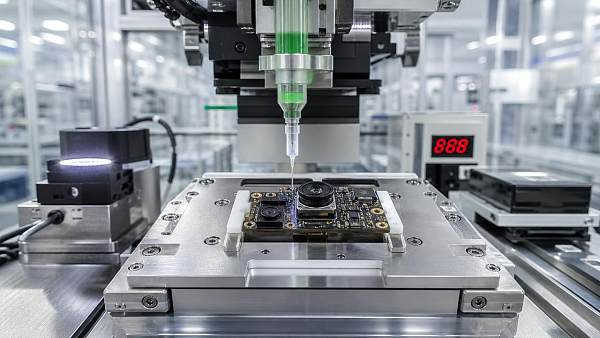
Lens barrel assembly is one of the most common places for non contact micro dispensing applications.
The challenge is not only depositing a tiny amount of adhesive.
It is depositing it in a shape that stays predictable after placement, part mating, and curing.
If the jetting system creates uneven dots, the barrel can tilt slightly.
That small shift can reduce optical alignment quality even when the measured volume looks acceptable.
In this scenario, the better judgment approach is to compare droplet uniformity, stand-off tolerance, and post-cure movement together.
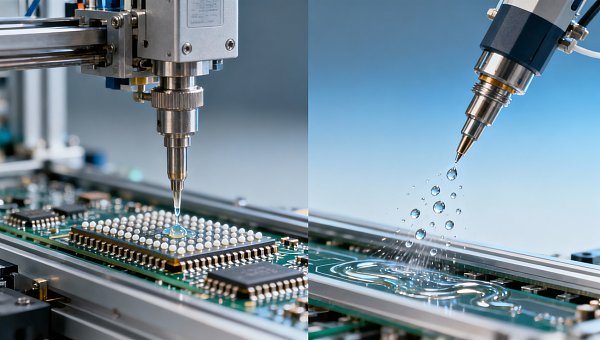
A faster valve is not automatically the better choice if it increases splashing or bead inconsistency.
Sensor-side adhesive placement is really a cleanliness control issue
Closer to the image sensor, non contact micro dispensing applications are usually judged more strictly.
Adhesive overflow, stringing, or misting can directly threaten image quality.
This is where non contact processing shows its main advantage.
The valve does not touch the surface, so the risk of physical scratching or contact-based contamination is reduced.
Still, the process is only stable when adhesive viscosity, nozzle condition, jet waveform, and ambient particles are controlled together.
More than one assembly line has learned that excellent lab results can collapse on the shop floor because the adhesive temperature drifted during long runs.
Different camera module scenarios change the selection logic
A useful way to evaluate non contact micro dispensing applications is to map the process against the actual module structure.
Compact consumer modules, automotive camera units, and industrial vision cameras may all use micro dispensing, but their priorities are not identical.
This comparison shows why non contact micro dispensing applications should not be selected from one benchmark sample alone.
A process tuned for smartphone module speed may not satisfy automotive validation needs.
Likewise, a robust automotive setting may be too slow or too conservative for compact consumer output targets.
High-speed lines need jet consistency across long production runs
In high-volume assembly, the discussion often starts with cycle time.
Yet the deeper issue is consistency after thousands of shots, not just the first few minutes of dispensing.
Non contact micro dispensing applications succeed here when the system keeps droplet shape stable despite pressure fluctuation, material aging, and nozzle contamination risk.
A line can appear efficient while hidden variation slowly reduces yield.
That is why process data, inline inspection, and preventive cleaning intervals are often as important as the valve specification itself.
Reliability-focused modules need material and process to be evaluated together
For harsher operating environments, non contact micro dispensing applications cannot be separated from adhesive behavior.
UV-curing materials may support faster assembly, but cure shadow areas must be checked carefully.
Thermal or dual-cure systems may widen the reliability window, though they also affect takt design and equipment layout.
In these cases, the right question is not whether jetting works.
The right question is whether the jetted adhesive pattern still performs after heat cycling, humidity, vibration, and aging.
What to check before choosing non contact micro dispensing applications
Selection becomes easier when the evaluation stays close to the real process window.
- Confirm the adhesive function at each point, not just the target volume.
- Measure acceptable droplet shape variation, not only average shot size.
- Check whether stand-off distance changes across part tolerances.
- Review viscosity stability over the full operating shift.
- Link dispensing parameters with curing behavior and downstream inspection.
- Assess cleaning frequency, spare parts use, and recipe changeover time.
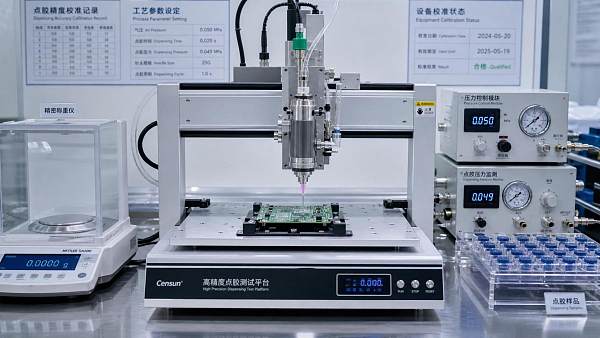
These points matter because non contact micro dispensing applications are affected by the interaction between material, valve, motion platform, and vision system.
Looking at only one element often leads to misleading conclusions.
This is especially relevant in broader industrial adhesive and dispensing environments, where similar jetting hardware may be used across electronics, chip packaging, sealing, and miniature bonding tasks.
Where teams often misread the process window
Several recurring misjudgments appear in non contact micro dispensing applications for camera module assembly.
One is assuming that a smaller nozzle always gives better accuracy.
In practice, it may raise clogging risk and reduce long-run stability.
Another is approving a process after static tests only.
Dynamic production introduces temperature variation, part tolerance shifts, and maintenance interruptions.
A third mistake is separating dispensing from cure verification.
A clean dot before curing does not guarantee bond integrity after exposure.
There is also a cost-related blind spot.
A low-cost setup can become expensive if it needs frequent stoppages, manual tuning, or scrap sorting under magnified inspection.
The more reliable approach is to compare total process cost, yield protection, and maintenance burden together.
A practical path to better fit and lower risk
Non contact micro dispensing applications work best when the decision starts from the assembly scene, not from a generic equipment brochure.
For camera modules, that usually means defining the adhesive task, mapping tolerance sensitivity, and testing shot stability under realistic runtime conditions.
It also helps to compare consumer, automotive, or industrial module requirements separately instead of assuming one setup fits all.
In practical evaluation, the next step is to build a short checklist around adhesive rheology, jet repeatability, cure compatibility, contamination risk, inspection method, and maintenance interval.
That kind of structured review makes non contact micro dispensing applications easier to validate and harder to misapply.
For any line moving toward smaller optics and faster automation, this is usually the most useful place to start.
Recommended News
 Sep 11, 2026How can adhesive waste be reduced on SMT lines using precision piezoelectric jet valves?How can I reduce adhesive waste on an EMS line? Discover how precision piezoelectric jet valves cut consumption by 20–30%, slash rework, and boost yield—learn the physics behind smarter dispensing.
 Sep 04, 2026When is a piezoelectric jet valve the right choice for adhesive dispensing?Discover when dispensing valve technology for adhesives benefits from piezoelectric jetting. Compare speed, precision, fluid compatibility, and validation factors for reliable production.
 Aug 27, 2026When does a piezoelectric jet valve outperform contact dispensing?Dispensing valve technology for adhesives: discover when piezoelectric jet valves improve precision, speed, and yield over contact dispensing.
 Jul 27, 2026How to Choose Low Viscosity Adhesives for Fast, Accurate DispensingLow viscosity adhesives for fast, accurate dispensing: learn how to evaluate rheology, wetting, cure, and equipment fit to reduce defects and improve production performance.
![]() Jul 07, 2026Improving Fluid Dispensing Precision Without Raising Assembly CostFluid dispensing precision can improve without raising assembly cost. Learn practical ways to cut waste, boost consistency, and compare upgrades before you invest.
Jul 07, 2026Improving Fluid Dispensing Precision Without Raising Assembly CostFluid dispensing precision can improve without raising assembly cost. Learn practical ways to cut waste, boost consistency, and compare upgrades before you invest. Jul 04, 2026Dispensing Precision for Jet Valves: Key Causes of Dot Size Variation and How to Control ThemDispensing precision for jet valves explained: discover the key causes of dot size variation, practical control methods, and proven steps to improve yield, consistency, and product reliability.
 Jun 27, 2026How to Improve Dispensing Accuracy Testing ResultsDispensing accuracy testing improves when you control fluid behavior, valve response, pressure stability, and measurement methods. Learn practical steps to get more reliable, production-ready results.
 Jun 19, 2026Fluid Control Systems Electronics: Selection Factors That Affect YieldFluid control systems electronics selection can make or break yield. Learn how fluid behavior, valve design, pressure control, and automation integration drive accuracy, uptime, and better production results.
 Jun 16, 2026Shanghai Show Opens With ±0.25μL Piezo Jet Valve DebutShanghai Show opens with a piezo jet valve debut featuring ±0.25μL repeatability. Explore how this dispensing innovation could reshape EMS and semiconductor packaging sourcing.
 Jun 15, 2026Non Contact Micro Dispensing Applications in Camera Module AssemblyNon contact micro dispensing applications in camera module assembly improve precision, cleanliness, and yield. Explore key use cases, process checks, and smart selection tips.
 Jun 13, 2026Micro Dispensing for Medical Devices: Accuracy Risks and Process TipsMicro dispensing for medical devices demands more than tiny shot sizes. Learn key accuracy risks, valve selection tips, process controls, and validation steps to improve repeatability and reduce production risk.
 Jun 12, 2026BIS Tightens AI Chip Export Rules for China-Headquartered FirmsBIS Tightens AI Chip Export Rules for China-Headquartered Firms: learn how the new BIS rule affects AI chip licensing, exports, compliance, and delivery planning.
 Jun 11, 2026How to Choose Low Viscosity Adhesives for Precision Dispensing ApplicationsLow viscosity adhesives for precision dispensing: learn how to balance flow, wetting, cure speed, and process stability to improve bond accuracy, reduce defects, and choose with confidence.
 Jun 04, 2026Dispensing Valves vs Piezo Jetting: Which Cuts Rework?Dispensing valves vs piezo jetting: learn which method cuts rework faster, lowers fluid waste, and improves precision for electronics, EV battery assembly, and automated production lines.

Editor's Selection
The Archive Newsletter
Critical industrial intelligence delivered every Tuesday. Peer-reviewed summaries of the week's most impactful logistics and market shifts.