
How to Improve Dispensing Accuracy Testing Results
by
Published
Views:
How to Improve Dispensing Accuracy Testing Results
Reliable dispensing accuracy testing is essential for technical evaluations that depend on stable volume, accurate placement, and repeatable process data.
When results drift, the problem rarely sits in one setting alone.
More often, dispensing accuracy testing is affected by valve response, fluid behavior, pressure control, calibration method, and the test environment.
That also means better results come from tightening the whole testing system, not just adjusting one parameter and hoping for consistency.
The sections below explain how to improve dispensing accuracy testing results in a practical, process-driven way.
Start With a Stable Testing Baseline
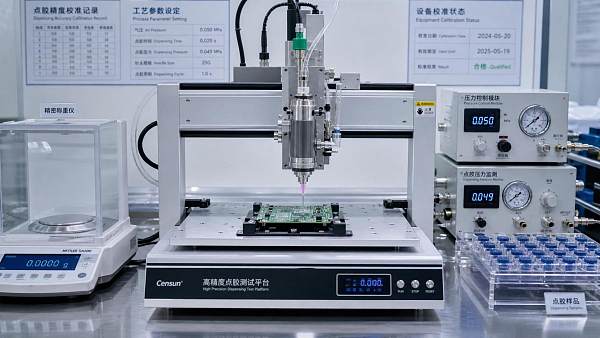
Good dispensing accuracy testing begins before the first shot is measured.
If the baseline shifts, the data loses value, even when average volume still looks acceptable.
Use the same substrate, nozzle type, fluid lot, dispense path, and measurement method across all runs.
Document ambient temperature and humidity at the start of every test.
For many adhesives and sealants, slight environmental changes alter viscosity enough to distort dispensing accuracy testing results.
A useful baseline checklist usually includes these points:
- fluid batch identification
- syringe or reservoir fill level
- needle gauge and wear condition
- air pressure stability
- shot count before sampling
- substrate flatness and cleanliness
This sounds basic, but weak baseline control is still one of the biggest reasons dispensing accuracy testing produces mixed conclusions.
Control the Material Before Tuning the Machine
In real production, machine settings get most of the attention.
Yet many dispensing accuracy testing failures come from the fluid itself.
Viscosity variation changes shot size, line width, dot formation, and tailing behavior.
Thixotropic materials may behave differently after rest time, mixing, or prolonged circulation.
For 2K materials, pot life and mixing quality directly affect dispensing accuracy testing reliability.
Before changing pressure or dispense time, verify these material conditions:
- Check whether the material has reached the recommended operating temperature.
- Confirm that degassing is complete and trapped air is minimized.
- Review shelf life, open time, and any recent batch change.
- For filled compounds, verify filler settlement and remixing consistency.
This is especially important for UV adhesives, underfill materials, potting compounds, and thermally conductive encapsulants.
Those fluids can show strong sensitivity to handling history, which later appears as unstable dispensing accuracy testing data.
Match the Valve, Nozzle, and Pressure Logic to the Fluid
A common mistake is testing an advanced fluid with a poorly matched dispense head.
Dispensing accuracy testing improves when the valve design fits the fluid rheology and target shot size.
Needle valves, diaphragm valves, auger systems, and piezoelectric jet valves behave very differently under the same settings.
For microliter or sub-microliter applications, valve response time often matters more than nominal pressure range.
Pressure should also be viewed as part of a system.
If the regulator reacts slowly, the displayed setting may not reflect the actual pressure during rapid cycling.
To improve dispensing accuracy testing, evaluate:
- valve opening and closing repeatability
- needle inner diameter versus particle size
- dead volume in the fluid path
- reservoir-to-valve distance
- pressure recovery during high-frequency dispensing
When these elements are aligned, dispensing accuracy testing usually becomes more predictable without aggressive parameter changes.
Use a Better Measurement Method, Not Just More Samples
Teams often respond to unstable results by increasing the sample count.
More samples help, but they do not fix a weak measurement setup.
Dispensing accuracy testing should use measurement criteria that match the real application.
For example, weight-based testing is useful for volume consistency, but it says little about placement deviation or bead geometry.
In electronics assembly, positional offset and dot diameter may be more critical than mass alone.
A stronger dispensing accuracy testing protocol may combine several metrics.
This approach gives dispensing accuracy testing results that support equipment selection and process qualification more convincingly.
Reduce Hidden Sources of Variation
When results fluctuate without an obvious pattern, hidden variation is usually involved.
The signal may come from vibration, tubing fatigue, inconsistent purge practice, or operator timing differences.
In automated systems, software timing resolution and trigger delay also influence dispensing accuracy testing.
A practical way to isolate root causes is to change one variable at a time and record the response immediately.
From recent process trends, the more revealing signal is often not average output, but spread over time.
Watch for these hidden variation sources:
- air bubbles entering after refill
- needle contamination during long runs
- worn seals inside the valve
- substrate height variation
- temperature rise near the dispense station
- inconsistent trigger synchronization
Once these are controlled, dispensing accuracy testing tends to show cleaner trends and more defensible pass-fail decisions.
Build a Testing Protocol That Reflects Real Production
Short bench tests can look excellent while real production later struggles.
That gap appears when dispensing accuracy testing ignores production rhythm, cycle time, and maintenance intervals.
A stronger protocol simulates actual operating conditions as closely as possible.
Include warm-up behavior, continuous run performance, stop-start recovery, and end-of-container consistency.
This is especially useful when comparing suppliers, valves, or dispensing platforms.
For technical and standard-driven decisions, a realistic dispensing accuracy testing plan should define:
- acceptance limits for volume and placement
- sampling intervals across the full run
- maintenance and purge frequency
- operator actions allowed during the test
- data recording format for comparison and traceability
With this structure, dispensing accuracy testing becomes a decision tool rather than a one-time lab exercise.
Turn Test Results Into Actionable Process Decisions
The final goal is not just better data.
The goal is better process control, supplier comparison, and equipment confidence.
When dispensing accuracy testing is done well, it shows where the process is stable, where risk is building, and where investment makes sense.
That may point to a different valve type, tighter temperature control, a revised purge routine, or stronger inline inspection.
In day-to-day operations, the most useful improvement is often a simpler one: standardize the setup, lock the variables, and review trend data early.
That is how dispensing accuracy testing results become more repeatable and more useful for long-term production quality control.
If the process must support electronics bonding, battery potting, sealing, underfill, or precision jetting, the same principle holds: test the full system, not just the dispenser in isolation.
Recommended News
 Sep 11, 2026How can adhesive waste be reduced on SMT lines using precision piezoelectric jet valves?How can I reduce adhesive waste on an EMS line? Discover how precision piezoelectric jet valves cut consumption by 20–30%, slash rework, and boost yield—learn the physics behind smarter dispensing.
 Sep 04, 2026When is a piezoelectric jet valve the right choice for adhesive dispensing?Discover when dispensing valve technology for adhesives benefits from piezoelectric jetting. Compare speed, precision, fluid compatibility, and validation factors for reliable production.
 Aug 27, 2026When does a piezoelectric jet valve outperform contact dispensing?Dispensing valve technology for adhesives: discover when piezoelectric jet valves improve precision, speed, and yield over contact dispensing.
 Jul 27, 2026How to Choose Low Viscosity Adhesives for Fast, Accurate DispensingLow viscosity adhesives for fast, accurate dispensing: learn how to evaluate rheology, wetting, cure, and equipment fit to reduce defects and improve production performance.
![]() Jul 07, 2026Improving Fluid Dispensing Precision Without Raising Assembly CostFluid dispensing precision can improve without raising assembly cost. Learn practical ways to cut waste, boost consistency, and compare upgrades before you invest.
Jul 07, 2026Improving Fluid Dispensing Precision Without Raising Assembly CostFluid dispensing precision can improve without raising assembly cost. Learn practical ways to cut waste, boost consistency, and compare upgrades before you invest. Jul 04, 2026Dispensing Precision for Jet Valves: Key Causes of Dot Size Variation and How to Control ThemDispensing precision for jet valves explained: discover the key causes of dot size variation, practical control methods, and proven steps to improve yield, consistency, and product reliability.
 Jun 27, 2026How to Improve Dispensing Accuracy Testing ResultsDispensing accuracy testing improves when you control fluid behavior, valve response, pressure stability, and measurement methods. Learn practical steps to get more reliable, production-ready results.
 Jun 19, 2026Fluid Control Systems Electronics: Selection Factors That Affect YieldFluid control systems electronics selection can make or break yield. Learn how fluid behavior, valve design, pressure control, and automation integration drive accuracy, uptime, and better production results.
 Jun 16, 2026Shanghai Show Opens With ±0.25μL Piezo Jet Valve DebutShanghai Show opens with a piezo jet valve debut featuring ±0.25μL repeatability. Explore how this dispensing innovation could reshape EMS and semiconductor packaging sourcing.
 Jun 15, 2026Non Contact Micro Dispensing Applications in Camera Module AssemblyNon contact micro dispensing applications in camera module assembly improve precision, cleanliness, and yield. Explore key use cases, process checks, and smart selection tips.
 Jun 13, 2026Micro Dispensing for Medical Devices: Accuracy Risks and Process TipsMicro dispensing for medical devices demands more than tiny shot sizes. Learn key accuracy risks, valve selection tips, process controls, and validation steps to improve repeatability and reduce production risk.
 Jun 12, 2026BIS Tightens AI Chip Export Rules for China-Headquartered FirmsBIS Tightens AI Chip Export Rules for China-Headquartered Firms: learn how the new BIS rule affects AI chip licensing, exports, compliance, and delivery planning.
 Jun 11, 2026How to Choose Low Viscosity Adhesives for Precision Dispensing ApplicationsLow viscosity adhesives for precision dispensing: learn how to balance flow, wetting, cure speed, and process stability to improve bond accuracy, reduce defects, and choose with confidence.
 Jun 04, 2026Dispensing Valves vs Piezo Jetting: Which Cuts Rework?Dispensing valves vs piezo jetting: learn which method cuts rework faster, lowers fluid waste, and improves precision for electronics, EV battery assembly, and automated production lines.



Editor's Selection
The Archive Newsletter
Critical industrial intelligence delivered every Tuesday. Peer-reviewed summaries of the week's most impactful logistics and market shifts.