
How to Compare Flame Retardant Thermal Management Materials
by
Published
Views:
Comparing flame retardant thermal management materials starts with a simple reality: heat control and fire safety must work together, not separately.
That is why a datasheet alone rarely gives enough direction. A material may show strong thermal conductivity, yet create problems in dispensing, curing, reliability, or compliance.
In electronics, EV battery systems, rail assemblies, power modules, and compact industrial equipment, these tradeoffs directly affect design margin, production stability, and sourcing risk.
A better comparison method looks at chemistry, thermal path design, flame performance, process fit, and long-term behavior in the actual assembly environment.
What these materials are really expected to do

Flame retardant thermal management materials are used to transfer, spread, or dissipate heat while helping a system resist ignition, flame spread, or thermal escalation.
They appear in potting compounds, gap fillers, encapsulants, interface pads, structural bonding systems, and sealants used around heat-generating components.
In practice, they are often filled polymer systems. Common resin families include silicone, epoxy, polyurethane, and hybrid formulations.
Their value comes from balancing several competing targets. Better thermal conductivity can increase filler loading, but higher filler loading can raise viscosity and reduce process stability.
Flame retardancy can also change curing behavior, mechanical strength, dielectric performance, or weight. That is why direct comparison needs context, not headline numbers.
Why comparison has become more demanding
The market is paying closer attention because assemblies are getting smaller, power density is rising, and compliance expectations are tightening across sectors.
Battery packs, inverters, onboard chargers, LED modules, telecom hardware, and industrial control electronics all combine thermal stress with strict safety expectations.
At the same time, production lines need repeatable dispensing. A material that performs well in a lab sample may still fail during automated mixing, jetting, bead control, or rework.
This is where platforms such as IADS add value. They connect material performance with dispensing accuracy, cure behavior, compliance review, and manufacturing practicality.
That wider view matters because flame retardant thermal management materials are no longer selected only by R&D. They affect sourcing, process planning, certification readiness, and field reliability.
The first comparison point is the thermal pathway
Thermal conductivity is the parameter most buyers notice first, but it should be read carefully.
A stated value in W/mK does not automatically mean better cooling in the final product. The real question is how the material performs inside the full thermal stack.
Thickness, bond line control, void content, surface wetting, and interface contact resistance often matter as much as the conductivity number itself.
For example, a highly filled compound with 3.0 W/mK may underperform a 2.0 W/mK material if the thicker system traps air or creates poor contact.
What to verify
- Thermal conductivity test method and direction, especially isotropic versus anisotropic data.
- Minimum and actual bond line thickness in application.
- Void resistance during dispensing or potting.
- Thermal cycling stability after cure and aging.
- Performance under compression, vibration, or module expansion.
When comparing flame retardant thermal management materials, the most useful question is not “Which one has the highest number?” but “Which one builds the most reliable thermal path?”
Flame performance needs standard-based reading
Flame retardancy claims should always be tied to a test standard, thickness, and sample condition.
UL 94 is common, but a V-0 result at one thickness does not guarantee the same result at another thickness or in a different geometry.
Some applications also need to consider glow wire behavior, smoke generation, halogen-free expectations, or battery-related safety requirements beyond simple vertical burn testing.
This matters especially in EV packs and enclosed electronic assemblies, where thermal runaway prevention and propagation delay are broader system questions.
A sound review compares flame retardant thermal management materials using the same standard set, not mixed supplier language.
Process behavior often decides the better option
A material can look ideal on paper and still create production loss if its rheology does not match the dispensing method.
Viscosity, thixotropy, filler sedimentation, pot life, cure speed, and mixing consistency all shape usable yield.
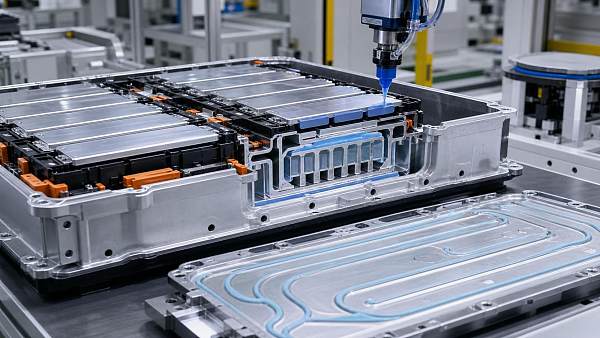
This is especially relevant for two-component battery potting compounds, automated bead dispensing, and high-volume encapsulation lines.
Key process questions
- Can the material run through current pumps, static mixers, or valves without excessive pressure?
- Does filler settling change ratio control during long shifts?
- Is the cure profile compatible with takt time and substrate temperature limits?
- Will the material slump, string, trap bubbles, or contaminate adjacent parts?
- Can the process window stay stable across seasonal temperature changes?
In many lines, the better material is the one that achieves acceptable thermal and flame performance with lower process variability.
Mechanical and electrical effects should not be treated as secondary
Flame retardant thermal management materials also influence stress distribution, insulation behavior, and assembly durability.
A rigid epoxy may support structural integrity, yet transfer stress to sensitive components during thermal cycling.
A soft silicone may absorb movement well, but it may require different handling for adhesion, contamination control, or downstream repair.
Electrical properties matter when the material surrounds live circuits or high-voltage battery elements. Dielectric strength, volume resistivity, and ionic cleanliness deserve review.
This is one reason IADS often frames material selection through both polymer chemistry and process application, rather than treating them as separate decisions.
Different applications require different comparison priorities
A useful comparison matrix changes with the application.
For EV battery modules, thermal propagation control, vibration resistance, dielectric safety, and large-volume dispensing usually dominate.
For consumer electronics, low-stress encapsulation, miniaturized dispensing accuracy, and tight cure control may be more critical.
For rail or industrial power equipment, long service life, environmental resistance, and compliance traceability often carry more weight.
That means flame retardant thermal management materials should be benchmarked against the failure mode of the target assembly, not against an abstract ideal.
A practical evaluation framework
A strong short list usually comes from structured comparison rather than supplier claims alone.
Use a layered review
- Screen for mandatory compliance, flame rating, and restricted substance requirements.
- Check thermal data in relation to bond line, geometry, and expected heat load.
- Review dispensing and curing compatibility with current equipment.
- Compare reliability data after humidity, thermal shock, and aging.
- Run pilot builds to confirm void control, rework impact, and cycle-time stability.
This approach reduces the risk of choosing flame retardant thermal management materials that satisfy one department while creating hidden problems elsewhere.
What to do next with your comparison results
Once the first comparison is complete, narrow the decision to a few materials with balanced thermal, flame, process, and reliability performance.
Then build a test plan around actual substrates, target thickness, cure conditions, dispensing equipment, and environmental loads.
It also helps to standardize data requests across suppliers, including UL details, REACH and RoHS status, rheology windows, and post-aging results.
For more complex programs, especially in battery, electronics, and automated dispensing environments, the most reliable decisions come from linking material review with process review from the start.
That is the practical way to compare flame retardant thermal management materials: treat them as part of a working system, not just a material category.
Recommended News
 Sep 24, 2026What to ask a thermal management materials manufacturer before samplingThermal management materials manufacturer checklist: ask the right sampling questions on heat paths, process fit, reliability, and production support.
 Sep 22, 2026Thermal Interface Pastes Explained: Key Properties for Power Electronics CoolingThermal interface pastes for power electronics cooling: compare conductivity, dielectric safety, pump-out resistance, and dispensing performance for reliable designs.
 Sep 11, 2026What to verify before choosing an EV battery thermal management supplierEV battery thermal management supplier selection guide: verify thermal performance, electrical safety, process compatibility, validation data, and supply support.
 Aug 23, 2026How to qualify a thermal interface adhesives supplier for EV battery assemblyThermal interface adhesives supplier selection for EV battery assembly: learn how to assess thermal performance, dispensing stability, compliance, and scale-up support.
 Jul 25, 2026ECHA Adds Three Phthalates to SVHC ListECHA Adds Three Phthalates to SVHC List: learn how DEHP, BBP, and DBP impact REACH documents, SCIP filing, and EU customs compliance for thermal materials suppliers.
 Jul 24, 2026ECHA Adds 3 SVHCs, REACH Declarations for Thermal Pastes Must Be UpdatedECHA adds 3 SVHCs: learn why REACH declarations for thermal pastes must be updated, how SCIP and SDS rules affect EU exports, and what suppliers should check now.
 Jul 23, 2026ECHA Adds 3 SVHCs, Prompting REACH UpdatesECHA Adds 3 SVHCs, Prompting REACH Updates: learn how Thermal Conductive Pastes, Flame-retardant PU Potting, and EU exporters should respond within six months.
 Jul 22, 2026ECHA SVHC Update Triggers REACH Review for Thermal PastesThermal conductive pastes face urgent REACH review after the ECHA SVHC update. Learn how new Candidate List entries affect SDS updates, EU exports, and compliance readiness.
 Jul 21, 2026ECHA Adds 3 SVHCs, Raising REACH DemandsECHA adds 3 SVHCs to the Candidate List, raising REACH demands for EU-bound thermal interface materials and thermal conductive pastes. See key risks, SCIP duties, and compliance actions.
 Jul 20, 2026ECHA Updates SVHC List, Pressuring Thermal Paste ComplianceECHA updates the SVHC list, raising urgent REACH compliance pressure for Thermal Conductive Pastes in the EU. See key deadlines, supply chain risks, and actions for buyers and manufacturers.
 Jul 19, 2026How to Choose Thermal Interface Materials for EV BatteriesThermal interface materials for EV batteries: learn how to compare conductivity, insulation, gap control, safety, and process fit to choose reliable, high-performance solutions.
 Jul 15, 2026Battery Thermal Management Materials: Comparing Gap Fillers, Pads, and PastesBattery thermal management materials compared: gap fillers, pads, and pastes for EV packs. Learn how to balance heat transfer, manufacturability, cost, and reliability.
 Jul 12, 2026UL94 Thermal Interface Materials: What Ratings Mean for Device SafetyUL94 thermal interface materials explained: learn what V-0, V-1, V-2, and HB ratings mean for device safety, compliance, and smarter material selection.
 Jul 06, 2026Thermal Interface Adhesives Price: Cost Drivers and Spec Trade-OffsThermal interface adhesives price explained: compare cost drivers, spec trade-offs, hidden procurement costs, and sourcing tips to choose the right material with better total value.
 Jul 06, 2026Thermal Interface Materials for Consumer Electronics: What Affects Cooling Performance?Thermal interface materials for consumer electronics directly shape cooling, reliability, and device comfort. Discover what really affects TIM performance beyond conductivity.
 Jul 04, 2026Battery Heat Dissipation Materials: What Improves Cooling Without Adding WeightBattery heat dissipation materials that boost cooling without extra weight. Learn how TIMs, gap fillers, films, and graphite solutions improve battery safety, lifespan, and pack efficiency.
 Jun 30, 2026How to Compare Flame Retardant Thermal Management MaterialsFlame retardant thermal management materials comparison made practical: learn how to assess thermal paths, flame ratings, process fit, and long-term reliability for smarter material selection.
 Jun 23, 2026Battery Thermal Management for Automotive: Paste or Potting Compound?Battery thermal management for automotive: should you choose thermal paste or potting compound? Compare heat transfer, protection, rework, and production fit to make a smarter EV battery design decision.
 Jun 23, 2026Industrial Adhesive Market Trends for EV Battery Thermal MaterialsIndustrial adhesive market trends EV battery leaders watch now are reshaping thermal materials, dispensing, and compliance. Discover what drives safer, faster EV battery production.
 Jun 18, 2026UL94 Thermal Management Adhesives: How to Balance Heat and Flame RatingsUL94 thermal management adhesives explained: learn how to balance flame ratings, heat dissipation, dispensing stability, and long-term reliability for safer, smarter material selection.
 Jun 14, 2026Battery Adhesive Technology: Key Trade-Offs in Thermal Control, Safety, and ReworkBattery adhesive technology shapes thermal control, safety, and rework in EV battery packs. Explore key trade-offs, process risks, and smarter material choices for reliable production.
 Jun 13, 2026Thermally Conductive Adhesives: Key Selection Factors for Heat-Sensitive DesignsThermally conductive adhesives selection guide for heat-sensitive designs. Learn how conductivity, viscosity, cure, and substrate fit improve reliability and cooling.
 Jun 12, 2026Guangzhou Adhesives Show Signals Compliance-Focused BuyingGuangzhou Adhesives Show signals compliance-focused buying as overseas buyers prioritize thermal conductive pastes, UV curing adhesives, and silicone encapsulants with sample validation and technical documentation.
 Jun 04, 2026Thermal Management Materials: Paste or Gap Filler?Thermal management materials: learn when thermal paste or gap filler is the smarter choice for electronics, EV batteries, and industrial systems to improve reliability and reduce production risk.









Editor's Selection
The Archive Newsletter
Critical industrial intelligence delivered every Tuesday. Peer-reviewed summaries of the week's most impactful logistics and market shifts.