
Thermal Management Materials: Paste or Gap Filler?
by
Published
Views:
Choosing between thermal paste and a gap filler is rarely a simple conductivity comparison. For technical evaluators, the better material is the one that fits your stack-up tolerance, assembly process, service life, and cost target with the least risk.
In most precision assemblies, thermal paste performs best when surfaces are flat, bond lines are thin, and low thermal resistance is the top priority. Gap filler is usually the safer choice when parts have height variation, larger interface gaps, vibration exposure, or automated high-volume assembly requirements.
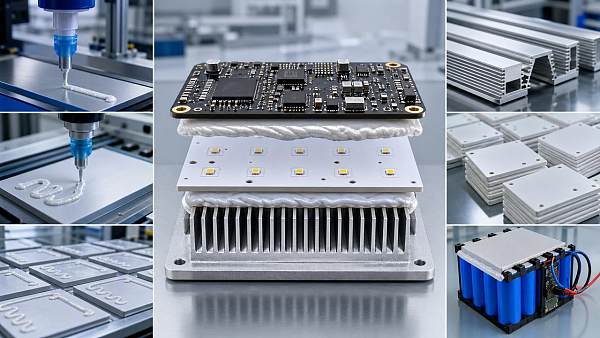
This article explains the real selection logic behind thermal management materials. It focuses on how paste and gap filler behave in electronics, EV battery systems, and industrial equipment, so evaluators can make decisions based on application fit rather than datasheet claims alone.
What technical evaluators are really deciding: thermal efficiency, tolerance control, and production risk
When people search for thermal management materials and compare paste versus gap filler, they are usually not asking for a textbook definition. They want to know which material reduces thermal risk without creating assembly instability, warranty exposure, or hidden manufacturing cost.
That is why conductivity numbers alone are not enough. A material with a higher stated W/m·K value may still underperform in real hardware if it pumps out, traps air, fails under cycling, or cannot accommodate dimensional variation between the heat source and heat sink.
For technical evaluation teams, the practical decision usually comes down to five questions. How large is the interface gap? How consistent are the mating surfaces? What compression force is available? Can the process be automated reliably? What happens after thousands of thermal cycles?
These questions matter across many sectors. In consumer electronics, thin form factors and high heat flux demand low interface resistance. In EV battery packs, interface variation and vibration matter more. In industrial control hardware, long operating life and maintenance conditions may dominate the decision.
Thermal paste: where it wins and where it creates risk
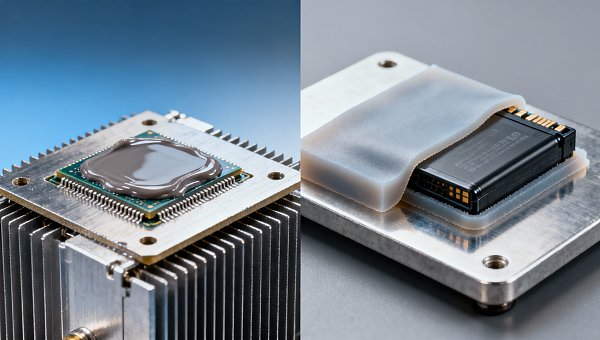
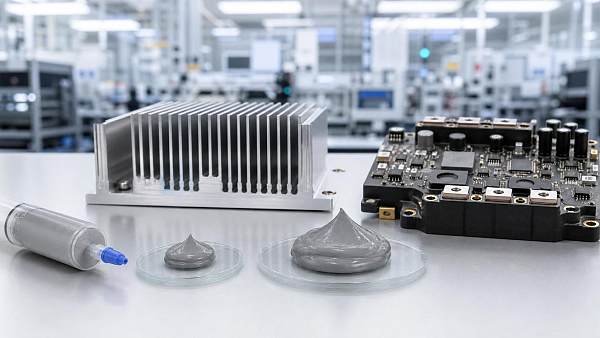
Thermal paste is designed to fill microscopic surface roughness and displace air at the interface between a heat-generating component and a cooler. It works best when the actual gap is very small and the clamping force is enough to spread the material into a thin, continuous layer.
Its main advantage is low bond-line thickness. Because the thermal path stays thin, paste can deliver very low thermal resistance, often making it the preferred option for CPUs, power modules, LEDs, and other applications where flatness is controlled and every degree matters.
Thermal paste also offers flexibility in prototyping and rework. It can be dispensed, screen printed, or manually applied, and components can often be removed and serviced more easily than with cured or highly conformable gap-filling materials.
However, paste becomes risky when the interface gap is not tightly controlled. If the distance between the component and the heat sink is too large, paste may not bridge it uniformly. The result can be voids, dry spots, unstable contact, and sharply increased thermal resistance.
Another concern is long-term material movement. Under thermal cycling, some pastes may pump out from the interface due to expansion and contraction. In high-vibration environments, this can gradually reduce contact quality and create unpredictable field performance.
Paste also places more pressure on process control. Dispensing volume, spread pattern, mounting pressure, and cleanliness all affect the final thermal result. In a lab, good technicians can manage this well. In mass production, consistency can become harder to maintain.
For technical evaluators, thermal paste is usually the stronger candidate when the design has a thin interface, controlled flatness, repeatable clamp load, and a clear need for minimum thermal resistance. Outside those conditions, its apparent performance advantage can narrow quickly.
Gap filler: why it is often the safer choice for uneven interfaces
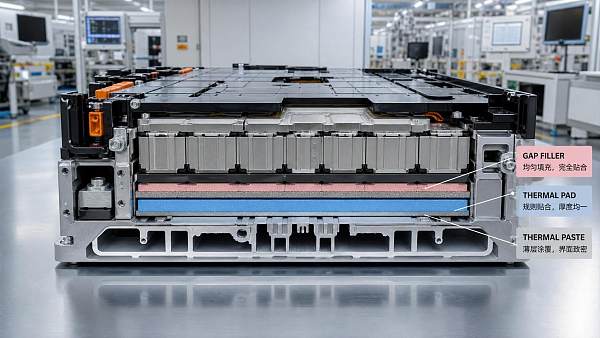
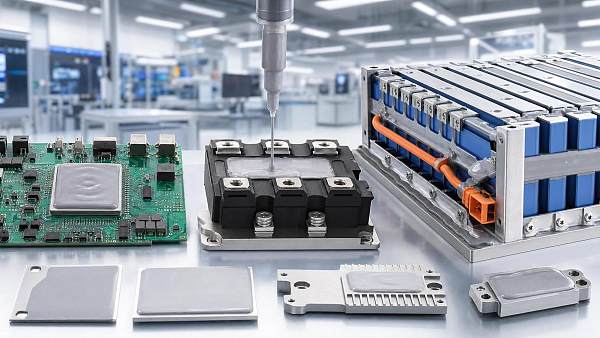
Gap filler is made to accommodate dimensional variation between mating parts while still transferring heat. It is commonly supplied as a soft pad, dispensable gel, or form-in-place material that compresses into larger or less predictable gaps than thermal paste can handle.
The biggest strength of a gap filler is tolerance absorption. If one component sits slightly higher than another, or if the enclosure and PCB have stack-up variation, a compliant gap filler can maintain contact across the whole interface without requiring extremely precise mechanical control.
This is especially valuable in EV battery systems, power electronics, telecom hardware, and industrial assemblies where multiple heat sources must connect to a common cooling plate or chassis. In these cases, mechanical variation is normal, not exceptional.
Gap fillers also help reduce localized stress. Because they compress and conform, they can transfer heat without demanding the same point pressure as paste-based interfaces. That makes them useful for fragile components, large-area interfaces, and assemblies exposed to vibration or shock.
From a manufacturing perspective, gap fillers often support more repeatable assembly outcomes. Pre-cut pads simplify placement, while dispensable gap fillers can integrate well with automated dispensing systems. This can improve consistency when compared with manual or semi-controlled paste application.
Still, gap filler has trade-offs. Its bond line is usually thicker than paste, so even a material with respectable conductivity may show higher total thermal resistance. Evaluators should remember that thickness can outweigh conductivity in the actual heat path.
Gap fillers can also add cost, especially in larger volumes or where premium silicone-free, low-bleed, or electrically specialized formulations are required. In some designs, compression set, outgassing, or surface contamination must also be assessed carefully.
How to decide between paste and gap filler in real applications
The most reliable selection method starts with the actual mechanical gap, not the datasheet headline. If the interface is near-zero and surface flatness is well controlled, thermal paste is often the first material to evaluate. If the gap is variable or clearly measurable, gap filler usually deserves priority.
Next, examine tolerance stack-up under real assembly conditions. Designers sometimes choose paste based on ideal CAD spacing, then discover during pilot builds that warped boards, component height variation, or housing distortion create larger gaps than expected. That is where field failures begin.
Compression force is another key factor. Paste depends on sufficient pressure to spread and wet the surface. If the assembly cannot provide stable clamping force, or if over-compression could damage the component, a softer gap filler may deliver more dependable contact.
Thermal cycling should also be part of the decision, not an afterthought. A material that performs well on day one may behave differently after repeated expansion and contraction. Pump-out, dry-out, compression set, and delamination should all be considered during qualification.
Process compatibility matters just as much as performance. If the production line already uses precision dispensing equipment with strong volume control, a dispensable paste or gel may be feasible. If assembly is distributed across multiple factories, pad-based gap filler may reduce variability.
Rework requirements can change the answer as well. Serviceable electronics often benefit from paste because interfaces can be reopened and renewed more easily. In sealed systems designed for long life without maintenance, the priority may shift toward stable conformability and vibration tolerance.
Finally, evaluate total cost, not unit material price alone. A cheaper paste can become expensive if it causes rework, inconsistent thermal results, or dispensing waste. A more expensive gap filler may still lower total cost by improving yield, speeding assembly, and reducing field risk.
Performance factors that matter more than the conductivity number
Many buyers start with thermal conductivity because it is easy to compare. But when evaluating thermal management materials, conductivity should be treated as only one variable in a larger system. The thermal path depends on thickness, contact quality, pressure, and long-term stability.
Bond-line thickness is often the hidden driver of actual performance. A 3 W/m·K paste at a very thin interface can outperform a 6 W/m·K gap filler used across a thick bond line. That is why application geometry must be evaluated before ranking material options.
Surface wetting also matters. If a material does not conform well to the mating surfaces, small air pockets can remain trapped. Since air is a poor thermal conductor, even minor voiding can reduce effective heat transfer far more than a nominal conductivity difference suggests.
Mechanical reliability should be assessed alongside thermal properties. In mobile or automotive systems, vibration, shock, and thermal expansion mismatch can change interface quality over time. A slightly less conductive but more stable material may produce better real-world thermal management.
Electrical behavior may also be important. Some applications require electrically insulating thermal interfaces, while others need careful control around sensitive circuits. Material bleed, ionic content, and contamination risk should be reviewed, especially in dense electronic packaging.
For regulated or customer-audited programs, compliance and cleanliness are part of the technical evaluation. Outgassing, siloxane migration, VOC profile, and compatibility with downstream processes can all affect whether a material is acceptable, even if its thermal performance is strong.
Application guidance for electronics, EV battery systems, and industrial equipment
In consumer and computing electronics, thermal paste is often preferred for processors, power semiconductors, and compact heat sink interfaces where surfaces are flat and thermal resistance must be minimized. The smaller the gap and the tighter the tolerance, the stronger the case for paste.
In power electronics and telecom assemblies, the answer is more mixed. If several components with different heights must contact one cold plate, a gap filler usually provides better tolerance management. If one flat, high-power device is mounted with strong clamp force, paste may still be superior.
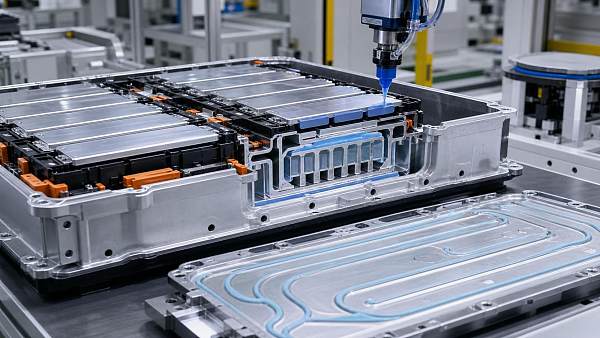
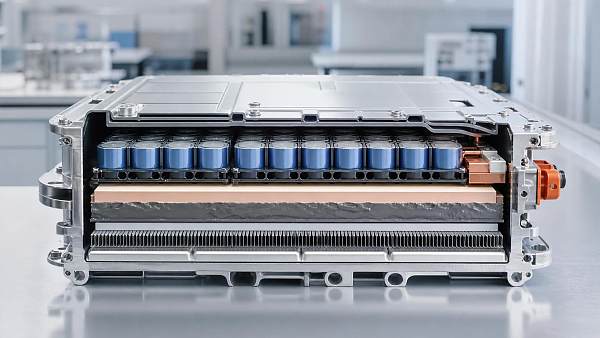
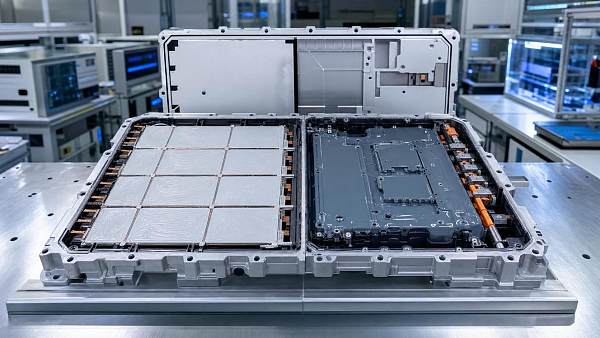
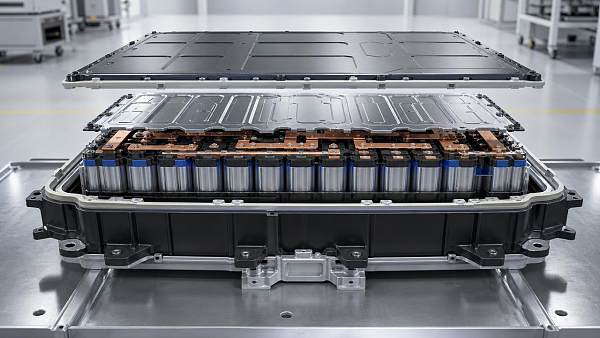
In EV battery packs, gap fillers are frequently favored because they can accommodate cell, module, and plate variation while helping manage vibration and thermal cycling. They also fit architectures where broad-area contact and process consistency are more important than the thinnest possible interface.
In industrial control cabinets, drives, and automation hardware, environment and service model become central. Where equipment must run for years with minimal maintenance, evaluators often prioritize materials with stable compression behavior and predictable assembly results over peak thermal numbers.
For high-frequency dispensing and advanced automated assembly environments, dispensable gap fillers and controlled paste systems can both work well. The deciding factor is whether the process can maintain the intended bond line and placement accuracy at production scale.
A practical evaluation framework for material selection
Start by mapping the interface geometry in production reality, not just design intent. Measure gap range, surface flatness, and assembly pressure across several samples. This quickly reveals whether the application belongs in the paste window or the gap-filler window.
Then shortlist candidate thermal management materials based on mechanical fit first. After that, compare conductivity, viscosity or hardness, operating temperature range, dielectric properties, and aging behavior. This sequence prevents teams from overvaluing marketing numbers too early.
Build test coupons or pilot assemblies that reflect real tolerances. Measure thermal resistance before and after cycling, vibration, humidity exposure, and service disassembly if relevant. A good material should perform consistently, not just produce one impressive initial result.
Also review process economics. Consider dispensing speed, placement complexity, scrap risk, storage requirements, and operator sensitivity. Technical evaluators often discover that the best-performing lab material is not the most scalable option for volume manufacturing.
When possible, involve thermal, mechanical, manufacturing, and quality teams together. Paste versus gap filler is a cross-functional decision. The strongest choice is usually the one that balances heat transfer, tolerance control, assembly repeatability, and lifecycle reliability.
Conclusion: choose the material that matches the interface, not the marketing claim
For technical evaluators, the choice between thermal paste and gap filler should begin with gap size, tolerance variation, clamp force, and lifecycle conditions. Paste is typically best for thin, controlled interfaces. Gap filler is typically best for uneven, variable, or vibration-prone assemblies.
In other words, the right thermal management materials decision is less about chasing the highest conductivity number and more about building a reliable thermal interface that survives real manufacturing and real service conditions.
If your application demands low resistance on flat surfaces, start with paste. If it demands conformability, tolerance absorption, and stable production outcomes, start with gap filler. The most effective evaluation is the one that connects material behavior to the actual assembly environment.
Recommended News
 Sep 11, 2026What to verify before choosing an EV battery thermal management supplierEV battery thermal management supplier selection guide: verify thermal performance, electrical safety, process compatibility, validation data, and supply support.
 Aug 23, 2026How to qualify a thermal interface adhesives supplier for EV battery assemblyThermal interface adhesives supplier selection for EV battery assembly: learn how to assess thermal performance, dispensing stability, compliance, and scale-up support.
 Jul 25, 2026ECHA Adds Three Phthalates to SVHC ListECHA Adds Three Phthalates to SVHC List: learn how DEHP, BBP, and DBP impact REACH documents, SCIP filing, and EU customs compliance for thermal materials suppliers.
 Jul 24, 2026ECHA Adds 3 SVHCs, REACH Declarations for Thermal Pastes Must Be UpdatedECHA adds 3 SVHCs: learn why REACH declarations for thermal pastes must be updated, how SCIP and SDS rules affect EU exports, and what suppliers should check now.
 Jul 23, 2026ECHA Adds 3 SVHCs, Prompting REACH UpdatesECHA Adds 3 SVHCs, Prompting REACH Updates: learn how Thermal Conductive Pastes, Flame-retardant PU Potting, and EU exporters should respond within six months.
 Jul 22, 2026ECHA SVHC Update Triggers REACH Review for Thermal PastesThermal conductive pastes face urgent REACH review after the ECHA SVHC update. Learn how new Candidate List entries affect SDS updates, EU exports, and compliance readiness.
 Jul 21, 2026ECHA Adds 3 SVHCs, Raising REACH DemandsECHA adds 3 SVHCs to the Candidate List, raising REACH demands for EU-bound thermal interface materials and thermal conductive pastes. See key risks, SCIP duties, and compliance actions.
 Jul 20, 2026ECHA Updates SVHC List, Pressuring Thermal Paste ComplianceECHA updates the SVHC list, raising urgent REACH compliance pressure for Thermal Conductive Pastes in the EU. See key deadlines, supply chain risks, and actions for buyers and manufacturers.
 Jul 19, 2026How to Choose Thermal Interface Materials for EV BatteriesThermal interface materials for EV batteries: learn how to compare conductivity, insulation, gap control, safety, and process fit to choose reliable, high-performance solutions.
 Jul 15, 2026Battery Thermal Management Materials: Comparing Gap Fillers, Pads, and PastesBattery thermal management materials compared: gap fillers, pads, and pastes for EV packs. Learn how to balance heat transfer, manufacturability, cost, and reliability.
 Jul 12, 2026UL94 Thermal Interface Materials: What Ratings Mean for Device SafetyUL94 thermal interface materials explained: learn what V-0, V-1, V-2, and HB ratings mean for device safety, compliance, and smarter material selection.
 Jul 06, 2026Thermal Interface Adhesives Price: Cost Drivers and Spec Trade-OffsThermal interface adhesives price explained: compare cost drivers, spec trade-offs, hidden procurement costs, and sourcing tips to choose the right material with better total value.
 Jul 06, 2026Thermal Interface Materials for Consumer Electronics: What Affects Cooling Performance?Thermal interface materials for consumer electronics directly shape cooling, reliability, and device comfort. Discover what really affects TIM performance beyond conductivity.
 Jul 04, 2026Battery Heat Dissipation Materials: What Improves Cooling Without Adding WeightBattery heat dissipation materials that boost cooling without extra weight. Learn how TIMs, gap fillers, films, and graphite solutions improve battery safety, lifespan, and pack efficiency.
 Jun 30, 2026How to Compare Flame Retardant Thermal Management MaterialsFlame retardant thermal management materials comparison made practical: learn how to assess thermal paths, flame ratings, process fit, and long-term reliability for smarter material selection.
 Jun 23, 2026Battery Thermal Management for Automotive: Paste or Potting Compound?Battery thermal management for automotive: should you choose thermal paste or potting compound? Compare heat transfer, protection, rework, and production fit to make a smarter EV battery design decision.
 Jun 23, 2026Industrial Adhesive Market Trends for EV Battery Thermal MaterialsIndustrial adhesive market trends EV battery leaders watch now are reshaping thermal materials, dispensing, and compliance. Discover what drives safer, faster EV battery production.
 Jun 18, 2026UL94 Thermal Management Adhesives: How to Balance Heat and Flame RatingsUL94 thermal management adhesives explained: learn how to balance flame ratings, heat dissipation, dispensing stability, and long-term reliability for safer, smarter material selection.
 Jun 14, 2026Battery Adhesive Technology: Key Trade-Offs in Thermal Control, Safety, and ReworkBattery adhesive technology shapes thermal control, safety, and rework in EV battery packs. Explore key trade-offs, process risks, and smarter material choices for reliable production.
 Jun 13, 2026Thermally Conductive Adhesives: Key Selection Factors for Heat-Sensitive DesignsThermally conductive adhesives selection guide for heat-sensitive designs. Learn how conductivity, viscosity, cure, and substrate fit improve reliability and cooling.
 Jun 12, 2026Guangzhou Adhesives Show Signals Compliance-Focused BuyingGuangzhou Adhesives Show signals compliance-focused buying as overseas buyers prioritize thermal conductive pastes, UV curing adhesives, and silicone encapsulants with sample validation and technical documentation.
 Jun 04, 2026Thermal Management Materials: Paste or Gap Filler?Thermal management materials: learn when thermal paste or gap filler is the smarter choice for electronics, EV batteries, and industrial systems to improve reliability and reduce production risk.









Editor's Selection
The Archive Newsletter
Critical industrial intelligence delivered every Tuesday. Peer-reviewed summaries of the week's most impactful logistics and market shifts.