
Flexible Adhesive for Automotive: What Prevents Bond Failure?
by
Published
Views:
Why a flexible adhesive for automotive can pass early tests and still fail later
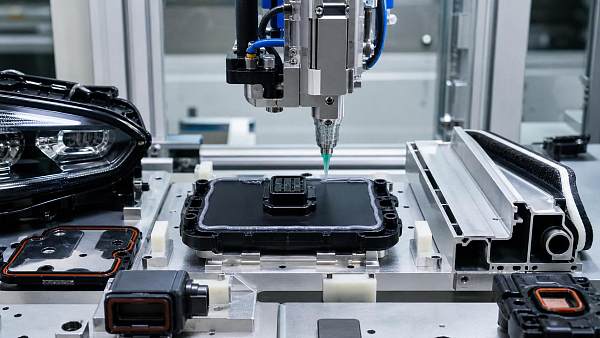
A flexible adhesive for automotive parts is rarely judged by initial tack alone.
In production, the real question is whether the bond survives movement, temperature swing, moisture, and process variation.
That is why one assembly line reports stable results, while another sees peeling, edge lift, or crack growth after aging.
The difference usually comes from the application scene, not from a single headline strength value.
Within automotive manufacturing, flexible bonding supports trim parts, sensor housings, lighting modules, battery-related sealing zones, and mixed-material joints.
Each area asks something different from a flexible adhesive for automotive use.
Some joints need peel resistance during vibration.
Others need gap filling, chemical resistance, low VOC behavior, or reliable curing in automated dispensing.
In practice, bond failure often starts where material behavior, fluid control, and curing conditions do not match the real service environment.
That broader view is also how industrial platforms such as IADS frame adhesive evaluation: chemistry, process, compliance, and durability must be read together.
Different automotive joints fail for different reasons
A flexible adhesive for automotive interiors faces a very different load than one used near the body, chassis, or electronics enclosure.
When a soft substrate meets painted metal, the issue is often surface energy and plasticizer migration.
When aluminum meets composite, the concern shifts toward thermal expansion mismatch and fatigue.
Around sensors or lighting modules, the bond line may also need to control stress without contaminating optics.
A common mistake is to treat these joints as similar because they all require flexibility.
Flexibility helps, but failure prevention depends on matching modulus, elongation, adhesion profile, and curing route to the actual part behavior.
This is why a flexible adhesive for automotive programs should be screened by use case, not by generic product family alone.
On lines with mixed substrates, surface condition decides more than datasheets suggest
In actual assembly, bond failure often begins before dispensing starts.
Release agents, stamping oils, oxide layers, and inconsistent paint cure can all weaken a flexible adhesive for automotive bonding.
The problem becomes harder when one line handles aluminum, e-coated steel, PP, ABS, and glass within the same production window.
Under those conditions, a good adhesive may still fail if the wetting window is unstable.
More reliable evaluation starts with the substrate pair and the surface state after the real upstream process.
Lab coupons prepared under ideal cleaning conditions can hide the risk.
It is often better to test parts taken directly from the line, including typical contamination and waiting time before bonding.
- Confirm whether surface energy stays stable across batches.
- Check if primers are truly needed or simply compensating for poor cleaning.
- Review open time between treatment and adhesive application.
- Compare failure mode before and after humidity aging.
These steps matter because flexible adhesive for automotive joints usually fails at the interface first, then appears as a material problem later.
When vibration and heat cycling dominate, softness alone is not enough
A frequent assumption is that a softer adhesive automatically protects the joint.
That is only partly true.
A flexible adhesive for automotive assemblies must absorb stress without losing cohesive strength.
If modulus is too low, the bond line may creep under constant load.
If it is too high, repeated vibration can drive crack initiation at edges and corners.
This becomes visible in door modules, bonded brackets, cable routing components, and enclosure seals exposed to road shock.
The better approach is to judge the full stress profile.
Dynamic movement, peak temperature, joint geometry, and bond thickness all influence service life.
Where dissimilar materials expand at different rates, elongation at break is less useful than retention after thermal cycling.
This is also where knowledge from adjacent sectors helps.
IADS often connects automotive bonding with EV battery potting, rail sealing, and electronics encapsulation because the same durability logic appears across industries.
Many bond failures are process failures hiding behind material selection
A flexible adhesive for automotive use may look stable on paper, yet fail because mixing, ratio control, or bead placement shifts during production.
That is especially relevant for two-component systems, moisture-curing materials, and narrow bond patterns near clips or corners.
Dispensing accuracy changes the bond more than many teams expect.
An undersized bead can create local stress concentration.
An oversized bead can trap cure byproducts, extend cycle time, or interfere with fit-up.
For automated lines, valve selection, static mixing quality, and viscosity stability are part of bond reliability.
That is why adhesive evaluation increasingly overlaps with fluid control evaluation.
A well-formulated flexible adhesive for automotive production still needs a repeatable dispensing window.
- Verify mix ratio drift over the full shift, not just at start-up.
- Measure bead width and height at complex corners.
- Track cure completion under actual fixture and temperature conditions.
- Review whether rework solvents or cleaners damage nearby materials.
These checks align with broader automated dispensing practice, where chemistry and valve behavior must be tuned together.
The most common misjudgments appear during qualification
Qualification sometimes focuses too much on room-temperature lap shear.
That result is useful, but it does not represent every flexible adhesive for automotive condition.
Another weak point is testing only one substrate finish.
In field use, finish variation is normal, especially across global supply chains.
There is also a cost trap.
A lower unit price may disappear once primers, slower curing, extra fixturing, or rework losses are included.
The more practical view is to compare total process fit.
A better way to choose a flexible adhesive for automotive programs
Selection becomes clearer when the joint is defined by service conditions first.
Start with the substrate pair, expected movement, temperature range, fluid exposure, and required cure speed.
Then review whether the flexible adhesive for automotive use matches the available dispensing method and line rhythm.
If bond consistency depends on primer, plasma treatment, or precise metering, that requirement should be accepted early, not discovered after failure.
It also helps to compare the adhesive within a wider manufacturing framework.
Bonding chemistry, static mixers, jetting accuracy, curing behavior, and compliance issues such as RoHS or VOC limits often affect final suitability together.
That integrated view is increasingly important for lightweight structures, electronics-rich vehicles, and EV-related assemblies.
Where failure risk remains unclear, the next useful step is not broad retesting.
It is a targeted matrix: real substrates, real process timing, and aging conditions that reflect the actual joint.
A flexible adhesive for automotive applications performs best when material choice, surface control, and dispensing discipline are qualified as one system.
That approach reduces unexpected bond failure and gives a more reliable basis for the next design or sourcing decision.
Recommended News
 Sep 17, 2026How do polyurethane sealants perform after thermal cycling in automotive windshield applications?How do polyurethane sealants perform after thermal cycling? Discover real-world durability insights for automotive windshield bonding—backed by OEM data and failure physics.
 Jul 18, 2026ECHA Draft Tightens Phthalate Limits for Sealant ExportsECHA Draft Tightens Phthalate Limits for Sealant Exports, cutting REACH Annex XVII thresholds to 0.01%. See how EU compliance risks may impact exporters, importers, and sourcing decisions.
 Jul 14, 2026CPSC Cuts Lead Limit for PU Windshield SealantsCPSC cuts lead limit for PU windshield sealants from 90 ppm to 5 ppm, creating urgent import, testing, and sourcing risks. Learn what the new rule means for compliance and shipments.
 Jun 29, 2026Japan JIS T 2810:2026 Adds Moist-Heat Test for PU Blade SealantsJapan JIS T 2810:2026 adds a moist-heat test for PU blade sealants, directly affecting certification, supplier approval, and export access. See what wind industry teams must review now.
 Jun 28, 2026Japan Enforces JIS T 2810:2026 for PU Blade SealantsJIS T 2810:2026 now governs PU blade sealants in Japan, setting a strict 85/85 durability threshold. Learn how TEPCO and MHI procurement rules affect compliance, exports, and market access.
 Jun 27, 2026JIS T 2810:2026 Raises Entry Bar for PU Blade SealantsJIS T 2810:2026 raises the compliance bar for PU blade sealants with new moisture-heat cycling and third-party test rules. See how it impacts certification, bidding, exports, and delivery planning.
 Jun 16, 2026Flexible Adhesive for Automotive: What Prevents Bond Failure?Flexible adhesive for automotive selection goes beyond initial strength. Learn what prevents bond failure under heat, vibration, moisture, and real production conditions.
 Jun 15, 2026Automotive Lightweighting: Where Adhesives Cut Weight MostAutomotive lightweighting starts with smarter joining. Discover where adhesives cut the most weight in body structures, EV battery packs, and modules for better performance and lower assembly cost.
Editor's Selection
The Archive Newsletter
Critical industrial intelligence delivered every Tuesday. Peer-reviewed summaries of the week's most impactful logistics and market shifts.