CPSC Cuts Lead Limit for PU Windshield Sealants
by
Published
Views:
On July 12, 2026, the U.S. Consumer Product Safety Commission (CPSC) issued an emergency final rule revising 16 CFR Part 1303 for polyurethane automotive windshield sealants, lowering the lead limit from 90 ppm to 5 ppm and immediately blocking import clearance for non-compliant batches. For importers, exporters, sealant manufacturers, testing providers, and procurement teams, the change matters because it shifts lead compliance from a routine specification issue into an immediate customs and delivery risk.
What the rule change now requires
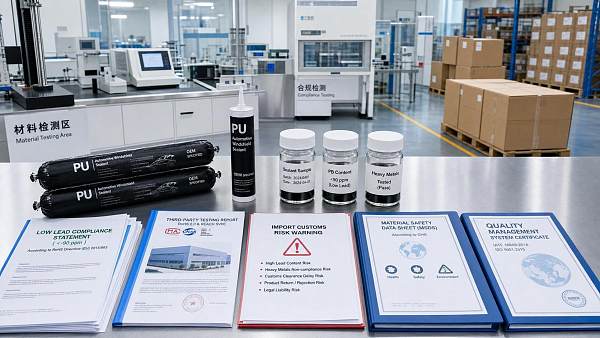
According to the provided event summary, the CPSC emergency final rule applies to polyurethane automotive windshield sealants and reduces the allowable lead content from 90 ppm to 5 ppm. The import restriction took effect on the date of release, meaning batches exceeding the new limit are barred from customs clearance from that point forward.
The rule applies regardless of country of origin, while production lines in China, Vietnam, and Mexico are identified for focused scrutiny. Importers are also required to provide third-party test reports using the ASTM F963-26 Appendix X3 method. If that documentation is not provided, the shipment will be automatically detained.
Where pressure will show up across the supply chain
Import clearance is becoming the first checkpoint
For direct trading companies and U.S. importers, the most immediate exposure lies at the border. The rule ties market entry to both a stricter lead threshold and a specific third-party testing document. That means compliance risk is no longer limited to product specification review; it now directly affects customs release, shipment timing, and the ability to move inventory into the market.
Formula and sourcing decisions move to the foreground
For manufacturers, contract processors, and raw material procurement teams, the change reaches back into formulation control and supplier qualification. Analysis shows the reduction from 90 ppm to 5 ppm leaves much less room for legacy material selection or inherited formulations. What deserves closer attention is whether existing raw material inputs, mixing controls, and supplier declarations can support a no-lead verification path under the required test method.
Testing and compliance documentation gain operational weight
For laboratories, certification-related service providers, and compliance teams, the rule elevates the role of third-party reports from supporting paperwork to a practical condition for shipment release. The immediate issue is not only whether testing is conducted, but whether the documentation is aligned with ASTM F963-26 Appendix X3 and ready at the time import procedures begin.
Delivery and purchasing schedules may tighten
For buyers, distributors, and downstream channel participants, the impact may appear through order confirmation, replenishment timing, and supplier approval requirements. Observably, once detention risk rises, procurement teams may place greater weight on report availability, document consistency, and traceability before confirming shipment or accepting delivery windows.
What companies should review now
Check whether current documents match the new entry requirement
From an industry perspective, companies handling affected sealants should first review whether their current compliance files actually include third-party reports prepared under ASTM F963-26 Appendix X3. If that document path is incomplete, the commercial issue may emerge before the product reaches the customer.
Reassess supplier qualification for high-attention production lines
Because the summary states that production lines in China, Vietnam, and Mexico will face focused scrutiny, companies sourcing from those locations should pay closer attention to supplier declarations, batch-level consistency, and document readiness. This should be understood as a compliance review priority, not as evidence that all products from those origins are non-compliant.
Review bid files, technical sheets, and shipment packages
Analysis shows that the rule change may require updates to technical documentation used in procurement and trade. Buyers and sellers should pay attention to whether product specifications, test references, quality files, and shipment records still reflect older lead thresholds or omit the now-required test basis.
Watch execution language beyond the headline rule
The event summary confirms the immediate import restriction and testing requirement, but it does not provide broader operational detail. For that reason, companies should continue monitoring how the rule is referenced in compliance checks, trade documentation, and customer-side qualification requirements, rather than assuming every execution detail is already settled.
How this development is best understood at this stage
Observably, this is more than a policy signal and less than a fully documented long-term enforcement picture. It is more appropriate to understand this as an already effective compliance trigger at the import stage, combined with an execution signal that pushes the PU windshield sealant segment toward formula adjustment and lead-free verification. At the same time, the full market response will still depend on how consistently the new threshold and document requirements are applied in practice.
Why the market will keep watching this rule
The immediate significance of this development is clear: lead compliance for the affected PU sealants has moved into a tighter and faster enforcement window tied directly to import clearance. A neutral reading is that the rule already has operational consequences for trade, testing, sourcing, and delivery, while some practical implementation details still warrant close observation. For industry participants, the event is best understood as a live compliance change with near-term execution impact rather than a distant regulatory discussion.
Basis of this article and what still needs verification
This article is based on the user-provided news title, event date, and event summary. Source types commonly relevant to developments of this kind include official regulator announcements, customs or trade authority notices, industry association updates, standards organization documents, and reporting by established trade media. No specific official source link was provided in the input, so the exact official publication path still needs to be verified on an ongoing basis. What also remains worth tracking are any further policy clarifications, enforcement language, certification and testing interpretation, changes in bid or procurement documents, industry feedback, and how companies implement the new requirement in practice.
Recommended News
 Sep 17, 2026How do polyurethane sealants perform after thermal cycling in automotive windshield applications?How do polyurethane sealants perform after thermal cycling? Discover real-world durability insights for automotive windshield bonding—backed by OEM data and failure physics.
 Jul 18, 2026ECHA Draft Tightens Phthalate Limits for Sealant ExportsECHA Draft Tightens Phthalate Limits for Sealant Exports, cutting REACH Annex XVII thresholds to 0.01%. See how EU compliance risks may impact exporters, importers, and sourcing decisions.
 Jul 14, 2026CPSC Cuts Lead Limit for PU Windshield SealantsCPSC cuts lead limit for PU windshield sealants from 90 ppm to 5 ppm, creating urgent import, testing, and sourcing risks. Learn what the new rule means for compliance and shipments.
 Jun 29, 2026Japan JIS T 2810:2026 Adds Moist-Heat Test for PU Blade SealantsJapan JIS T 2810:2026 adds a moist-heat test for PU blade sealants, directly affecting certification, supplier approval, and export access. See what wind industry teams must review now.
 Jun 28, 2026Japan Enforces JIS T 2810:2026 for PU Blade SealantsJIS T 2810:2026 now governs PU blade sealants in Japan, setting a strict 85/85 durability threshold. Learn how TEPCO and MHI procurement rules affect compliance, exports, and market access.
 Jun 27, 2026JIS T 2810:2026 Raises Entry Bar for PU Blade SealantsJIS T 2810:2026 raises the compliance bar for PU blade sealants with new moisture-heat cycling and third-party test rules. See how it impacts certification, bidding, exports, and delivery planning.
 Jun 16, 2026Flexible Adhesive for Automotive: What Prevents Bond Failure?Flexible adhesive for automotive selection goes beyond initial strength. Learn what prevents bond failure under heat, vibration, moisture, and real production conditions.
 Jun 15, 2026Automotive Lightweighting: Where Adhesives Cut Weight MostAutomotive lightweighting starts with smarter joining. Discover where adhesives cut the most weight in body structures, EV battery packs, and modules for better performance and lower assembly cost.




Editor's Selection
The Archive Newsletter
Critical industrial intelligence delivered every Tuesday. Peer-reviewed summaries of the week's most impactful logistics and market shifts.