Display Bonding: Key Failure Modes and Material Trade-Offs
by
Published
Views:
Display bonding sits at the intersection of optics, materials science, and process control. It affects contrast, touch sensitivity, impact resistance, moisture protection, and assembly yield at the same time.
That is why material choice rarely comes down to bond strength alone. In practical display bonding work, the better question is which failure modes matter most for the product and process window.
Across consumer devices, vehicle displays, industrial HMIs, medical screens, and rugged panels, the trade-offs between OCA, LOCA, and related bonding systems shape reliability, throughput, and field performance.
Why display bonding matters beyond simple lamination

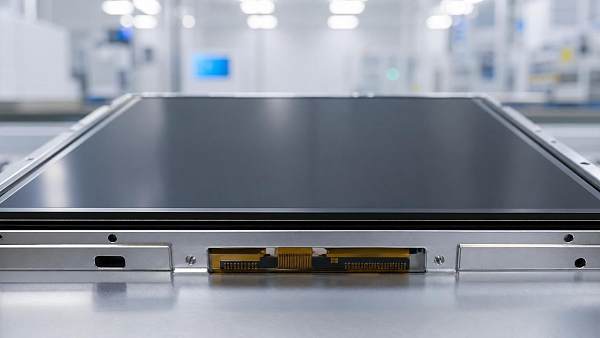
A display stack is not just glass and adhesive. It usually includes cover lenses, touch sensors, polarizers, OLED or LCD modules, coatings, edge seals, and sometimes uneven component geometry.
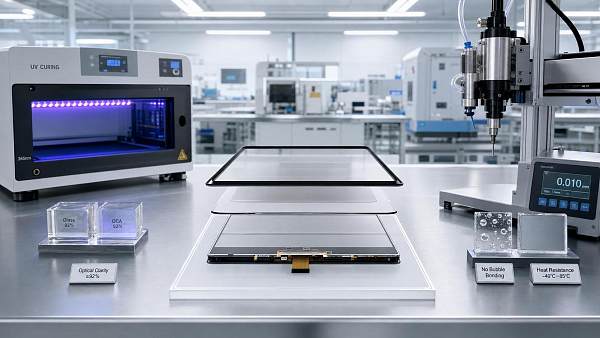
Display bonding fills the air gap or joins layers directly. The result can improve light transmission, reduce internal reflection, raise drop resistance, and limit dust ingress.
In demanding applications, the adhesive also becomes a mechanical buffer. It must tolerate thermal cycling, vibration, UV exposure, humidity, and chemical contact without creating optical defects.
This is where the topic expands from a materials issue into a broader manufacturing decision. Adhesive chemistry, dispensing precision, curing behavior, and inspection capability all influence final performance.
The main material routes in display bonding
The two most common routes are OCA and LOCA, but each solves a different set of constraints. Neither is universally superior.
OCA: controlled thickness and cleaner handling
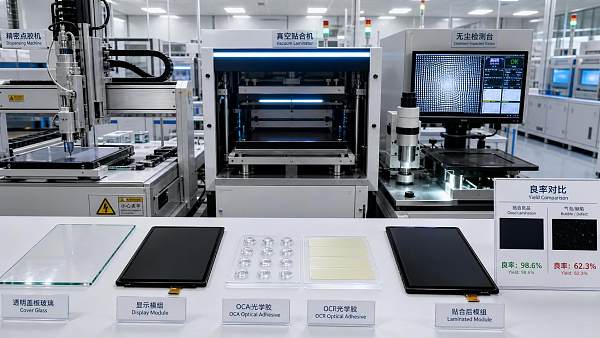
Optically clear adhesive films offer uniform thickness, good haze control, and relatively stable process behavior. They are often preferred for flat surfaces and higher repeatability.
OCA can simplify contamination control, but it may struggle with complex topography, edge gaps, or aggressive curvature. Lamination pressure and surface cleanliness remain critical.
LOCA: better gap filling, tighter process sensitivity
Liquid optically clear adhesive is useful when the stack includes uneven surfaces, narrow bezels, or three-dimensional features. It can wet out complex geometries more effectively.
However, LOCA introduces more variables. Dispense volume, flow path, bubble escape, UV access, and cure shrinkage all become major parts of display bonding quality control.
Other bonding paths
Some projects evaluate silicone optical gels, hybrid UV-thermal systems, or specialty tapes for edge attachment. These are usually driven by rework needs, stress management, or unusual environmental requirements.
Failure modes that deserve early attention
Most display bonding failures do not begin with catastrophic separation. They start as small process deviations that later show up as optical defects, touch issues, or weathering problems.
These issues often overlap. A system that passes initial adhesion testing may still fail under humidity, thermal shock, or long UV exposure because the weakest point is optical stability rather than peel strength.
Material trade-offs that shape selection
In display bonding, every gain usually comes with a cost somewhere else. A faster cure can reduce takt time, yet create higher internal stress or less tolerance for shadowed cure zones.
A stronger bond can improve drop performance, but make rework nearly impossible. A softer material may absorb impact better, but introduce pump-out, creep, or edge movement over time.
Optical requirements also complicate selection. Low haze, high transmittance, and stable refractive matching matter, but they do not guarantee good environmental resistance.
- Higher modulus often supports dimensional stability, but may increase stress on brittle layers.
- Lower viscosity improves gap filling, but can raise bleed risk and bubble sensitivity.
- UV-curable systems improve throughput, but cure depth and shadow areas must be validated carefully.
- Reworkable materials reduce scrap risk, but may sacrifice long-term environmental robustness.
This balance is especially important when display bonding moves from handheld devices into transportation, outdoor equipment, and industrial control panels, where service life expectations are higher.
Process capability is part of the material decision
A material can look excellent on a data sheet and still perform poorly in production. Display bonding quality depends on how consistently the line can repeat the required process window.
For OCA, lamination pressure profile, roller control, vacuum support, and particle management often decide yield. For LOCA, fluid control becomes even more central.
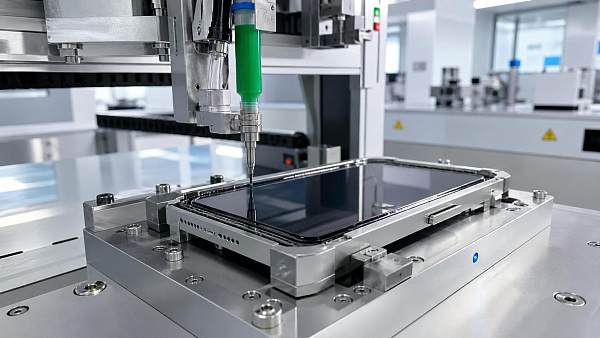
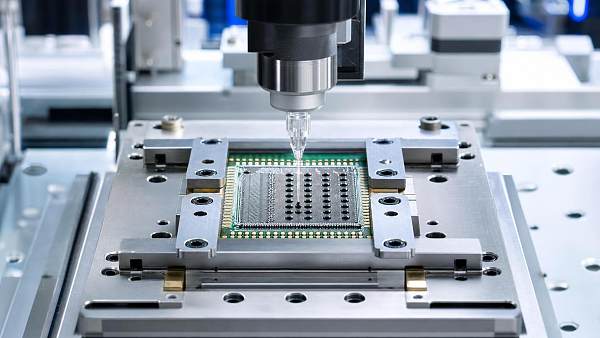
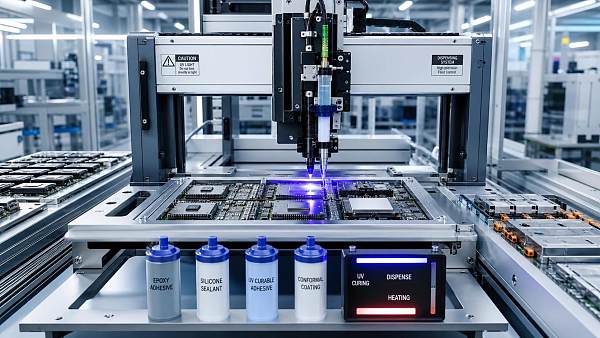
Dispensing equipment, jet valves, static mixing, and cure energy calibration should be treated as part of the same qualification package. That systems view is increasingly common in advanced electronics assembly.
This is also why platforms such as IADS matter in evaluation work. They connect adhesive formulation, dispensing precision, curing method, compliance, and production economics in one decision framework.
What to verify during line trials
- Bubble escape behavior across different dispense patterns
- Optical uniformity after cure and after thermal aging
- Adhesion on coated glass, plastic, and low-energy surfaces
- Shrinkage impact near camera windows, bezels, and corners
- Rework success rate without damage to adjacent layers
Where display bonding requirements diverge by application
Not all screens fail for the same reasons. The right display bonding choice changes with the use environment and service model.
The commercial consequence is clear. Material comparison only becomes meaningful when tied to the actual environment, expected lifetime, and serviceability target.
A practical way to compare options
A useful display bonding review starts with failure risk ranking rather than product brochures. That means identifying what cannot go wrong in the final device.
Then map those priorities to measurable criteria: transmittance drift, bond retention after damp heat, void rate, cure depth, ionic cleanliness, and rework outcome.
It also helps to compare materials at the system level. A slightly more expensive adhesive may still lower total cost if it reduces bubble defects, scrap, cure time, or equipment instability.
For teams reviewing suppliers through an IADS-style lens, the strongest signals are usually cross-functional. Look for evidence across chemistry, dispensing compatibility, compliance readiness, and scale-up consistency.
Key questions worth carrying forward
- Which failure mode creates the largest field risk?
- How stable is the optical result after aging, not only after assembly?
- Can the existing dispensing and curing setup hold the process window?
- Is rework a design requirement or only a development convenience?
- What hidden cost appears when yield loss and inspection load are included?
Display bonding decisions improve when material data, process evidence, and application stress conditions are reviewed together. That is usually the point where trade-offs become clearer and selection risk drops.
The next step is not broad comparison for its own sake. It is building a short list around the real stack structure, cure route, reliability target, and inspection capability, then validating against the failure modes most likely to matter.
Recommended News
 Oct 05, 2026How to assess a chip packaging adhesives manufacturer for ACF reliabilityChip packaging adhesives manufacturer selection starts with ACF reliability: compare bonding windows, validation data, lot control, and process support to reduce yield risk.
 Oct 02, 2026When can conductive solder replacement adhesives meet joint resistance targets?Conductive solder replacement adhesives can meet joint resistance targets when material, bond-line control, curing, and reliability testing align. Explore the key evaluation factors.
 Aug 19, 2026What affects yield most in the screen bezel bonding processScreen bezel bonding process yield depends most on surface cleanliness, dispensing consistency, alignment, and cure control. Learn how to reduce defects and improve bonding reliability.
 Aug 14, 2026Display Bonding for LCD: How to Reduce Optical Mura and Air Gap RiskDisplay bonding for LCD explained: reduce optical mura, eliminate air gaps, and improve bonding clarity with practical process tips.
 Aug 08, 2026How to Evaluate a Display Bonding Materials Supplier for Optical Clarity and YieldDisplay bonding materials supplier evaluation starts with optical clarity and yield. Learn how to compare process support, reliability, cure control, and production fit.
 Jul 30, 2026How to Evaluate Conductive Electronic Adhesives for Fine-Pitch BondingConductive electronic adhesives for fine-pitch bonding demand more than high conductivity. Learn how to assess rheology, cure, adhesion, and stability to reduce shorts and improve yield.
 Jul 25, 2026Capillary Underfill Bonding: Key Process Risks and Control PointsCapillary underfill bonding explained: discover key process risks, void causes, cure challenges, and control points to improve assembly yield, reliability, and package performance.
 Jul 21, 2026Industrial Adhesive Market Trends in Electronics for 2026Industrial adhesive market trends electronics in 2026 reveal how faster curing, precision dispensing, and compliance shape reliability, cost, and smart sourcing in electronics manufacturing.
 Jul 10, 2026Display Bonding: Key Failure Modes and Material Trade-OffsDisplay bonding failure modes explained: compare OCA, LOCA, and material trade-offs affecting optics, durability, yield, and process control across demanding display applications.
![]() Jul 07, 2026Camera Module Sensor Bonding: Choosing Adhesives for Low Stress and Clean OpticsCamera module sensor bonding guide: learn how to choose low-stress, low-outgassing adhesives for clean optics, higher yield, and more reliable camera module assembly.
Jul 07, 2026Camera Module Sensor Bonding: Choosing Adhesives for Low Stress and Clean OpticsCamera module sensor bonding guide: learn how to choose low-stress, low-outgassing adhesives for clean optics, higher yield, and more reliable camera module assembly. Jul 06, 2026Screen Bezel Bonding Adhesive: Key Checks for Strength and Display FinishScreen bezel bonding adhesive selection starts with more than strength. Learn the key checks for gap control, curing consistency, aging durability, and cleaner display finish.
 Jul 05, 2026Underfill Material Manufacturer Checklist for Consistent Bond ReliabilityUnderfill material manufacturer checklist for stronger bond reliability: compare flow stability, quality control, compliance, and supply support to reduce defects and choose with confidence.
 Jul 03, 2026Consumer Electronics Bonding Supplier Checklist: Quality, Lead Time, and Process FitConsumer electronics bonding supplier selection starts with quality, lead time, and process fit. Discover a practical checklist to reduce risk, improve yield, and choose with confidence.
 Jun 29, 2026Camera Module Bonding: How to Reduce Shift and FoggingCamera module bonding guide to reduce shift and fogging with better adhesive selection, dispensing, and curing control. Learn practical steps to improve yield and optical stability.
 Jun 26, 2026Solder Replacement Adhesives for SMT: Process Limits, Reliability, and ROISolder replacement adhesives for SMT: explore process limits, reliability, and ROI to see where low-heat bonding can cut defects, protect sensitive assemblies, and justify targeted adoption.
 Jun 26, 2026Display Bonding Adhesive Material Selection: Optical Clarity vs. Rework RiskDisplay bonding adhesive material selection shapes clarity, yield, and rework cost. Explore how to balance optical performance with repair risk for smarter, higher-value display assemblies.
 Jun 25, 2026Vietnam Adhesives Show to Spotlight ACA/ACF, UV Line FitVietnam Adhesives Show will spotlight ACA/ACF and UV line fit at VIASEAL Vietnam 2026, revealing localized electronics assembly solutions, certification readiness, and Southeast Asia sourcing opportunities.
 Jun 24, 2026Vietnam Adhesives Show Opens Aug. 5 With ACA/ACF FocusVietnam Adhesives Show opens Aug. 5 in Hanoi, spotlighting ACA/ACF, UV camera module adhesives, and RoHS 3 plus TCVN 7837:2025 compliance for EMS buyers and suppliers.
 Jun 23, 2026Vietnam Adhesives Expo Highlights ACA/ACF and UV Curing ShiftVietnam Adhesives Expo spotlights ACA/ACF conductive adhesives and 365 nm UV curing trends, revealing how Vietnam electronics supply chains are redefining qualification, certification, and sourcing opportunities.
 Jun 21, 2026IEC 62776:2026 Tightens LED Adhesive TestingIEC 62776:2026 tightens LED adhesive testing with mandatory halogen, ion migration, and silver migration checks. See how ACA/ACF and UV-curable adhesive suppliers can stay export-ready.
 Jun 18, 2026Display Bonding Adhesives: Key Checks Before Final Material SelectionDisplay bonding adhesives: discover the key checks before final material selection, from optical stability and curing to dispensing, reliability, and supplier readiness.
 Jun 15, 2026How to Evaluate a Camera Module VCM Bonding SupplierCamera module VCM bonding supplier selection affects yield, focus stability, and contamination control. Learn the key technical and sourcing checks before you shortlist.
 Jun 14, 2026Silver Filled Solder Replacement Adhesives: When Lower Heat Improves Assembly YieldSilver filled solder replacement adhesives help reduce heat stress, warpage, and yield loss in sensitive assemblies. Learn where they outperform solder and how to qualify them with confidence.
 Jun 13, 2026BGA Underfill for Flip Chip: Common Voiding Causes and FixesBGA underfill for flip chip: learn the most common voiding causes, from trapped air to cure issues, and discover practical fixes to improve yield, reliability, and process stability.





Editor's Selection
The Archive Newsletter
Critical industrial intelligence delivered every Tuesday. Peer-reviewed summaries of the week's most impactful logistics and market shifts.