
Shenzhen Adhesive Project Signals Supply and Certification Shift
by
Published
Views:
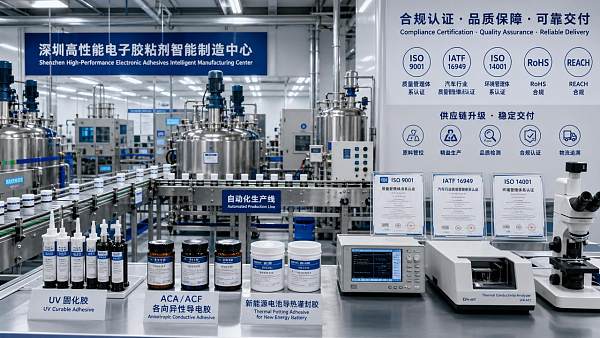
On May 25, 2026, a high-performance adhesive project was signed in Shenzhen, pointing to a practical shift in how parts of the electronics and automotive supply chain may handle delivery, certification support, and sourcing for advanced adhesive materials. The development matters not only because new UV curing adhesive, ACA/ACF anisotropic conductive adhesive, and thermal potting adhesive capacity is planned, but also because it connects directly to trade lead-time pressure, localized testing for AEC-Q200-grade adhesive applications, and the wider compliance expectations facing exporters, manufacturers, buyers, and testing-related service providers.
What Has Been Confirmed So Far
The confirmed event is the signing and landing of a high-performance adhesive project in Shenzhen on May 25, 2026, with a total investment of RMB 633 million. The project focuses on production lines for UV curing adhesives, ACA/ACF anisotropic conductive adhesives, and thermally conductive potting adhesives for new energy batteries.
According to the provided information, the project is expected to bring 20,000 tons of UV and electronic adhesive capacity into operation in 2027. After reaching full capacity, it is expected to strengthen China’s stable supply capability for high-end electronic adhesives serving Europe and the United States, ease the current average export delivery pressure of 8 to 12 weeks, and support localized testing services for adhesives related to AEC-Q200 automotive-grade certification.
Where the Practical Effects May Appear First
Sourcing teams may reassess lead-time and specification risk
From an industry perspective, procurement teams in electronics and related manufacturing segments may be among the first to feel the impact. The reason is straightforward: the project is tied to product categories that are often sensitive to specification matching, validation timing, and delivery stability. What deserves closer attention is whether buyers begin adjusting procurement schedules, approved supplier reviews, and technical document checks in response to shorter expected supply cycles and more localized testing support.
For these companies, the key business effect is likely to appear in purchasing plans, supplier qualification reviews, and delivery coordination. They should pay close attention to product specification alignment, testing records, technical datasheets, and any future changes in bid documents or customer material approval requirements linked to automotive-grade or electronics-grade use cases.
Export-facing manufacturers may gain flexibility, but documentation remains critical
Manufacturers supplying export markets may see this project as a potential supply-chain execution signal rather than an immediate rule change. Analysis shows that if delivery pressure is reduced from the currently cited 8 to 12 weeks, exporters may have more room to manage production planning and customer commitments. However, this does not remove the need for traceability, product consistency records, and customer-facing compliance documentation.
The business impact here is most likely to center on order fulfillment, after-sales quality response, and shipment readiness. Companies should continue to watch certification-related materials, batch traceability files, test reports, and customer contract terms that may reference qualification status or technical acceptance criteria.
Testing and certification-related service providers may see a new local demand pattern
The reference to localized testing support for AEC-Q200-related adhesive applications is especially relevant for laboratories, validation service providers, and certification-support businesses. Observably, the immediate significance is not that a new certification rule has been announced, but that local testing capability may become more important in project qualification and customer approval workflows.
These participants should pay attention to how future testing requests are described in technical files, supplier onboarding processes, and customer validation procedures. The main compliance concern is not a newly confirmed standard text in the provided information, but the possible shift in where and how testing evidence is prepared, reviewed, and accepted.
What Companies Should Monitor Next
Watch how certification support is reflected in real procurement practice
The provided information confirms support for localized testing services tied to AEC-Q200 automotive-grade certification, but it does not define execution details. It is therefore more appropriate to monitor whether customers, tender documents, or supplier qualification procedures begin to reference local testing pathways more clearly.
Check whether delivery assumptions in contracts need updating
Because the project is described as helping relieve the current average export delivery cycle of 8 to 12 weeks, companies should review whether their existing procurement plans, inventory assumptions, and customer lead-time commitments still match market conditions once the project moves closer to operation.
Prepare technical files for specification matching and traceability
For UV adhesives, ACA/ACF materials, and battery-related thermal potting products, technical alignment usually matters as much as supply availability. Companies should therefore keep product specifications, test records, quality files, and change-control materials ready for customer review, especially where export delivery, automotive-grade expectations, or localized validation support may become part of commercial discussions.
Track whether market practice changes before treating this as a settled rule shift
The current information supports attention to an execution signal, not a completed market-wide transition. Businesses should continue to verify whether future official wording, customer qualification criteria, and supply agreements show a real change in how sourcing, testing, and delivery are being handled.
Why This Looks More Like an Execution Signal Than a Finished Rule Change
Analysis shows that this development is best understood as a supply-chain and compliance execution signal with possible implications for trade delivery, localized testing, and certification support. It does not, based on the provided facts alone, establish a new regulation, publish a new standard text, or confirm a revised trade rule.
What deserves closer attention is the way this project links capacity expansion with two practical pressure points: export delivery timing and local support for AEC-Q200-related testing. That combination suggests the market is responding to compliance-sensitive demand rather than simply adding undifferentiated capacity. Even so, the pace at which customers, testing bodies, and procurement teams adapt remains something that still needs observation.
How This Development Is Best Interpreted Now
At this stage, the Shenzhen project is more appropriately understood as a concrete industrial move that may influence sourcing logic, delivery planning, and certification-support arrangements around advanced electronic adhesives. Its importance lies less in announcing a formal new rule and more in signaling where operational expectations in the supply chain may be heading.
A rational reading is that the project could improve supply stability and local validation support once implemented, while the actual market effect will depend on how procurement requirements, testing acceptance, contract practice, and customer qualification processes evolve afterward. For industry participants, continued monitoring is more useful than treating the event as a fully settled compliance outcome.
Basis of This Article and What Still Needs Verification
This article is generated based on the user-provided news title, event date, and event summary. The specific official source link was not provided in the input, so it still needs to be verified through later checks.
For events of this kind, commonly relevant source types may include official announcements, regulatory releases, customs or trade authority information, industry association updates, standard-setting documents, and reporting by authoritative media. What still requires ongoing observation includes any detailed policy wording, certification implementation interpretation, tender document changes, industry feedback, and actual enterprise execution after the project moves forward.
Recommended News
 Aug 19, 2026What affects yield most in the screen bezel bonding processScreen bezel bonding process yield depends most on surface cleanliness, dispensing consistency, alignment, and cure control. Learn how to reduce defects and improve bonding reliability.
 Aug 14, 2026Display Bonding for LCD: How to Reduce Optical Mura and Air Gap RiskDisplay bonding for LCD explained: reduce optical mura, eliminate air gaps, and improve bonding clarity with practical process tips.
 Aug 08, 2026How to Evaluate a Display Bonding Materials Supplier for Optical Clarity and YieldDisplay bonding materials supplier evaluation starts with optical clarity and yield. Learn how to compare process support, reliability, cure control, and production fit.
 Jul 30, 2026How to Evaluate Conductive Electronic Adhesives for Fine-Pitch BondingConductive electronic adhesives for fine-pitch bonding demand more than high conductivity. Learn how to assess rheology, cure, adhesion, and stability to reduce shorts and improve yield.
 Jul 25, 2026Capillary Underfill Bonding: Key Process Risks and Control PointsCapillary underfill bonding explained: discover key process risks, void causes, cure challenges, and control points to improve assembly yield, reliability, and package performance.
 Jul 21, 2026Industrial Adhesive Market Trends in Electronics for 2026Industrial adhesive market trends electronics in 2026 reveal how faster curing, precision dispensing, and compliance shape reliability, cost, and smart sourcing in electronics manufacturing.
 Jul 10, 2026Display Bonding: Key Failure Modes and Material Trade-OffsDisplay bonding failure modes explained: compare OCA, LOCA, and material trade-offs affecting optics, durability, yield, and process control across demanding display applications.
![]() Jul 07, 2026Camera Module Sensor Bonding: Choosing Adhesives for Low Stress and Clean OpticsCamera module sensor bonding guide: learn how to choose low-stress, low-outgassing adhesives for clean optics, higher yield, and more reliable camera module assembly.
Jul 07, 2026Camera Module Sensor Bonding: Choosing Adhesives for Low Stress and Clean OpticsCamera module sensor bonding guide: learn how to choose low-stress, low-outgassing adhesives for clean optics, higher yield, and more reliable camera module assembly. Jul 06, 2026Screen Bezel Bonding Adhesive: Key Checks for Strength and Display FinishScreen bezel bonding adhesive selection starts with more than strength. Learn the key checks for gap control, curing consistency, aging durability, and cleaner display finish.
 Jul 05, 2026Underfill Material Manufacturer Checklist for Consistent Bond ReliabilityUnderfill material manufacturer checklist for stronger bond reliability: compare flow stability, quality control, compliance, and supply support to reduce defects and choose with confidence.
 Jul 03, 2026Consumer Electronics Bonding Supplier Checklist: Quality, Lead Time, and Process FitConsumer electronics bonding supplier selection starts with quality, lead time, and process fit. Discover a practical checklist to reduce risk, improve yield, and choose with confidence.
 Jun 29, 2026Camera Module Bonding: How to Reduce Shift and FoggingCamera module bonding guide to reduce shift and fogging with better adhesive selection, dispensing, and curing control. Learn practical steps to improve yield and optical stability.
 Jun 26, 2026Solder Replacement Adhesives for SMT: Process Limits, Reliability, and ROISolder replacement adhesives for SMT: explore process limits, reliability, and ROI to see where low-heat bonding can cut defects, protect sensitive assemblies, and justify targeted adoption.
 Jun 26, 2026Display Bonding Adhesive Material Selection: Optical Clarity vs. Rework RiskDisplay bonding adhesive material selection shapes clarity, yield, and rework cost. Explore how to balance optical performance with repair risk for smarter, higher-value display assemblies.
 Jun 25, 2026Vietnam Adhesives Show to Spotlight ACA/ACF, UV Line FitVietnam Adhesives Show will spotlight ACA/ACF and UV line fit at VIASEAL Vietnam 2026, revealing localized electronics assembly solutions, certification readiness, and Southeast Asia sourcing opportunities.
 Jun 24, 2026Vietnam Adhesives Show Opens Aug. 5 With ACA/ACF FocusVietnam Adhesives Show opens Aug. 5 in Hanoi, spotlighting ACA/ACF, UV camera module adhesives, and RoHS 3 plus TCVN 7837:2025 compliance for EMS buyers and suppliers.
 Jun 23, 2026Vietnam Adhesives Expo Highlights ACA/ACF and UV Curing ShiftVietnam Adhesives Expo spotlights ACA/ACF conductive adhesives and 365 nm UV curing trends, revealing how Vietnam electronics supply chains are redefining qualification, certification, and sourcing opportunities.
 Jun 21, 2026IEC 62776:2026 Tightens LED Adhesive TestingIEC 62776:2026 tightens LED adhesive testing with mandatory halogen, ion migration, and silver migration checks. See how ACA/ACF and UV-curable adhesive suppliers can stay export-ready.
 Jun 18, 2026Display Bonding Adhesives: Key Checks Before Final Material SelectionDisplay bonding adhesives: discover the key checks before final material selection, from optical stability and curing to dispensing, reliability, and supplier readiness.
 Jun 15, 2026How to Evaluate a Camera Module VCM Bonding SupplierCamera module VCM bonding supplier selection affects yield, focus stability, and contamination control. Learn the key technical and sourcing checks before you shortlist.
 Jun 14, 2026Silver Filled Solder Replacement Adhesives: When Lower Heat Improves Assembly YieldSilver filled solder replacement adhesives help reduce heat stress, warpage, and yield loss in sensitive assemblies. Learn where they outperform solder and how to qualify them with confidence.
 Jun 13, 2026BGA Underfill for Flip Chip: Common Voiding Causes and FixesBGA underfill for flip chip: learn the most common voiding causes, from trapped air to cure issues, and discover practical fixes to improve yield, reliability, and process stability.
 Jun 11, 2026Shenzhen Adhesive Project Signals Supply and Certification ShiftShenzhen Adhesive Project signals change in supply and certification for UV curing adhesive, ACA/ACF anisotropic conductive adhesive, and thermal potting adhesive—see what it means for sourcing, lead times, and compliance.
 Jun 11, 2026Silver Conductive Adhesive for PCB and Sensor Assembly: Key Specs That MatterSilver conductive adhesive selection starts with the specs that drive real performance. Learn how resistivity, adhesion, cure, viscosity, and thermal stability affect PCB and sensor assembly reliability.















Editor's Selection
The Archive Newsletter
Critical industrial intelligence delivered every Tuesday. Peer-reviewed summaries of the week's most impactful logistics and market shifts.