
How to Evaluate a Camera Module VCM Bonding Supplier
by
Published
Views:
Choosing a camera module VCM bonding supplier is rarely a simple price comparison. In compact optics assembly, bonding quality influences focus stability, dust control, curing speed, rework risk, and long-term yield. When modules are getting smaller and tolerances tighter, supplier evaluation needs to connect adhesive chemistry, dispensing behavior, process compatibility, and delivery discipline into one practical decision.
Why supplier evaluation matters more in VCM bonding
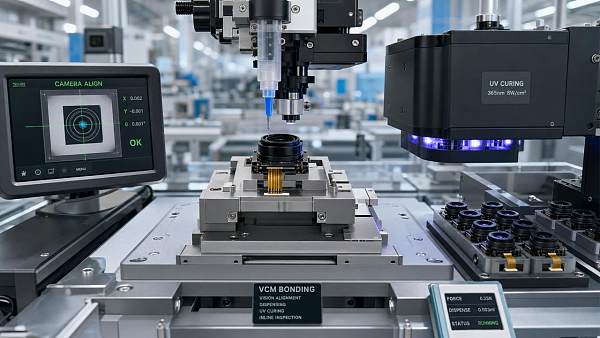
VCM bonding sits at the intersection of optical alignment, micro-dispensing, and controlled curing. A weak supplier choice can create hidden costs long before a module fails in the field.
The bond line in a voice coil motor camera module must stay consistent under vibration, thermal cycling, and repeated focusing movement. Even small variation in viscosity or cure profile can shift assembly performance.
That is why a camera module VCM bonding supplier should be assessed as a process partner, not only as a material vendor. The right source helps protect yield, throughput, and reliability at the same time.
What a capable camera module VCM bonding supplier should understand
In practical terms, VCM bonding covers adhesives and related process support used to secure critical components within autofocus camera modules. This may involve lens barrel fixing, magnet bonding, bracket attachment, reinforcement, or sealing around sensitive areas.
A capable camera module VCM bonding supplier should understand more than bond strength values on a datasheet. The supplier should also understand capillary control, low outgassing behavior, fast UV response, secondary heat cure options, and compatibility with automated dispensing systems.
This is where the wider bonding and dispensing perspective becomes useful. Platforms such as IADS frame supplier evaluation through polymer chemistry, fluid dynamics, dispensing precision, curing behavior, compliance, and production economics rather than isolated product claims.
The material is only one part of the decision
For example, a UV-curing adhesive may look attractive because it supports faster takt time. Yet if the adhesive shows unstable jetting behavior or poor shadow-area curing, line performance can still suffer.
Likewise, a low-cost adhesive can become expensive when nozzle clogging, stringing, or inconsistent bead shape increases inspection rejects. A reliable camera module VCM bonding supplier should be ready to discuss those realities clearly.
The main evaluation dimensions before shortlisting
A strong review process usually compares suppliers across technical, operational, and commercial criteria. Looking at one dimension alone often leads to avoidable downstream problems.
When comparing a camera module VCM bonding supplier, the most useful question is not “Who has the lowest quote?” It is “Who can keep the assembly window stable at scale?”
Technical signals that deserve closer attention
Some supplier claims sound strong on paper but reveal gaps during line trials. A closer review usually focuses on how the adhesive behaves under real assembly conditions.
Consistency between batches
Microliter-level dispensing leaves little room for fluctuation. If viscosity drifts between batches, shot size, wetting pattern, and placement accuracy can shift quickly.
A trustworthy camera module VCM bonding supplier should provide batch control data, shelf-life guidance, and clear storage conditions. Stable production starts with stable incoming material.
Cure profile and heat exposure
Not every module design can tolerate the same thermal budget. Some assemblies benefit from UV-first fixation with secondary moisture or heat curing, while others need low-temperature paths.
The supplier should explain cure speed, shadow-area performance, post-cure stability, and shrinkage behavior. In optics assembly, over-shrinkage can create subtle alignment issues.
Outgassing and contamination risk
Lens haze, sensor contamination, and volatile residue remain major concerns in miniature camera modules. This is especially important in enclosed spaces with sensitive optical surfaces.
A camera module VCM bonding supplier should be ready to discuss low outgassing formulation design, cleanliness control, and validation methods used for optical applications.
How dispensing capability affects supplier choice
In many projects, the adhesive and the dispensing method should be evaluated together. A material that performs well in static testing may still be difficult to meter accurately on a fast production line.
IADS often highlights how bonding materials and fluid control systems influence each other. That matters in VCM work, where piezoelectric jetting, needle dispensing, valve response, and vision-guided placement can decide final line efficiency.
- Check whether the supplier has validated the adhesive with common dispensing valves or jet systems.
- Ask for bead geometry data, minimum shot volume, and repeatability under production rhythm.
- Review whether the adhesive is prone to tailing, stringing, sedimentation, or nozzle skinning.
- Confirm whether the supplier can support parameter setting during sampling and line transfer.
If a camera module VCM bonding supplier cannot discuss dispensing windows in detail, qualification risk rises. In this field, chemistry and equipment cannot be separated cleanly.
Commercial and operational checks that prevent sourcing surprises
Technical fit is essential, but sourcing decisions also depend on how well the supplier can support routine business execution. A strong sample result is not enough.
Documentation and change control
Look for disciplined document management. Technical datasheets, SDS files, compliance declarations, and certificate updates should be current and easy to verify.
Change control is especially important. If a camera module VCM bonding supplier modifies raw materials, packaging, or process conditions without structured notification, requalification costs can escalate.
Lead time and pack format
Small-format syringes, cartridges, frozen packs, and light-protected containers each influence handling and waste. The right format depends on line setup and usage rate.
Short lead time matters, but predictable lead time matters more. A camera module VCM bonding supplier with weak forecasting discipline can disrupt planning even with acceptable quality.
Global support and regional response
For multi-site production, localized support can reduce qualification delay. It helps to know whether technical assistance, replacement batches, and complaint response are available near the assembly location.
A practical shortlist method
A useful evaluation model keeps the shortlist narrow and evidence-based. It also prevents discussions from drifting toward broad marketing claims.
- Define the exact bonding point, substrate combination, curing route, and dispensing method.
- Set pass criteria for viscosity range, cure speed, outgassing, bond strength, and visual cleanliness.
- Request trial samples from each camera module VCM bonding supplier under comparable conditions.
- Score suppliers on technical results, responsiveness, documentation quality, and supply resilience.
- Run a limited pilot before full approval, especially when automation or new cure equipment is involved.
This approach turns supplier selection into a manageable process. It also makes internal alignment easier when quality, operations, and sourcing teams review the same evidence.
Where to focus next
The best camera module VCM bonding supplier is usually the one that fits the full assembly context, not the one with the most impressive headline specification. In camera module production, repeatability, contamination control, and process support often outweigh isolated performance numbers.
A sensible next step is to build a comparison sheet around adhesive behavior, dispensing compatibility, compliance status, and change control discipline. From there, sample testing becomes more focused, and supplier discussions become easier to verify.
For teams tracking camera adhesives, UV materials, jet valves, and automated fluid control, broader intelligence from sources such as IADS can help connect supplier claims with real process requirements. That wider view often leads to a better shortlist and fewer surprises after qualification.
Recommended News
 Aug 19, 2026What affects yield most in the screen bezel bonding processScreen bezel bonding process yield depends most on surface cleanliness, dispensing consistency, alignment, and cure control. Learn how to reduce defects and improve bonding reliability.
 Aug 14, 2026Display Bonding for LCD: How to Reduce Optical Mura and Air Gap RiskDisplay bonding for LCD explained: reduce optical mura, eliminate air gaps, and improve bonding clarity with practical process tips.
 Aug 08, 2026How to Evaluate a Display Bonding Materials Supplier for Optical Clarity and YieldDisplay bonding materials supplier evaluation starts with optical clarity and yield. Learn how to compare process support, reliability, cure control, and production fit.
 Jul 30, 2026How to Evaluate Conductive Electronic Adhesives for Fine-Pitch BondingConductive electronic adhesives for fine-pitch bonding demand more than high conductivity. Learn how to assess rheology, cure, adhesion, and stability to reduce shorts and improve yield.
 Jul 25, 2026Capillary Underfill Bonding: Key Process Risks and Control PointsCapillary underfill bonding explained: discover key process risks, void causes, cure challenges, and control points to improve assembly yield, reliability, and package performance.
 Jul 21, 2026Industrial Adhesive Market Trends in Electronics for 2026Industrial adhesive market trends electronics in 2026 reveal how faster curing, precision dispensing, and compliance shape reliability, cost, and smart sourcing in electronics manufacturing.
 Jul 10, 2026Display Bonding: Key Failure Modes and Material Trade-OffsDisplay bonding failure modes explained: compare OCA, LOCA, and material trade-offs affecting optics, durability, yield, and process control across demanding display applications.
![]() Jul 07, 2026Camera Module Sensor Bonding: Choosing Adhesives for Low Stress and Clean OpticsCamera module sensor bonding guide: learn how to choose low-stress, low-outgassing adhesives for clean optics, higher yield, and more reliable camera module assembly.
Jul 07, 2026Camera Module Sensor Bonding: Choosing Adhesives for Low Stress and Clean OpticsCamera module sensor bonding guide: learn how to choose low-stress, low-outgassing adhesives for clean optics, higher yield, and more reliable camera module assembly. Jul 06, 2026Screen Bezel Bonding Adhesive: Key Checks for Strength and Display FinishScreen bezel bonding adhesive selection starts with more than strength. Learn the key checks for gap control, curing consistency, aging durability, and cleaner display finish.
 Jul 05, 2026Underfill Material Manufacturer Checklist for Consistent Bond ReliabilityUnderfill material manufacturer checklist for stronger bond reliability: compare flow stability, quality control, compliance, and supply support to reduce defects and choose with confidence.
 Jul 03, 2026Consumer Electronics Bonding Supplier Checklist: Quality, Lead Time, and Process FitConsumer electronics bonding supplier selection starts with quality, lead time, and process fit. Discover a practical checklist to reduce risk, improve yield, and choose with confidence.
 Jun 29, 2026Camera Module Bonding: How to Reduce Shift and FoggingCamera module bonding guide to reduce shift and fogging with better adhesive selection, dispensing, and curing control. Learn practical steps to improve yield and optical stability.
 Jun 26, 2026Solder Replacement Adhesives for SMT: Process Limits, Reliability, and ROISolder replacement adhesives for SMT: explore process limits, reliability, and ROI to see where low-heat bonding can cut defects, protect sensitive assemblies, and justify targeted adoption.
 Jun 26, 2026Display Bonding Adhesive Material Selection: Optical Clarity vs. Rework RiskDisplay bonding adhesive material selection shapes clarity, yield, and rework cost. Explore how to balance optical performance with repair risk for smarter, higher-value display assemblies.
 Jun 25, 2026Vietnam Adhesives Show to Spotlight ACA/ACF, UV Line FitVietnam Adhesives Show will spotlight ACA/ACF and UV line fit at VIASEAL Vietnam 2026, revealing localized electronics assembly solutions, certification readiness, and Southeast Asia sourcing opportunities.
 Jun 24, 2026Vietnam Adhesives Show Opens Aug. 5 With ACA/ACF FocusVietnam Adhesives Show opens Aug. 5 in Hanoi, spotlighting ACA/ACF, UV camera module adhesives, and RoHS 3 plus TCVN 7837:2025 compliance for EMS buyers and suppliers.
 Jun 23, 2026Vietnam Adhesives Expo Highlights ACA/ACF and UV Curing ShiftVietnam Adhesives Expo spotlights ACA/ACF conductive adhesives and 365 nm UV curing trends, revealing how Vietnam electronics supply chains are redefining qualification, certification, and sourcing opportunities.
 Jun 21, 2026IEC 62776:2026 Tightens LED Adhesive TestingIEC 62776:2026 tightens LED adhesive testing with mandatory halogen, ion migration, and silver migration checks. See how ACA/ACF and UV-curable adhesive suppliers can stay export-ready.
 Jun 18, 2026Display Bonding Adhesives: Key Checks Before Final Material SelectionDisplay bonding adhesives: discover the key checks before final material selection, from optical stability and curing to dispensing, reliability, and supplier readiness.
 Jun 15, 2026How to Evaluate a Camera Module VCM Bonding SupplierCamera module VCM bonding supplier selection affects yield, focus stability, and contamination control. Learn the key technical and sourcing checks before you shortlist.
 Jun 14, 2026Silver Filled Solder Replacement Adhesives: When Lower Heat Improves Assembly YieldSilver filled solder replacement adhesives help reduce heat stress, warpage, and yield loss in sensitive assemblies. Learn where they outperform solder and how to qualify them with confidence.
 Jun 13, 2026BGA Underfill for Flip Chip: Common Voiding Causes and FixesBGA underfill for flip chip: learn the most common voiding causes, from trapped air to cure issues, and discover practical fixes to improve yield, reliability, and process stability.
 Jun 11, 2026Shenzhen Adhesive Project Signals Supply and Certification ShiftShenzhen Adhesive Project signals change in supply and certification for UV curing adhesive, ACA/ACF anisotropic conductive adhesive, and thermal potting adhesive—see what it means for sourcing, lead times, and compliance.
 Jun 11, 2026Silver Conductive Adhesive for PCB and Sensor Assembly: Key Specs That MatterSilver conductive adhesive selection starts with the specs that drive real performance. Learn how resistivity, adhesion, cure, viscosity, and thermal stability affect PCB and sensor assembly reliability.








Editor's Selection
The Archive Newsletter
Critical industrial intelligence delivered every Tuesday. Peer-reviewed summaries of the week's most impactful logistics and market shifts.