
ECHA Adds 3 SVHCs, Raising REACH Demands
by
Published
Views:
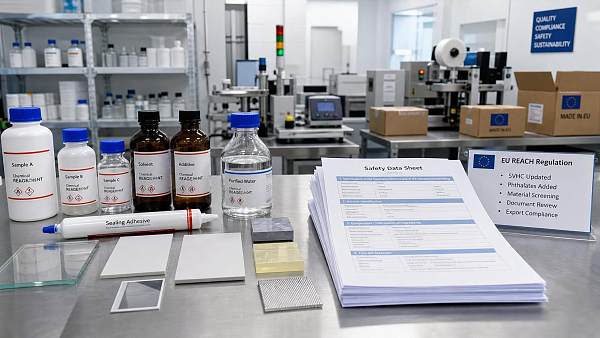
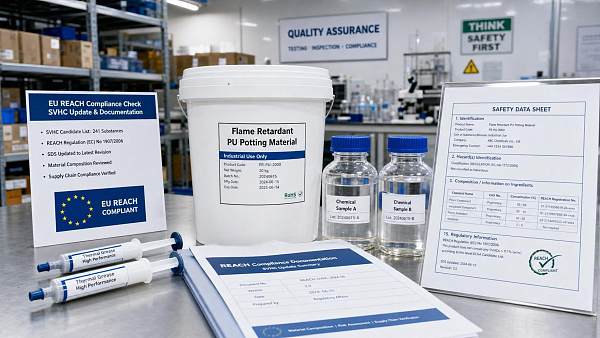
On July 20, 2026, the European Chemicals Agency (ECHA) added three new substances to the SVHC Candidate List, a move that immediately draws attention from exporters of halogen-containing thermal interface materials and thermal conductive pastes headed for the EU market. For Chinese thermal material manufacturers, the update is not just a list change: from October 2026, products containing SVHCs above 0.1% will require safe-use information for importers and a SCIP database notification, making document readiness, customer agreement updates, and supply chain traceability more pressing.

What the July 20 update confirms
The confirmed facts are limited but commercially relevant. ECHA formally added three substances to the SVHC Candidate List on July 20, 2026. According to the provided information, one of the newly added substances is a chlorinated organic flame retardant, which directly affects the export compliance of halogen-containing thermal interface materials and thermal conductive pastes.
The same information states that from October 2026, products exported to the EU that contain SVHC substances above 0.1% must be accompanied by safe-use guidance for importers and must also be notified in the SCIP database. The adjustment is directly related to export documentation, updates to customer technical agreements, and supply chain traceability requirements for Chinese thermal material manufacturers.
Where the compliance pressure is likely to appear first
Export-facing manufacturers will feel the impact in paperwork and declarations
From an industry perspective, companies shipping thermal interface materials or thermal conductive pastes to the EU are likely to face the earliest operational impact. The reason is straightforward: the requirement is tied to whether SVHC content exceeds 0.1%, which directly affects REACH-related declarations, importer communications, and SCIP filing obligations. What deserves closer attention is whether existing compliance statements and product documentation still match the updated candidate list.
Procurement and formulation teams may need closer substance screening
Analysis shows that upstream procurement and formulation-related functions may also be affected, especially where halogen-containing inputs are involved. The practical issue is not only whether a listed substance is present, but whether supplier information is detailed enough to support updated declarations and traceability. In business terms, this can influence material screening, supplier confirmation cycles, and the timing of customer responses.
EU importers and customer-facing teams will need clearer technical alignment
For importers and commercial teams serving EU accounts, the update may create immediate follow-up questions around substance content, safe-use instructions, and compliance statements. Observably, the impact here is concentrated in technical agreements, specification reviews, and delivery-related communication. Where customer documentation has not yet been aligned with the July update, transaction friction may increase.
Supply chain service providers may face heavier traceability demands
Service providers involved in documentation handling, regulatory coordination, or supply chain support may see a narrower but still important effect. The stated adjustment is directly linked to traceability requirements, which means supporting records, material declarations, and document consistency may receive greater scrutiny in EU-bound transactions.
What companies should review now
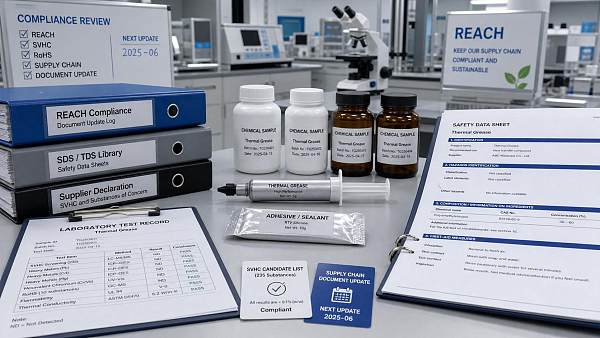
Check whether current REACH statements still reflect the updated list
Analysis shows that the first practical task is to review whether existing REACH compliance declarations for affected products remain usable after the July 20 update. This is especially relevant for halogen-containing thermal interface materials and thermal conductive pastes where the newly listed chlorinated organic flame retardant may have direct relevance.
Separate regulatory facts from customer contract timing
What deserves closer attention is the difference between the regulatory trigger and commercial execution. The confirmed fact is that from October 2026, products above the 0.1% threshold require safe-use information and SCIP notification. In practice, however, customer technical agreements, procurement approvals, and internal document workflows may need updating before that point, depending on shipment schedules and buyer requirements.
Reinforce supplier communication and traceability records
Observably, supply chain traceability is not a secondary issue in this update. Companies should focus on whether supplier-provided substance information is current, consistent, and detailed enough to support export files and customer inquiries. For businesses serving EU buyers, incomplete upstream information could become a delivery risk even before any formal rejection occurs.
Prepare for more detailed importer communication
From an industry perspective, companies should expect a more document-driven exchange with EU importers once the October 2026 requirement becomes operational. Safe-use guidance and SCIP-related handling are not only regulatory tasks; they also affect how technical, sales, and compliance teams coordinate external communication.
Why this looks more like an operational signal than a one-day event
Analysis shows that this development is better understood as an operational compliance signal rather than a stand-alone news item. The confirmed regulatory change is specific, but its business meaning depends on how quickly companies can map affected substances to products, update declarations, and align with customer requirements. It is more appropriate to understand this as a near-term compliance adjustment with possible longer-tail implications for formulation review and supply chain transparency.
Observably, the current information does not confirm broader market outcomes, product substitutions, or commercial losses. What it does confirm is a tighter compliance expectation for certain EU-bound thermal material products, especially where SVHC content and traceability documentation intersect.
How the market should read this update
The significance of this update lies less in headline value and more in execution detail. ECHA's addition of three SVHC substances creates a defined compliance checkpoint for exporters of halogen-containing thermal interface materials and thermal conductive pastes, with October 2026 marking the key implementation point stated in the provided information. At this stage, it is more appropriate to understand the development as a concrete short-term compliance change and a broader signal that document accuracy, customer alignment, and supply chain traceability will remain under close attention.
Basis of this article and what still needs verification
This article is based on the user-provided news title, event date, and event summary. For this type of regulatory update, relevant source categories usually include official agency announcements, company disclosures, industry association updates, authoritative media reporting, and standard-setting or regulatory documents.
No specific official source link was provided in the input, so the exact official reference should continue to be verified. Areas that still warrant follow-up include any subsequent official wording, implementation clarifications, and how affected exporters and EU trading counterparts update their technical and documentation practices in response.
Recommended News
 Aug 23, 2026How to qualify a thermal interface adhesives supplier for EV battery assemblyThermal interface adhesives supplier selection for EV battery assembly: learn how to assess thermal performance, dispensing stability, compliance, and scale-up support.
 Jul 25, 2026ECHA Adds Three Phthalates to SVHC ListECHA Adds Three Phthalates to SVHC List: learn how DEHP, BBP, and DBP impact REACH documents, SCIP filing, and EU customs compliance for thermal materials suppliers.
 Jul 24, 2026ECHA Adds 3 SVHCs, REACH Declarations for Thermal Pastes Must Be UpdatedECHA adds 3 SVHCs: learn why REACH declarations for thermal pastes must be updated, how SCIP and SDS rules affect EU exports, and what suppliers should check now.
 Jul 23, 2026ECHA Adds 3 SVHCs, Prompting REACH UpdatesECHA Adds 3 SVHCs, Prompting REACH Updates: learn how Thermal Conductive Pastes, Flame-retardant PU Potting, and EU exporters should respond within six months.
 Jul 22, 2026ECHA SVHC Update Triggers REACH Review for Thermal PastesThermal conductive pastes face urgent REACH review after the ECHA SVHC update. Learn how new Candidate List entries affect SDS updates, EU exports, and compliance readiness.
 Jul 21, 2026ECHA Adds 3 SVHCs, Raising REACH DemandsECHA adds 3 SVHCs to the Candidate List, raising REACH demands for EU-bound thermal interface materials and thermal conductive pastes. See key risks, SCIP duties, and compliance actions.
 Jul 20, 2026ECHA Updates SVHC List, Pressuring Thermal Paste ComplianceECHA updates the SVHC list, raising urgent REACH compliance pressure for Thermal Conductive Pastes in the EU. See key deadlines, supply chain risks, and actions for buyers and manufacturers.
 Jul 19, 2026How to Choose Thermal Interface Materials for EV BatteriesThermal interface materials for EV batteries: learn how to compare conductivity, insulation, gap control, safety, and process fit to choose reliable, high-performance solutions.
 Jul 15, 2026Battery Thermal Management Materials: Comparing Gap Fillers, Pads, and PastesBattery thermal management materials compared: gap fillers, pads, and pastes for EV packs. Learn how to balance heat transfer, manufacturability, cost, and reliability.
 Jul 12, 2026UL94 Thermal Interface Materials: What Ratings Mean for Device SafetyUL94 thermal interface materials explained: learn what V-0, V-1, V-2, and HB ratings mean for device safety, compliance, and smarter material selection.
 Jul 06, 2026Thermal Interface Adhesives Price: Cost Drivers and Spec Trade-OffsThermal interface adhesives price explained: compare cost drivers, spec trade-offs, hidden procurement costs, and sourcing tips to choose the right material with better total value.
 Jul 06, 2026Thermal Interface Materials for Consumer Electronics: What Affects Cooling Performance?Thermal interface materials for consumer electronics directly shape cooling, reliability, and device comfort. Discover what really affects TIM performance beyond conductivity.
 Jul 04, 2026Battery Heat Dissipation Materials: What Improves Cooling Without Adding WeightBattery heat dissipation materials that boost cooling without extra weight. Learn how TIMs, gap fillers, films, and graphite solutions improve battery safety, lifespan, and pack efficiency.
 Jun 30, 2026How to Compare Flame Retardant Thermal Management MaterialsFlame retardant thermal management materials comparison made practical: learn how to assess thermal paths, flame ratings, process fit, and long-term reliability for smarter material selection.
 Jun 23, 2026Battery Thermal Management for Automotive: Paste or Potting Compound?Battery thermal management for automotive: should you choose thermal paste or potting compound? Compare heat transfer, protection, rework, and production fit to make a smarter EV battery design decision.
 Jun 23, 2026Industrial Adhesive Market Trends for EV Battery Thermal MaterialsIndustrial adhesive market trends EV battery leaders watch now are reshaping thermal materials, dispensing, and compliance. Discover what drives safer, faster EV battery production.
 Jun 18, 2026UL94 Thermal Management Adhesives: How to Balance Heat and Flame RatingsUL94 thermal management adhesives explained: learn how to balance flame ratings, heat dissipation, dispensing stability, and long-term reliability for safer, smarter material selection.
 Jun 14, 2026Battery Adhesive Technology: Key Trade-Offs in Thermal Control, Safety, and ReworkBattery adhesive technology shapes thermal control, safety, and rework in EV battery packs. Explore key trade-offs, process risks, and smarter material choices for reliable production.
 Jun 13, 2026Thermally Conductive Adhesives: Key Selection Factors for Heat-Sensitive DesignsThermally conductive adhesives selection guide for heat-sensitive designs. Learn how conductivity, viscosity, cure, and substrate fit improve reliability and cooling.
 Jun 12, 2026Guangzhou Adhesives Show Signals Compliance-Focused BuyingGuangzhou Adhesives Show signals compliance-focused buying as overseas buyers prioritize thermal conductive pastes, UV curing adhesives, and silicone encapsulants with sample validation and technical documentation.
 Jun 04, 2026Thermal Management Materials: Paste or Gap Filler?Thermal management materials: learn when thermal paste or gap filler is the smarter choice for electronics, EV batteries, and industrial systems to improve reliability and reduce production risk.















Editor's Selection
The Archive Newsletter
Critical industrial intelligence delivered every Tuesday. Peer-reviewed summaries of the week's most impactful logistics and market shifts.