How electronics miniaturization is shaping conductive adhesive demand
by
Published
Views:
How electronics miniaturization is shaping conductive adhesive demand
Among the adhesive market trends electronics manufacturers are monitoring, miniaturization is reshaping demand for conductive adhesives. Smaller components, tighter interconnect spacing, and heat-sensitive substrates are increasing the importance of precise deposition, reliable electrical performance, and compatible curing processes. For business evaluators, the opportunity extends beyond material sales to dispensing equipment, process integration, and supplier capabilities.
The commercial story is not simply that smaller electronics consume more adhesive. Individual joints may require less material, and solder remains difficult to displace in many applications. What changes is the value of making a reliable connection within a narrower manufacturing window. A material that works on a laboratory coupon may still be unsuitable for a crowded sensor assembly running across multiple production shifts.
Demand is shifting toward difficult interfaces, not universal solder replacement
Conductive adhesives deserve attention where electrical connection and mechanical bonding must coexist under temperature, geometry, or substrate constraints. Flexible circuits, compact sensor packages, selected semiconductor die-attach applications, and conductive connections to temperature-sensitive parts are relevant examples. These are application-specific opportunities, not evidence that adhesives will replace solder across electronics manufacturing.
Consider a sensor connected to a thin flexible substrate. Its assembly may be constrained by allowable heat exposure, pad metallurgy, and movement during service. A conductive adhesive can offer a useful joining route, but only if adhesion, contact resistance, and mechanical compliance remain acceptable after environmental exposure. Lower processing temperature alone does not establish a business case.
Miniaturization also produces competing effects. More functions within a device can create additional connection points, while smaller deposits reduce consumption per connection. Integration may eliminate some discrete joints altogether. Market assessments therefore need to distinguish growth in qualified applications from growth in kilograms shipped. Higher-value formulations can gain commercial importance without a matching increase in material volume.
Different conductive adhesive technologies address different opportunities
Isotropic conductive adhesives conduct through the cured material in multiple directions. Silver-filled formulations are widely used within this category, with performance influenced by filler loading, particle morphology, resin chemistry, and the resulting conductive network. They can serve selected die-attach and component-bonding applications, but lateral conductivity becomes a concern when neighboring conductors sit close together.
Anisotropic conductive films and pastes take a different approach. Under suitable bonding conditions, conductive particles establish connections through the bond thickness while maintaining lateral insulation. This makes them relevant to fine-pitch interconnections, including certain display and flex-circuit assemblies. However, they require control of pressure, temperature, alignment, and particle capture; they are not interchangeable with a dispensed silver epoxy.
These distinctions matter when evaluating suppliers. A company with strong silver-epoxy die-attach expertise does not automatically have a credible position in anisotropic interconnect materials. Likewise, electrically conductive adhesives should not be grouped indiscriminately with thermally conductive potting compounds or electrically insulating underfills. Those adjacent markets share some chemistry and processing knowledge, but their performance requirements and qualification paths differ.
The smaller the joint, the more deposition becomes part of the product
At tighter spacing, the deposited shape can matter as much as the formulation’s headline conductivity. Too much material may bridge adjacent pads or contaminate a keep-out area. Too little can leave incomplete contact or inadequate bond coverage. Substrate wetting and adhesive movement during placement can change the final footprint after an apparently accurate dispense.
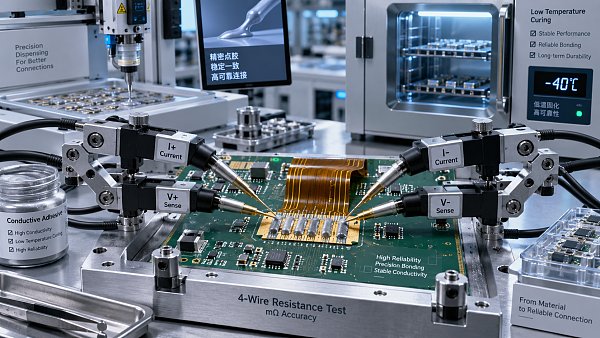
This is where dispensing equipment becomes commercially significant. Piezoelectric jet valves can support non-contact deposition in suitable applications, but not every conductive adhesive is jettable. Particle size distribution, viscosity, thixotropic recovery, settling behavior, and valve geometry all influence performance. A smaller nominal droplet specification is not persuasive unless the actual filled adhesive runs consistently.
A realistic equipment trial should include production interruptions. Does the first deposit after an idle period match steady-state output? Does material accumulate around the nozzle? How does the adhesive behave near the end of its usable working life? These details often reveal more about operating cost than a short demonstration on an uncluttered test substrate.
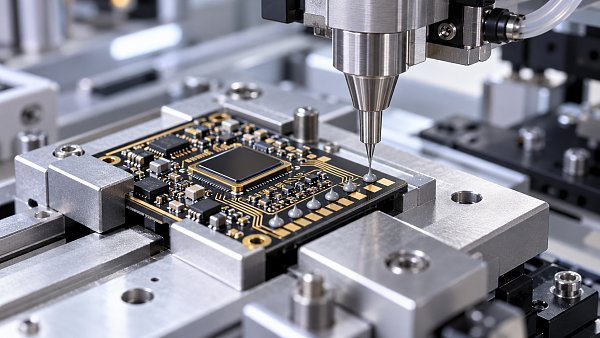
Vision inspection helps locate deposits and identify shape defects, but a good-looking dot does not prove a sound electrical connection. Inspection needs to connect deposit geometry with post-placement bondline behavior and electrical testing. Otherwise, automation can reproduce an unstable process very precisely.
Curing and reliability can overturn an attractive material specification
Cure compatibility is a frequent dividing line between a promising sample and a usable production material. An adhesive may offer favorable electrical properties after a cure schedule that the assembled device cannot tolerate. Conversely, shortening the schedule to meet throughput targets can change conversion, adhesion, and resistance stability. The relevant question is what performance the material achieves within the factory’s actual thermal budget.
UV curing also needs careful interpretation. Although UV-curing adhesives are useful elsewhere in electronics assembly, conductive fillers and opaque components can restrict light access. A fast light-curing process should not be assumed feasible for a hidden conductive joint. Suitability depends on the formulation, joint geometry, and any validated secondary cure mechanism.
Reliability testing must examine the complete interface. Bulk volume resistivity is useful for material comparison, but it does not capture contact resistance at the adhesive-to-pad boundary. Surface finish, contamination, moisture exposure, thermal cycling, and mechanical strain can affect the assembled connection. Silver-containing systems may also require evaluation for electrochemical migration under relevant humidity and electrical-bias conditions.
There is a practical trade-off here: increasing conductive filler can improve electrical performance, yet may complicate flow, dispensing, or mechanical behavior. A compliant formulation may accommodate movement but miss another requirement. Buyers should expect a balanced process window, not a material that leads every datasheet category.
The business case belongs at assembly level
Price per gram is an incomplete purchasing metric. In miniature assemblies, material retained in a cartridge, discarded during purging, or lost after its usable life can materially affect effective cost. A lower-priced adhesive may become expensive if it needs frequent cleaning, refrigerated handling, or long changeovers.
Silver price exposure adds another variable, but reducing silver content is not automatically a saving. A formulation change can alter conductivity, deposition behavior, and qualification requirements. Silver-saving claims should be evaluated at equivalent connection performance and acceptable yield, rather than by filler percentage alone.
For a meaningful comparison, calculate cost per accepted assembly. Include material consumption and waste, dispensing maintenance, cure capacity, inspection, rework, and scrap. Recoverability matters too: a defective adhesive connection on an expensive module may be harder to repair than the purchasing comparison assumes. The economic advantage often comes from a stable process rather than the cheapest formulation.
Supplier evaluation is becoming a test of integration capability
As manufacturing tolerances narrow, suppliers need to demonstrate more than a suitable product grade. Material consistency, application support, and change control become part of the purchasing decision. Evaluators should ask for evidence that addresses the intended production conditions:
- Process-window evidence: Results across realistic dispensing, placement, and cure conditions, rather than one optimized setting.
- Batch consistency: Controls for rheology, filler dispersion, storage stability, and relevant electrical properties.
- Equipment compatibility: Trials using the intended valve or bonding system, including idle recovery and cleaning requirements.
- Qualification support: Traceability, change notification, failure-analysis access, and documentation appropriate to the application.
- Supply resilience: Shelf-life implications, transport conditions, production location, and a workable response to interruptions.
Compliance documentation needs similar discipline. RoHS and REACH information should be assessed for the specific supplied material and applicable obligations. “Halogen-free” claims need a defined basis. None of these documents, by itself, demonstrates electrical reliability or customer approval for a particular assembly.
This materials-to-process perspective is central to Global Industrial Adhesives & Dispensing Systems (IADS), which examines bonding chemistry alongside dispensing, curing, automation, and supplier capability. For commercial evaluation, those connections are more useful than treating conductive adhesives and precision dispensing as unrelated purchasing categories.
Where demand signals deserve closer attention
The most credible opportunities sit where connection geometry, substrate sensitivity, or assembly architecture creates a specific need. Fine-pitch flex connections, selected compact sensors, and specialized packaging applications warrant investigation, but each has different material choices and competitive alternatives. A broad consumer-electronics growth forecast cannot establish demand for a particular conductive adhesive technology.
Application-specific evidence is more revealing: a material qualified on a defined substrate, repeatable deposits using production equipment, stable resistance after relevant testing, and a supply arrangement that supports the planned manufacturing footprint. Qualification can make an incumbent supplier difficult to replace, although it also raises the cost and time required to win new business.
For the next supplier discussion, request a joined-up evidence package covering the adhesive, deposition method, cure profile, assembled-joint performance, and cost assumptions. If those elements were tested separately under incompatible conditions, the opportunity is not yet production-ready—however attractive the miniaturization story sounds.
Recommended News
 Oct 24, 2026How electronics miniaturization is shaping conductive adhesive demandExplore adhesive market trends electronics manufacturers are tracking as miniaturization reshapes conductive adhesive demand. Discover dispensing and supplier insights for smarter sourcing.
 Oct 19, 2026Choosing semiconductor bonding materials for fine-pitch assemblyChoose semiconductor bonding materials for fine-pitch assembly with confidence. Learn how gap size, flow, cure, and reliability testing guide selection and reduce assembly risks.
 Oct 05, 2026How to assess a chip packaging adhesives manufacturer for ACF reliabilityChip packaging adhesives manufacturer selection starts with ACF reliability: compare bonding windows, validation data, lot control, and process support to reduce yield risk.
 Oct 02, 2026When can conductive solder replacement adhesives meet joint resistance targets?Conductive solder replacement adhesives can meet joint resistance targets when material, bond-line control, curing, and reliability testing align. Explore the key evaluation factors.
 Aug 19, 2026What affects yield most in the screen bezel bonding processScreen bezel bonding process yield depends most on surface cleanliness, dispensing consistency, alignment, and cure control. Learn how to reduce defects and improve bonding reliability.
 Aug 14, 2026Display Bonding for LCD: How to Reduce Optical Mura and Air Gap RiskDisplay bonding for LCD explained: reduce optical mura, eliminate air gaps, and improve bonding clarity with practical process tips.
 Aug 08, 2026How to Evaluate a Display Bonding Materials Supplier for Optical Clarity and YieldDisplay bonding materials supplier evaluation starts with optical clarity and yield. Learn how to compare process support, reliability, cure control, and production fit.
 Jul 30, 2026How to Evaluate Conductive Electronic Adhesives for Fine-Pitch BondingConductive electronic adhesives for fine-pitch bonding demand more than high conductivity. Learn how to assess rheology, cure, adhesion, and stability to reduce shorts and improve yield.
 Jul 25, 2026Capillary Underfill Bonding: Key Process Risks and Control PointsCapillary underfill bonding explained: discover key process risks, void causes, cure challenges, and control points to improve assembly yield, reliability, and package performance.
 Jul 21, 2026Industrial Adhesive Market Trends in Electronics for 2026Industrial adhesive market trends electronics in 2026 reveal how faster curing, precision dispensing, and compliance shape reliability, cost, and smart sourcing in electronics manufacturing.
 Jul 10, 2026Display Bonding: Key Failure Modes and Material Trade-OffsDisplay bonding failure modes explained: compare OCA, LOCA, and material trade-offs affecting optics, durability, yield, and process control across demanding display applications.
![]() Jul 07, 2026Camera Module Sensor Bonding: Choosing Adhesives for Low Stress and Clean OpticsCamera module sensor bonding guide: learn how to choose low-stress, low-outgassing adhesives for clean optics, higher yield, and more reliable camera module assembly.
 Jul 06, 2026Screen Bezel Bonding Adhesive: Key Checks for Strength and Display FinishScreen bezel bonding adhesive selection starts with more than strength. Learn the key checks for gap control, curing consistency, aging durability, and cleaner display finish.
 Jul 05, 2026Underfill Material Manufacturer Checklist for Consistent Bond ReliabilityUnderfill material manufacturer checklist for stronger bond reliability: compare flow stability, quality control, compliance, and supply support to reduce defects and choose with confidence.
 Jul 03, 2026Consumer Electronics Bonding Supplier Checklist: Quality, Lead Time, and Process FitConsumer electronics bonding supplier selection starts with quality, lead time, and process fit. Discover a practical checklist to reduce risk, improve yield, and choose with confidence.
 Jun 29, 2026Camera Module Bonding: How to Reduce Shift and FoggingCamera module bonding guide to reduce shift and fogging with better adhesive selection, dispensing, and curing control. Learn practical steps to improve yield and optical stability.
 Jun 26, 2026Solder Replacement Adhesives for SMT: Process Limits, Reliability, and ROISolder replacement adhesives for SMT: explore process limits, reliability, and ROI to see where low-heat bonding can cut defects, protect sensitive assemblies, and justify targeted adoption.
 Jun 26, 2026Display Bonding Adhesive Material Selection: Optical Clarity vs. Rework RiskDisplay bonding adhesive material selection shapes clarity, yield, and rework cost. Explore how to balance optical performance with repair risk for smarter, higher-value display assemblies.
 Jun 25, 2026Vietnam Adhesives Show to Spotlight ACA/ACF, UV Line FitVietnam Adhesives Show will spotlight ACA/ACF and UV line fit at VIASEAL Vietnam 2026, revealing localized electronics assembly solutions, certification readiness, and Southeast Asia sourcing opportunities.
 Jun 24, 2026Vietnam Adhesives Show Opens Aug. 5 With ACA/ACF FocusVietnam Adhesives Show opens Aug. 5 in Hanoi, spotlighting ACA/ACF, UV camera module adhesives, and RoHS 3 plus TCVN 7837:2025 compliance for EMS buyers and suppliers.
 Jun 23, 2026Vietnam Adhesives Expo Highlights ACA/ACF and UV Curing ShiftVietnam Adhesives Expo spotlights ACA/ACF conductive adhesives and 365 nm UV curing trends, revealing how Vietnam electronics supply chains are redefining qualification, certification, and sourcing opportunities.
 Jun 21, 2026IEC 62776:2026 Tightens LED Adhesive TestingIEC 62776:2026 tightens LED adhesive testing with mandatory halogen, ion migration, and silver migration checks. See how ACA/ACF and UV-curable adhesive suppliers can stay export-ready.
 Jun 18, 2026Display Bonding Adhesives: Key Checks Before Final Material SelectionDisplay bonding adhesives: discover the key checks before final material selection, from optical stability and curing to dispensing, reliability, and supplier readiness.
 Jun 15, 2026How to Evaluate a Camera Module VCM Bonding SupplierCamera module VCM bonding supplier selection affects yield, focus stability, and contamination control. Learn the key technical and sourcing checks before you shortlist.



Editor's Selection
The Archive Newsletter
Critical industrial intelligence delivered every Tuesday. Peer-reviewed summaries of the week's most impactful logistics and market shifts.