
Electronics Potting: How to Prevent Cracking and Voids
by
Published
Views:
Why does electronics potting crack or trap voids so easily?
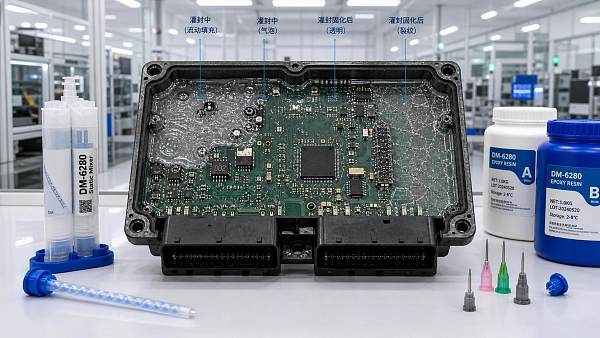
Electronics potting looks simple on paper, yet small process shifts can create large reliability problems.
A housing fills, the surface levels, and the part seems finished. Later, cracks appear, bubbles expand, or moisture reaches sensitive circuits.
That usually happens because electronics potting is not only a filling step. It is also a thermal, chemical, and mechanical balance.
If viscosity is too high, air stays inside. If shrinkage is too strong, stress builds during cure. If the cure profile is rushed, the center behaves differently from the edges.
In practical production, cracking and voids often come from a chain of small errors rather than one dramatic mistake.
This is why electronics potting must be judged as a full process, including material selection, static mixing, dispensing behavior, venting, and curing control.
That broader view is common across industrial adhesive and dispensing analysis on IADS, where material chemistry and fluid control are treated as one system.
Is the problem usually the potting compound, or the process around it?
More often, it is the interaction between both.
A well-chosen resin can still fail if mix ratio drifts, if the shot pattern traps air, or if the substrate carries moisture or flux residue.
On the other hand, a stable dispensing setup cannot rescue a material with poor elongation, excessive exotherm, or unsuitable thermal expansion.
A useful way to judge electronics potting defects is to separate them into four sources.
- Material factors: viscosity, filler loading, shrinkage, hardness, thermal conductivity, and cure mechanism.
- Mixing factors: ratio accuracy, static mixer condition, unmixed streaks, and air entrainment.
- Dispensing factors: flow path, fill speed, needle position, jetting pattern, and reservoir pressure stability.
- Curing factors: oven ramp, ambient humidity, part geometry, heat concentration, and cure depth consistency.
In electronics potting for sensors, controllers, lighting modules, and power electronics, the same resin may perform differently in different cavity shapes.
That is why process validation should include the actual housing, actual board, and actual fill volume.
A quick defect diagnosis table
Before changing everything at once, compare the defect pattern against likely causes.
Which material choices reduce cracking before production even starts?
This is where many defects can be prevented early.
Electronics potting materials are not interchangeable, even when they share the same basic label such as epoxy, polyurethane, or silicone.
Epoxy systems often offer strong adhesion and chemical resistance, but some grades cure hard and transmit more stress to delicate components.
Polyurethane can absorb vibration better, yet moisture sensitivity during processing needs attention.
Silicone usually handles thermal cycling well, especially where flexibility matters, though adhesion and contamination control must be reviewed carefully.
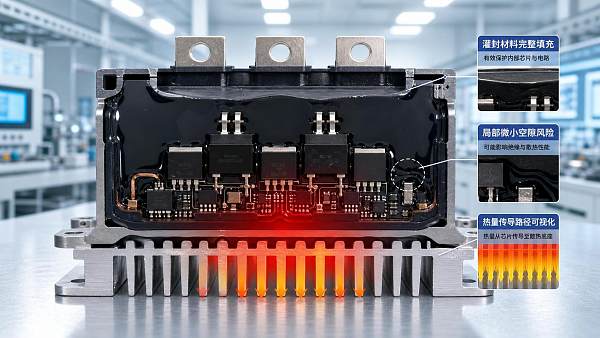
For electronics potting in power modules or battery-adjacent assemblies, thermal conductivity also matters because trapped heat can speed aging and distort cure behavior.
A practical shortlist should compare more than datasheet hardness.
- Elongation and modulus after cure
- Shrinkage during cross-linking
- Viscosity at real production temperature
- Pot life versus actual takt time
- Flame retardancy, RoHS, REACH, or halogen-free needs
- Thermal conductivity if the assembly carries heat
In many cases, a slightly softer compound prevents more failures than a very rigid high-strength formula.
That judgment becomes even more important when electronics potting surrounds mixed materials such as aluminum, copper, FR-4, and engineering plastics.
How can mixing and dispensing create hidden voids?
Void formation often begins before the material reaches the part.
Two-component electronics potting systems depend on accurate ratio control, consistent feed pressure, and proper static mixing.
If one side pulses, the mixer wears out, or the material is too cold, the compound may carry microbubbles that are hard to see immediately.
Dispensing method matters as much as chemistry. A top-down fast pour can seal air under tall components. A controlled bottom-up fill often performs better.
For tight electronics potting cavities, slower flow with a moving needle usually beats aggressive high-speed filling.
Automated dispensing platforms, piezo-assisted control, and stable fluid paths help, but setup discipline is still essential.
The most useful checks are usually simple.
- Warm material to a controlled process window before mixing.
- Replace static mixers on a fixed schedule, not only after visible failure.
- Avoid sharp flow turns where filler-rich compounds can separate.
- Use vacuum degassing where the material and cycle time allow it.
- Validate shot repeatability by weight, not visual fill height alone.
This is also where IADS-style process thinking becomes useful, because dispensing precision and polymer behavior cannot be optimized separately.
What curing mistakes lead to cracks after the part already looks acceptable?
A clean surface after fill does not guarantee a safe cure.
Cracks often show up later because internal stress builds quietly during polymerization and cooling.
Thick electronics potting sections are especially sensitive. The core can become much hotter than the outer layer, creating uneven shrinkage.
If the cure ramp is too steep, exotherm rises quickly. If the assembly cools too fast, stress remains locked into the cured mass.
Another overlooked issue is moisture. Some materials react poorly when ambient humidity is uncontrolled, while others need substrate drying before potting starts.
For that reason, curing should be documented as a full profile, not only as a final oven temperature.
Signs the cure profile needs review
- Cracks appear only after burn-in, vibration, or temperature cycling.
- Large parts fail more often than small parts using the same resin.
- The cured top surface looks fine, but cross-sections reveal void growth.
- Different ovens produce different hardness or adhesion results.
A staged cure, lower peak exotherm, or thinner sequential fill can solve problems that no formula change can fully fix.
How do you build a more reliable electronics potting routine?
The most reliable routine is the one that turns hidden variables into measured checkpoints.
Instead of reacting only to failed parts, define a small control plan around the most sensitive steps.
For electronics potting, that usually includes incoming material condition, mix ratio verification, dispense weight, void inspection, and cure confirmation.
If the product works in high vibration, high humidity, or thermal shock, the validation method should reflect those stresses early.
A sensible implementation checklist can stay compact.
- Match compound flexibility to substrate movement and service temperature.
- Confirm cavity venting before adjusting pump speed.
- Record temperature and humidity during mixing and cure.
- Cross-section sample parts when launching a new fill geometry.
- Review compliance and material data together with processing data.
That last point matters more than it seems.
In industrial applications, electronics potting decisions often connect thermal performance, flame retardancy, dispensing accuracy, and regulatory readiness in one workflow.
A knowledge framework like IADS is useful here because it links encapsulants, automated fluid control, curing behavior, and application risk in one place.
So what should be checked first when failures keep returning?
Start with the variables that most often drift quietly: material temperature, mix ratio, fill path, and cure profile.
If cracking dominates, compare modulus, shrinkage, and thermal expansion against the real assembly structure.
If voids dominate, review how air enters, where it gets trapped, and whether the fill pattern gives it a way out.
The key with electronics potting is to resist one-step fixes. A new resin alone may not solve a venting problem. Slower fill alone may not solve a cure-stress problem.
A better next step is to document one representative defect, map the full process around it, and compare material, dispensing, and curing conditions side by side.
That approach reduces rework, shortens troubleshooting time, and leads to more reliable sealed assemblies under real operating conditions.
Recommended News
 Sep 17, 2026When silicone chip packaging adhesives prevent solder joint crackingSilicone chip packaging adhesives help prevent solder joint cracking by absorbing stress, reducing board flex, and improving BGA reliability. Explore smarter protection strategies.
 Sep 15, 2026Silicone vs. polyurethane: which offers better vibration damping for EV battery module assembly?Should I use silicone or polyurethane for vibration protection? Discover which material delivers superior long-term damping, thermal stability & safety in EV battery modules.
 Sep 03, 2026How to prevent leaks when selecting a battery pack sealing adhesiveBattery pack sealing adhesive selection made practical: prevent leaks with proven guidance on joint design, curing, dispensing, durability testing, and serviceability.
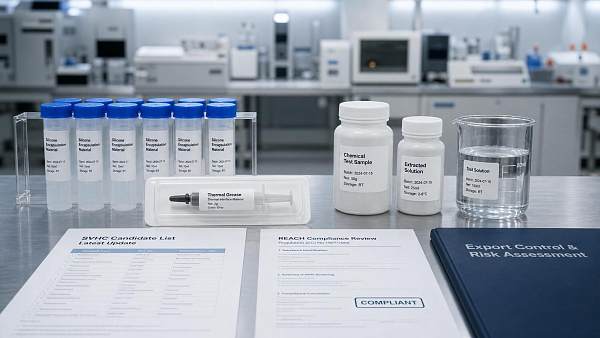
 Aug 16, 2026EU REACH Adds 5 SVHCs, Triggering Mandatory SCIP Reporting from Aug. 15, 2026EU REACH adds 5 SVHCs, making SCIP reporting mandatory from Aug. 15, 2026. Learn how the new REACH candidate list impacts exporters, epoxy adhesives, silicone encapsulants, and EU compliance.
 Aug 12, 2026How Electronics Potting for Power Modules Affects Heat Dissipation and ReliabilityElectronics potting for power modules directly impacts heat dissipation, insulation, and long-term reliability. Learn how to choose materials that reduce risk and improve performance.
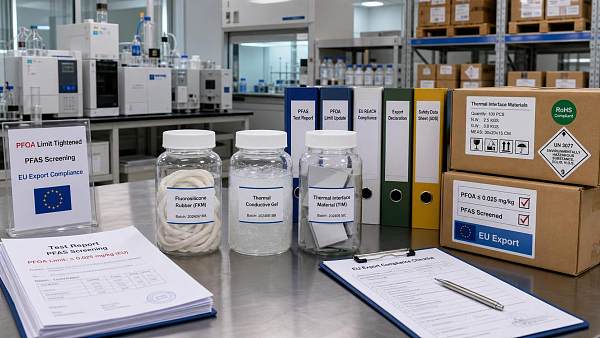
 Aug 11, 2026EU PFOA Rule Takes Full Effect on Aug. 10EU PFOA Rule takes full effect on Aug. 10, tightening REACH limits for electronics and new energy materials. See who is affected, key compliance risks, and what exporters should check now.
 Aug 10, 2026ECHA Tightens PFOA Limit for Fluorinated Silicone ExportsECHA tightens PFOA limit to 25 ppb for fluorinated silicone exports. Learn how Silicone Encapsulants and Thermal Conductive Pastes can meet EU REACH compliance fast.
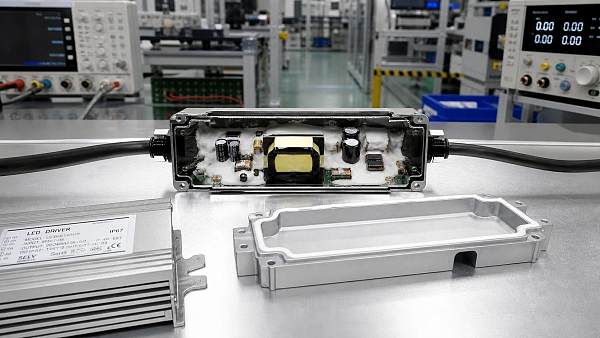
 Aug 07, 2026How to Choose Electronics Potting for LED Drivers by Heat and IP RatingElectronics potting for LED drivers: learn how to choose the right compound by heat path, IP rating, stress, and cure behavior to improve reliability and simplify selection.
 Jul 26, 2026ECHA Adds Two Flame Retardants to SVHC ListECHA Adds Two Flame Retardants to SVHC List: learn how DPTEBP and TBBPS may affect EU exports, SDS updates, declarations, and October 2026 compliance deadlines.
 Jul 19, 2026ECHA SVHC Update Raises Export Risks for Silicone MaterialsECHA SVHC update raises export risks for silicone materials, including silicone encapsulants and thermal conductive pastes. Learn the REACH, SCIP, and traceability impacts before October 2026.
 Jul 14, 2026Japan’s New JIS Rule Pulls Silicone Encapsulant Orders to ChinaSilicone encapsulant demand is shifting to China as Japan’s new JIS rule nears. See how compliance, certification, and EMS procurement are reshaping orders before October 2026.
 Jul 13, 2026Japan Enforces JIS T 2801-2026 on Silicone EncapsulantsJapan Enforces JIS T 2801-2026 on Silicone Encapsulants: learn how new thermal shock and ion migration tests affect PSE access, supplier approval, and Japan-bound compliance plans.
 Jul 09, 2026How to Evaluate an Electronics Packaging Adhesive Supplier for Yield StabilityElectronics packaging adhesive supplier evaluation starts with yield stability. Learn how to compare consistency, compliance, process fit, and total cost for smarter sourcing.
 Jul 04, 2026How to Evaluate Electronic Potting Materials in Japan for Heat, Moisture, and ComplianceElectronic potting materials Japan: learn how to compare heat resistance, moisture protection, and compliance data to choose reliable compounds for automotive, EV, and electronics projects.
 Jul 03, 2026China Customs Splits Out Silicone Encapsulants HS CodeChina Customs splits out Silicone Encapsulants HS code to 3910.0099, tightening filing, UL/IEC documentation, and rebate timing. See what exporters and buyers must do now.
 Jul 02, 2026China Splits Out Silicone Encapsulants Under New HS CodeChina splits out silicone encapsulants under new HS code 3506.9900.11. See how the rule affects export compliance, tax rebate timing, and global delivery planning.
 Jul 01, 2026China Creates HS 2026.7.11 for Silicone EncapsulantsChina creates HS 2026.7.11 for silicone encapsulants, reshaping customs declarations, rebate timing, and export compliance. Learn what exporters and buyers must review now.
 Jun 29, 2026How to Choose Electronic Potting Sealants for Heat and MoistureElectronic potting sealants for heat and moisture: learn how to match materials to real operating conditions, improve reliability, and avoid costly process mistakes.
 Jun 24, 2026Electronic Packaging Adhesive Price Benchmarks by Cure Type and VolumeElectronic packaging adhesive price benchmarks by cure type and volume. Compare UV, epoxy, silicone, package formats, and hidden process costs to source smarter and cut total line expense.
 Jun 24, 2026East China Silicone Cuts Extend DMC, 107 Gum Lead TimesEast China silicone cuts are extending DMC and 107 gum lead times to 6–8 weeks. Learn how supply pressure, force majeure risk, and procurement delays may affect exports and sealant makers.
 Jun 23, 2026China Silicone Output Cuts Tighten DMC SupplyChina silicone output cuts are tightening DMC supply and extending export lead times. See how firmer prices, 107 rubber shortages, and procurement risks may impact buyers and adhesive manufacturers.
 Jun 21, 2026EV Battery Encapsulation Materials: How to Balance Thermal Safety and ReworkabilityEV battery encapsulation materials guide for balancing thermal safety and reworkability. Compare epoxy, silicone, and polyurethane options to improve EV pack safety, serviceability, and cost.
 Jun 19, 2026Electronics Potting: How to Prevent Cracking and VoidsElectronics potting guide: learn how to prevent cracking and voids by optimizing material choice, mixing, dispensing, and cure control for more reliable assemblies.
 Jun 12, 2026Silicone Potting for Automotive Electronics: Failure Prevention GuideSilicone potting for automotive electronics: learn how to prevent failure by matching material, dispensing, and cure to heat, vibration, moisture, and real vehicle conditions.








Editor's Selection
The Archive Newsletter
Critical industrial intelligence delivered every Tuesday. Peer-reviewed summaries of the week's most impactful logistics and market shifts.