
How silicone encapsulation prevents moisture failures in sensors
by
Published
Views:
How Silicone Encapsulation Prevents Moisture Failures in Sensors
Moisture-related sensor failures rarely begin with an obvious flood event. More often, the damage starts quietly: humidity enters a housing during daily temperature swings, condensation forms near a connector or solder joint, ionic residue becomes conductive, and a measurement that once looked stable begins to drift. In more severe cases, corrosion attacks exposed metallization, leakage paths develop across a PCB, or a short circuit appears only after repeated field cycling.
For industrial, automotive, rail, energy, outdoor monitoring, and factory automation equipment, electronic encapsulation for sensors is often the difference between a protected assembly and a component that performs well only in a dry laboratory. Silicone encapsulation is widely used because it combines electrical insulation, water repellence, flexibility, and tolerance for movement caused by vibration or thermal expansion. But it is not a universal answer, and treating silicone as a fully hermetic moisture barrier is one of the more common evaluation mistakes.
The practical question is not simply, “Can silicone cover the sensor?” It is whether the material, package design, surface preparation, cure profile, and dispensing method together prevent moisture from reaching the failure-sensitive areas without changing the sensor’s response.
Moisture failure is usually an interface problem
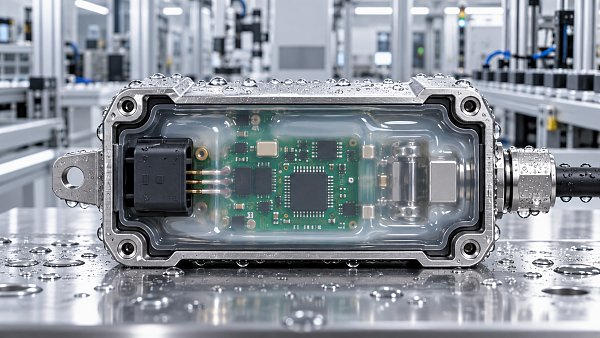
A sensor package may have a robust molded body and still fail at its weakest interface. Typical entry routes include the boundary between potting compound and housing, wire exits, connector backshells, component leads, PCB edges, and microscopic voids left by dispensing. Water does not need a large opening. Repeated humidity exposure, pressure changes, capillary action, and condensation can gradually exploit a narrow interfacial path.
The electrical consequences depend on the device. A Hall sensor, position sensor, current sensor, or pressure-transmitter electronics board may suffer leakage current or corrosion. A strain-gauge-based device may show offset changes if encapsulation stresses the sensing structure. Optical sensors can lose signal quality when condensation or volatile deposits affect a window. In temperature-sensitive assemblies, a potting compound that insulates too aggressively may also alter thermal response time.
This is why moisture protection cannot be evaluated from a material data sheet alone. A cured silicone may have suitable dielectric properties, yet the actual assembly can remain vulnerable if adhesion to the substrate is inconsistent or if the dispensing pattern traps air around pins and low-clearance components.
Why silicone is often the preferred encapsulant for stressed sensor assemblies
Silicone encapsulants are valued less for being rigid barriers and more for their ability to remain compliant after cure. Sensors are often built from materials with very different coefficients of thermal expansion: FR-4, copper, ceramic, molded plastics, aluminum housings, glass, and semiconductor packages can all move differently as temperature changes. A hard encapsulant can transfer that movement into solder joints, bond wires, thin ceramic elements, or calibrated sensing components.
A low-modulus silicone can absorb part of that movement instead. In a vibration-exposed sensor mounted on industrial machinery or within a vehicle subsystem, this flexibility can reduce mechanical stress concentration around leads and corners. The same property is useful where the assembly sees thermal cycling, intermittent condensation, or repeated pressure changes inside an enclosure.
Most silicone systems are also hydrophobic. Rather than readily wetting the cured surface, liquid water tends to bead and is less likely to form a persistent conductive film. When the silicone fully surrounds vulnerable electrical areas and bonds reliably to the intended surfaces, it helps isolate those areas from liquid water, contaminants, and direct humidity exposure.
There is an important qualification. Silicone rubber is generally more permeable to water vapor than dense epoxy systems. That does not make it unsuitable for moisture protection; it means the protection mechanism is different. Silicone is highly effective when the real field risk is condensation, splashing, vibration, thermal movement, and interface cracking. If the application requires an extremely low vapor transmission rate or near-hermetic sealing over a long service life, a different package strategy may be needed, potentially involving housing design, gaskets, coatings, metal or glass sealing, or a more impermeable material in selected areas.
The encapsulation design must respect what the sensor needs to measure
The best encapsulation is not necessarily full potting. Some sensor elements must remain exposed to their environment. A humidity sensor cannot be buried in silicone and still be expected to react normally to ambient humidity. Pressure sensors may require a protected pressure port or diaphragm arrangement. Gas sensors, optical sensors, microphones, and certain flow-sensing devices have similarly specific exposure requirements.
In these designs, silicone is often applied selectively: around the control electronics, at cable exits, over solder joints, or as a gasket-like seal around a protected cavity. Masking and keep-out zones deserve as much attention as the material selection. Silicone creeping into a vent, optical path, connector contact area, or calibration reference volume can create a failure that is difficult to diagnose after assembly.
Evaluators should also ask whether the cured material introduces mechanical loading or thermal insulation where the sensor is sensitive. A compliant gel or very soft silicone may suit a delicate component better than a firmer potting compound. Conversely, an assembly with large gaps, high vibration, or a need for better package rigidity may require a more structured formulation. There is no useful “best silicone” without defining the package function.
Adhesion is where many moisture-protection plans succeed or fail
Silicone’s flexibility is helpful, but its adhesion behavior must be tested on the actual substrate stack. Metals, solder masks, ceramics, engineering plastics, cable jackets, conformal coatings, and molded housings do not respond the same way. Surface energy, mold-release residue, oxidation, flux residue, oils from handling, and prior coatings can all affect bonding.
A common production error is to judge adhesion immediately after cure on clean development samples, then assume the result will hold on normal manufacturing parts. In reality, a small change in cleaning, incoming plastic formulation, storage time, or operator handling can turn a well-bonded seal into one that peels at the housing wall after temperature cycling.
Where adhesion is critical, the process should define substrate preparation rather than leaving it to informal shop-floor practice. Depending on the assembly, this may include controlled cleaning, drying, plasma treatment, abrasion, or an appropriate primer. These options are not interchangeable. A primer can improve bonding substantially on a difficult substrate, but it adds a material-control step, application consistency concerns, and its own curing or storage requirements.
For sensor modules expected to see frequent wet-dry cycling, inspect the material boundary after environmental testing, not only the electrical output. Electrical function can remain normal during a short test while an interfacial channel has already begun to form.
Dispensing quality matters as much as chemistry
A correctly selected silicone can still produce unreliable protection if the dispensing process creates voids, incomplete coverage, or variable fill height. Air pockets are especially troublesome around fine-pitch leads, connector pins, vertical walls, and undercut components. They may retain moisture, reduce dielectric spacing, and become a pathway for corrosion.
For two-component silicone systems, mix ratio control and static mixing are central process variables. Inadequate mixing can leave regions with incomplete cure or inconsistent mechanical properties. Pot life must be matched to the actual dispensing schedule; a material that behaves well at the start of a shift may flow differently near the end of its usable working window. One-component moisture-cure silicone introduces a different concern: thick sections may cure slowly because access to ambient moisture is limited.
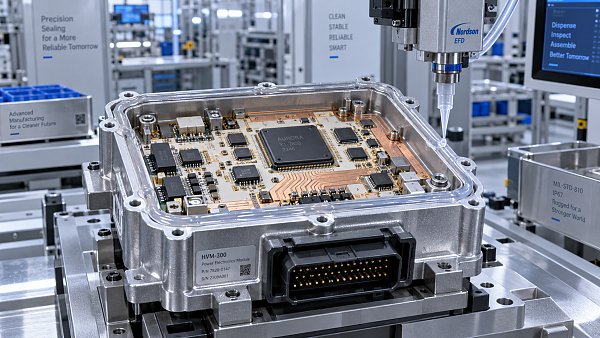
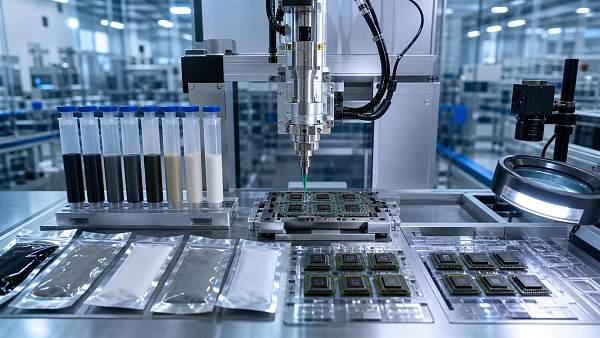
The choice between needle dispensing, volumetric metering, valve dispensing, or automated motion systems should follow geometry and required repeatability. A simple bead around a housing perimeter may not need the same equipment as selective protection around compact sensor electronics. For tight clearances or microliter-scale deposits, jetting and automated fluid control can reduce contact with delicate parts, but the process still needs verification for deposit placement, wetting, and final coverage.
In practical process reviews, it is useful to cut open representative potted samples. Cross-sections often reveal problems that an external visual inspection misses: voids beneath components, shadowed zones, uneven material depth, or poor wetting at the wall. This is a straightforward check, yet it is sometimes skipped once a line appears to be running smoothly.
Cure chemistry can affect sensor reliability
Not all silicone cure systems behave alike. Addition-cure formulations are often selected where low by-product generation and controlled curing are important. Condensation-cure materials may be practical in some sealing operations, but their cure mechanism and potential by-products need consideration around sensitive electronics, metals, or enclosed volumes. The right choice depends on the specific formulation and assembly, not on a broad label alone.
Cure inhibition also deserves attention. Certain contaminants, residues, or incompatible materials can interfere with some silicone systems. If curing becomes tacky, uneven, or delayed near a particular component, the immediate temptation is to increase oven time. That may not solve a chemical compatibility problem and can expose the sensor to unnecessary thermal stress. A controlled compatibility study is usually more useful than trial-and-error heating.
For enclosed sensor packages, consider volatile content and the possibility of deposits on optical, contact, or sensing surfaces. This is particularly relevant when the design includes windows, relay contacts, miniature cavities, or other surfaces where a thin film can affect function. Material suppliers can provide relevant product documentation, but final suitability still needs confirmation in the assembled device.
A sensible evaluation plan looks beyond initial electrical tests
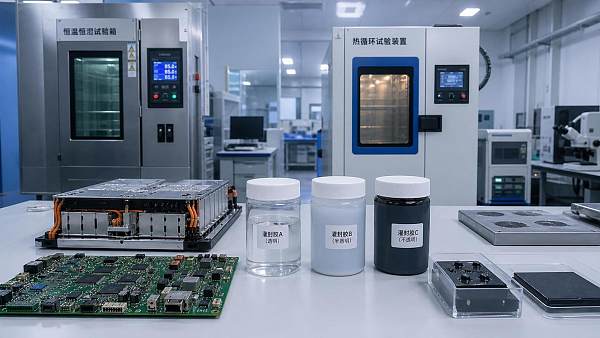
A newly potted sensor may pass a bench test and still be poorly prepared for field exposure. Evaluation should reflect the environment that actually drives failure: temperature cycling, humidity exposure, condensation risk, immersion or splash where relevant, vibration, chemical contact, and power-on operation during moisture stress. The exact test sequence should be aligned with product requirements and applicable customer or industry standards rather than copied from an unrelated program.
Useful observations extend beyond pass or fail. Track sensor offset, noise, response time, insulation behavior, visible corrosion, adhesion loss, cracking, changes in material appearance, and any variation between positions in the dispensing pattern. If one cavity on a multi-part fixture produces different results, the root cause may be fill dynamics or cure uniformity rather than the silicone itself.
Material selection also has a compliance and supply-chain dimension. For globally supplied assemblies, evaluators commonly need to review declarations related to restricted substances, halogen requirements where applicable, and customer-specific documentation. These requirements should be checked against the exact formulation and current supplier documentation, especially when a material is reformulated or produced at a different site.
Choosing silicone with the full assembly in view
The strongest silicone encapsulation strategy begins with a failure map: where moisture enters, what component is most sensitive, how the package moves during use, and which surfaces must remain exposed. From there, the decision becomes more disciplined. A soft silicone may protect a fragile sensor from stress but need a well-designed housing to control vapor exposure. A firmer thermally conductive silicone may suit heat-generating electronics but should be checked for its influence on measurement response and dispense behavior. A silicone with excellent flow may reach tight gaps, while a more thixotropic grade may better hold a bead on a vertical wall.
This is the intersection of polymer chemistry, package design, and dispensing control that industrial adhesives and fluid-handling teams deal with every day. For sensor protection, the material is only one part of the solution. Reliable electronic encapsulation for sensors comes from eliminating uncontrolled interfaces, preventing voids, managing cure, and validating the finished assembly under conditions close to reality. When those details are handled well, silicone does more than cover electronics: it gives the sensor a much better chance of staying stable after moisture, vibration, and thermal cycling begin to act on the system.
Recommended News
 Sep 23, 2026How silicone encapsulation prevents moisture failures in sensorsElectronic encapsulation for sensors: discover how silicone reduces moisture failures, protects critical interfaces, and improves reliability under vibration and thermal cycling.
 Sep 22, 2026How to verify UL94 V-0 performance in silicone encapsulantsSilicone encapsulants UL94 V0: learn how to verify flame performance through test evidence, minimum thickness, cure controls, and traceable production practices.
 Sep 22, 2026Automotive Silicone Encapsulation: Preventing Cracks in High-Temperature ElectronicsAutomotive silicone encapsulation prevents cracks in high-temperature electronics with proven control of dispensing, voids, curing, and inspection.
 Sep 21, 2026How to Select Sensor Encapsulation Materials for Heat, Moisture, and ShockEncapsulation materials for sensors: learn how to balance heat resistance, moisture sealing, and shock protection for reliable, high-performance sensor assemblies.
 Sep 21, 2026Sealing Hybrid Packages: Material Choices for Moisture Protection and ReliabilitySealing of hybrid packages: compare epoxy, silicone, polyurethane, and dual-cure materials for dependable moisture protection and long-term reliability.
 Sep 17, 2026When silicone chip packaging adhesives prevent solder joint crackingSilicone chip packaging adhesives help prevent solder joint cracking by absorbing stress, reducing board flex, and improving BGA reliability. Explore smarter protection strategies.
 Sep 15, 2026Silicone vs. polyurethane: which offers better vibration damping for EV battery module assembly?Should I use silicone or polyurethane for vibration protection? Discover which material delivers superior long-term damping, thermal stability & safety in EV battery modules.
 Sep 03, 2026How to prevent leaks when selecting a battery pack sealing adhesiveBattery pack sealing adhesive selection made practical: prevent leaks with proven guidance on joint design, curing, dispensing, durability testing, and serviceability.
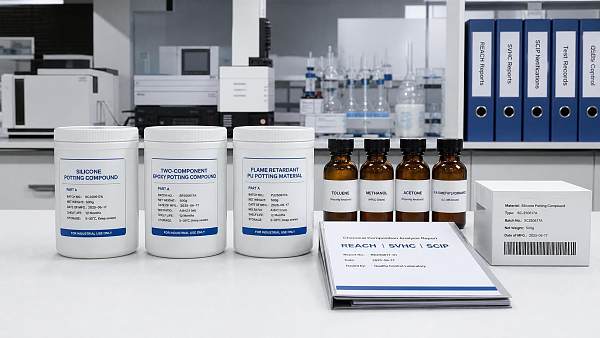
 Aug 16, 2026EU REACH Adds 5 SVHCs, Triggering Mandatory SCIP Reporting from Aug. 15, 2026EU REACH adds 5 SVHCs, making SCIP reporting mandatory from Aug. 15, 2026. Learn how the new REACH candidate list impacts exporters, epoxy adhesives, silicone encapsulants, and EU compliance.
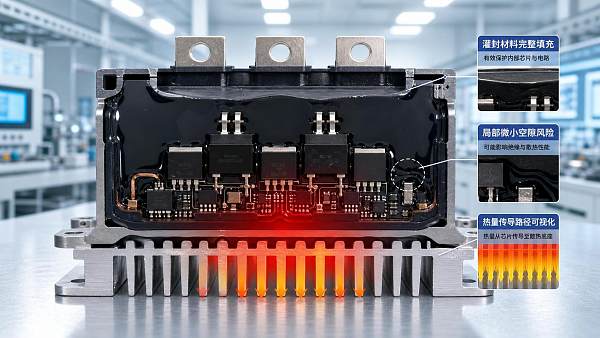
 Aug 12, 2026How Electronics Potting for Power Modules Affects Heat Dissipation and ReliabilityElectronics potting for power modules directly impacts heat dissipation, insulation, and long-term reliability. Learn how to choose materials that reduce risk and improve performance.
 Aug 11, 2026EU PFOA Rule Takes Full Effect on Aug. 10EU PFOA Rule takes full effect on Aug. 10, tightening REACH limits for electronics and new energy materials. See who is affected, key compliance risks, and what exporters should check now.
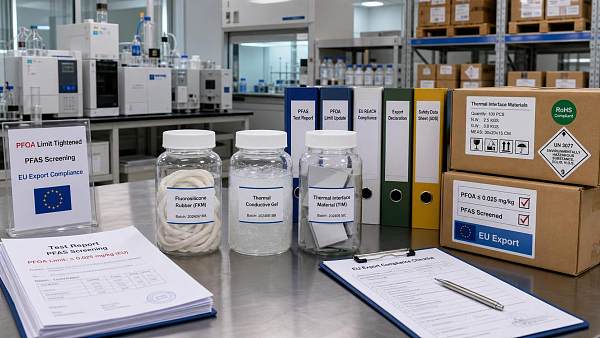
 Aug 10, 2026ECHA Tightens PFOA Limit for Fluorinated Silicone ExportsECHA tightens PFOA limit to 25 ppb for fluorinated silicone exports. Learn how Silicone Encapsulants and Thermal Conductive Pastes can meet EU REACH compliance fast.
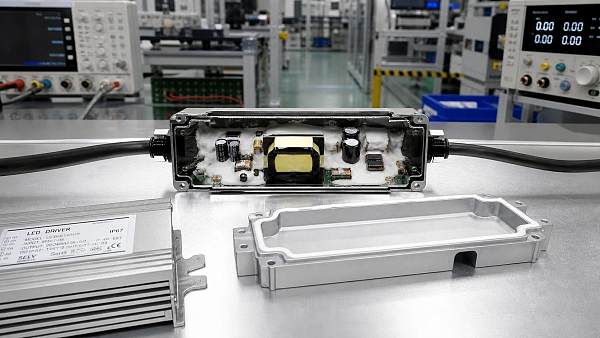
 Aug 07, 2026How to Choose Electronics Potting for LED Drivers by Heat and IP RatingElectronics potting for LED drivers: learn how to choose the right compound by heat path, IP rating, stress, and cure behavior to improve reliability and simplify selection.
 Jul 26, 2026ECHA Adds Two Flame Retardants to SVHC ListECHA Adds Two Flame Retardants to SVHC List: learn how DPTEBP and TBBPS may affect EU exports, SDS updates, declarations, and October 2026 compliance deadlines.
 Jul 19, 2026ECHA SVHC Update Raises Export Risks for Silicone MaterialsECHA SVHC update raises export risks for silicone materials, including silicone encapsulants and thermal conductive pastes. Learn the REACH, SCIP, and traceability impacts before October 2026.
 Jul 14, 2026Japan’s New JIS Rule Pulls Silicone Encapsulant Orders to ChinaSilicone encapsulant demand is shifting to China as Japan’s new JIS rule nears. See how compliance, certification, and EMS procurement are reshaping orders before October 2026.
 Jul 13, 2026Japan Enforces JIS T 2801-2026 on Silicone EncapsulantsJapan Enforces JIS T 2801-2026 on Silicone Encapsulants: learn how new thermal shock and ion migration tests affect PSE access, supplier approval, and Japan-bound compliance plans.
 Jul 09, 2026How to Evaluate an Electronics Packaging Adhesive Supplier for Yield StabilityElectronics packaging adhesive supplier evaluation starts with yield stability. Learn how to compare consistency, compliance, process fit, and total cost for smarter sourcing.
 Jul 04, 2026How to Evaluate Electronic Potting Materials in Japan for Heat, Moisture, and ComplianceElectronic potting materials Japan: learn how to compare heat resistance, moisture protection, and compliance data to choose reliable compounds for automotive, EV, and electronics projects.
 Jul 03, 2026China Customs Splits Out Silicone Encapsulants HS CodeChina Customs splits out Silicone Encapsulants HS code to 3910.0099, tightening filing, UL/IEC documentation, and rebate timing. See what exporters and buyers must do now.
 Jul 02, 2026China Splits Out Silicone Encapsulants Under New HS CodeChina splits out silicone encapsulants under new HS code 3506.9900.11. See how the rule affects export compliance, tax rebate timing, and global delivery planning.
 Jul 01, 2026China Creates HS 2026.7.11 for Silicone EncapsulantsChina creates HS 2026.7.11 for silicone encapsulants, reshaping customs declarations, rebate timing, and export compliance. Learn what exporters and buyers must review now.
 Jun 29, 2026How to Choose Electronic Potting Sealants for Heat and MoistureElectronic potting sealants for heat and moisture: learn how to match materials to real operating conditions, improve reliability, and avoid costly process mistakes.
 Jun 24, 2026Electronic Packaging Adhesive Price Benchmarks by Cure Type and VolumeElectronic packaging adhesive price benchmarks by cure type and volume. Compare UV, epoxy, silicone, package formats, and hidden process costs to source smarter and cut total line expense.

Editor's Selection
The Archive Newsletter
Critical industrial intelligence delivered every Tuesday. Peer-reviewed summaries of the week's most impactful logistics and market shifts.