When Structural Adhesives Can Replace Riveting in Metal Assemblies
by
Published
Views:
In metal assemblies, the debate has shifted from whether bonding works to when it can outperform fasteners. For many projects, structural adhesive replacement riveting is no longer a niche option. It is a practical evaluation path tied to fatigue life, corrosion control, weight reduction, surface appearance, and process automation.
That shift matters across transport, electronics housings, industrial equipment, rail interiors, battery structures, and mixed-material assemblies. It also explains why technical research platforms such as IADS increasingly connect adhesive chemistry, dispensing precision, curing behavior, and compliance data into one decision framework.
Where the replacement question really begins
Structural adhesive replacement riveting does not start with adhesive strength alone. The first question is how the joint carries load over time, under temperature change, vibration, impact, and manufacturing variation.
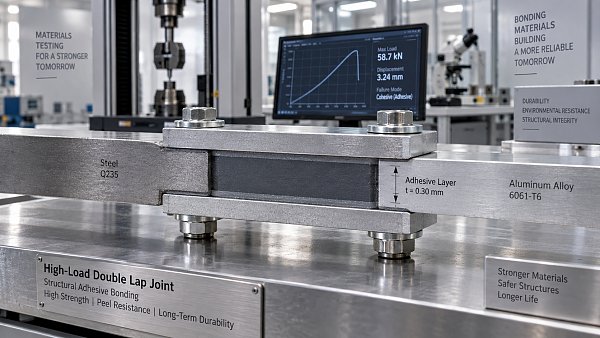
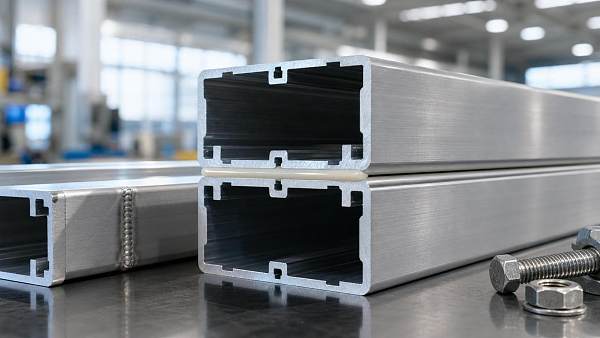
A riveted joint transfers force through concentrated points. A bonded joint spreads stress across a larger area. That difference can improve fatigue behavior, reduce local deformation, and help thin-gauge metal parts stay dimensionally stable.
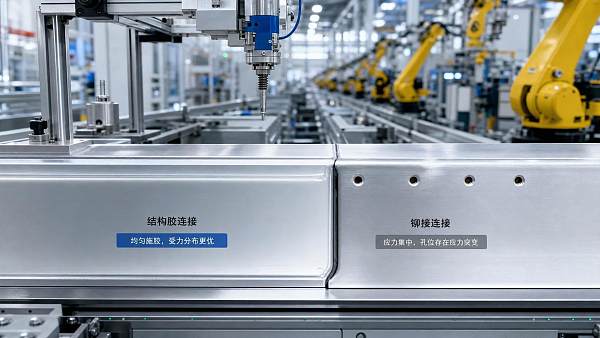
This is why structural adhesive replacement riveting is often considered during redesign, not only during material substitution. The joining method changes how the assembly behaves, how it looks, and how it moves through production.
Why more industries are reassessing rivets
Several pressures are driving this reassessment. Lightweighting remains a major one, especially where every gram affects fuel use, battery range, handling, or payload efficiency.
Corrosion is another factor. Mechanical fastening can break protective coatings and create galvanic risk between dissimilar metals. A suitable adhesive layer can act as both a structural interface and a barrier.
Appearance also matters more than before. Bonding removes visible fastener heads and avoids distortion caused by drilling or setting operations. In enclosures, panels, and covers, that can simplify downstream finishing.
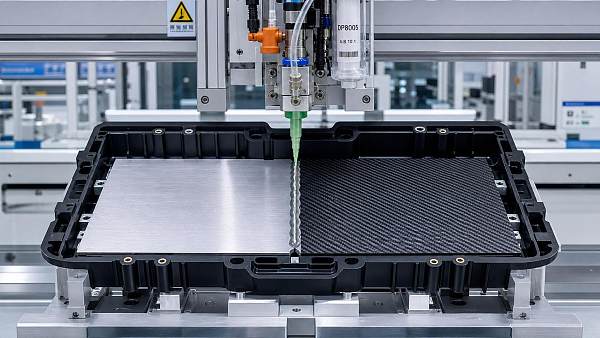
Then there is manufacturing logic. Automated dispensing, static mixing, jetting, and controlled cure windows make adhesive joining more measurable than older assumptions suggest. That is one reason IADS tracks both materials and fluid control systems, rather than treating them as separate topics.
What qualifies a joint for structural adhesive replacement riveting
Not every riveted assembly should be bonded. The strongest candidates usually share several technical conditions.
- Loads are mainly shear, peel is limited, and joint geometry supports broad adhesive contact.
- Substrates can be cleaned, treated, or coated in a repeatable way.
- Assembly tolerances allow control of bondline thickness.
- Production can accommodate fixture time, cure time, or heat-assisted cure.
- Inspection methods are defined before launch, not after the first quality issue.
Simple lap joints often convert more easily than joints exposed to edge peel, prying loads, or frequent disassembly. Structural adhesive replacement riveting is usually more credible when the product architecture already supports distributed loading.
Material compatibility matters early
Metal type, coating system, oil residue, and oxide condition all affect results. Aluminum, stainless steel, coated steel, and plated components can behave very differently under the same adhesive family.
That is why structural adhesive replacement riveting should be screened with both chemistry and process in mind. A strong 2K epoxy on paper can fail in practice if the pretreatment window is unstable.
How adhesives change performance beyond holding parts together
A bonded metal assembly does more than resist separation. It can also damp vibration, isolate dissimilar materials, and reduce stress peaks around holes. In many applications, those side effects are as valuable as nominal joint strength.
For battery enclosures, electronics frames, rail panels, and transport modules, vibration control is not a secondary benefit. It affects noise, durability, seal integrity, and long-term service behavior.
Bonding can also protect surface treatments. Riveting usually requires drilling, punching, or deformation. That may expose bare metal or create crack initiation points near the fastener location.
Typical application zones where bonding makes sense
The most realistic structural adhesive replacement riveting opportunities appear in assemblies where sealing, stiffness, corrosion separation, and appearance matter alongside strength.
Examples include metal covers, brackets with broad overlap, battery tray subassemblies, appliance frames, transportation interior panels, thin enclosures, and mixed-material support structures.
In some cases, a hybrid method remains the better answer. Adhesives handle distributed stress and sealing, while a limited number of rivets provide positional security during cure or localized crash retention.
That hybrid logic often appears before full replacement. It lets teams gather fatigue, corrosion, and process data without redesigning the entire joint concept at once.
Where replacement is less convincing
Frequent field disassembly is a warning sign. So are joints dominated by peel, sharp impact, uncontrolled contamination, or very high-temperature exposure beyond the adhesive system limit.
Structural adhesive replacement riveting is also harder to justify where cure time cannot be absorbed and no practical fixture strategy exists.
The process side is often the real decision point
Many conversion projects fail for process reasons, not material reasons. Meter-mix accuracy, bead geometry, open time, substrate cleanliness, and bondline control often decide the outcome long before mechanical testing starts.
This is where the wider IADS perspective becomes useful. Structural bonding cannot be separated from dispensing equipment, static mixers, jet valves, fixture design, and cure monitoring.
For 2K epoxy systems, mix ratio drift can change final strength and toughness. For automated lines, inconsistent bead placement can create voids or starved areas. For coated metals, poor wetting can undermine the whole structural adhesive replacement riveting case.
- Define the real service load, not only the design load.
- Test on production-intent surfaces, not ideal lab coupons.
- Measure cure behavior under actual line conditions.
- Include corrosion, vibration, and thermal cycling in validation.
- Review compliance needs such as RoHS, REACH SVHC, and halogen requirements where relevant.
How to judge cost without missing the bigger picture
Piece-price comparisons are rarely enough. Rivets may look cheaper per unit, while the total assembly picture tells a different story.
A fair comparison should include drilling or piercing operations, tool wear, noise control, labor content, secondary sealing, corrosion risk, aesthetic finishing, fixture time, inspection, scrap, and warranty exposure.
Structural adhesive replacement riveting becomes attractive when fewer parts are needed, thinner substrates become possible, or downstream quality improves. It can also create value by simplifying automation and reducing variation between operators or stations.
That does not mean bonding always lowers cost. It means the cost model must follow the process reality, not a narrow material line item.
A practical route to the next decision
The most useful next step is to narrow the question. Instead of asking whether adhesives can replace rivets in general, isolate one joint family, one substrate set, and one production scenario.
From there, build a comparison around joint geometry, surface condition, cure window, corrosion demand, inspection method, and expected service loads. A small pilot often reveals more than a large slide deck.
Structural adhesive replacement riveting is most persuasive when chemistry, dispensing, and joint design are evaluated together. That integrated view is increasingly necessary in lightweight transport, electronics-adjacent metal assemblies, and automated production environments.
A disciplined review of one candidate assembly, supported by process-capable testing data, usually shows whether bonding should stay a supplement, become a hybrid method, or replace riveting outright.
Recommended News
 Oct 08, 2026When do automotive adhesive lightweighting applications justify 2K epoxy?Adhesive lightweighting applications automotive: discover when 2K epoxy delivers durable, lightweight structural bonding for mixed-material vehicle designs.
 Sep 28, 2026How material characterization predicts structural adhesive bond durabilityStructural adhesive material characterization reveals how mechanical, thermal, cure, and environmental data predict bond durability—helping engineers select reliable solutions with confidence.
 Sep 25, 2026How to select epoxy structural bonding materials for high-load jointsEpoxy structural bonding materials: learn how to select durable solutions for high-load joints, balancing strength, toughness, surface prep, cure, and environmental resistance.
 Sep 20, 2026When 2K epoxy structural industrial bonding solutions make senseStructural industrial bonding solutions with 2K epoxy help engineers achieve durable, sealed joints for mixed materials. Explore selection, curing, and design insights.
 Sep 18, 2026How bonding applications in wind energy prevent fatigue-related failuresBonding applications in wind energy help prevent fatigue-related failures through durable joint design, crack resistance, cure control, and reliable production processes.
 Sep 23, 2026PCB Underfill Selection Guide for Fine-Pitch Components and Thermal CyclingPCB underfill selection guide for fine-pitch BGAs, CSPs, and flip-chip devices. Compare flow, CTE, modulus, adhesion, curing, and dispensing for reliable thermal cycling performance.
 Sep 23, 2026Circuit Board Level Underfill Market: Growth Drivers and Supply Chain OutlookExplore the electronic circuit board level underfill material market with actionable insights on reliability, dispensing precision, material selection, and supply chain resilience.
 Sep 20, 2026Rail Bonding Solutions for Vibration, Fire Safety, and Long-Term DurabilityBonding solutions for rail: explore proven strategies for vibration resistance, fire safety, durable joints, surface preparation, and production-ready validation.
 Sep 19, 2026Lightweight Adhesives for EVs: Reducing Mass Without Compromising Joint StrengthLight weighting adhesives for EVs help reduce vehicle mass while maintaining joint strength, durability, and production efficiency. Explore smarter bonding solutions for EV designs.
 Sep 15, 2026How fluid control engineering prevents voids in 2K epoxy sealantsFluid control engineering for sealants helps prevent voids in 2K epoxy systems. Explore practical methods for stable metering, mixing, pressure control, and air-free cavity filling.
 Sep 10, 2026When do adhesive lightweighting applications make sense in aerospace?Adhesive lightweighting applications aerospace: learn when bonded joints reduce mass, improve load transfer, and support durable, certifiable aircraft designs.
 Aug 28, 2026How to select an epoxy rail vehicle structural adhesive for fatigue loadsEpoxy rail vehicle structural adhesive selection for fatigue loads: evaluate toughness, joint design, surface prep, curing, and rail compliance for durable bonds.
 Aug 25, 2026When does BGA underfill technology for PCB assembly reduce field failures?BGA underfill technology for pcb assembly reduces field failures when thermal cycling, shock, or board flex drive solder fatigue. Learn when it boosts reliability—and when it adds cost without real gains.
 Aug 11, 2026How to Choose Epoxy Adhesive Systems for Metal Bonding Under Heat and VibrationEpoxy adhesive systems for metal bonding: learn how to compare heat resistance, vibration durability, cure profile, and dispensing fit to choose a more reliable solution.
 Aug 10, 2026Industrial Adhesive Technology Analysis: What Drives Bond Strength and Process Stability?Industrial adhesive technology analysis reveals what drives bond strength and process stability—from chemistry and surface prep to curing and dispensing. Learn how to reduce failure risk.
 Aug 05, 2026How to Evaluate Lightweight Structural Bonding for Composites Under Dynamic LoadsLightweight structural bonding for composites under dynamic loads demands more than static strength. Explore fatigue, impact, surface prep, and process factors to choose durable, weight-saving bonds.
 Jul 14, 2026How to Choose Lightweight Structural Bonding for PlasticsLightweight structural bonding for plastics explained: compare adhesive types, joint design, process control, and durability factors to choose lighter, stronger, production-ready assemblies.
 Jul 13, 2026Choosing an Adhesive for Automotive Supplier ProgramsAdhesive for automotive supplier programs affects strength, process stability, compliance, and launch risk. Learn how to choose the right solution for reliable, scalable production.
 Jul 11, 2026Automotive Adhesive Bonding Process: Key Steps That Prevent Bond FailureAutomotive adhesive bonding process essentials: learn the key steps that prevent bond failure, improve durability, and optimize surface prep, dispensing, and cure control in automotive assembly.
 Jul 09, 2026When Structural Adhesives Can Replace Riveting in Metal AssembliesStructural adhesive replacement riveting: learn when bonded metal assemblies can outperform rivets in fatigue, corrosion control, weight reduction, and automation.
 Jul 08, 2026Best Ways to Bond Dissimilar Material Composites Without CrackingDissimilar material bonding composites: learn how to prevent cracks in metal, plastic, battery, and laminate assemblies with smarter adhesive, process, and stress-control strategies.
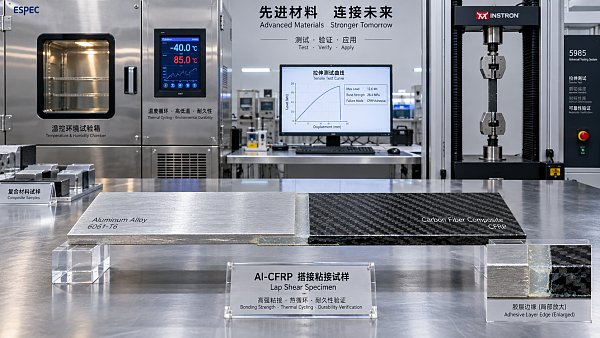
![]() Jul 07, 2026How Lap Shear Testing Reveals Structural Adhesive Joint Failure RisksLap shear structural adhesive joint testing reveals hidden failure risks before launch. Learn how process conditions, substrates, and aging affect joint reliability.
Jul 07, 2026How Lap Shear Testing Reveals Structural Adhesive Joint Failure RisksLap shear structural adhesive joint testing reveals hidden failure risks before launch. Learn how process conditions, substrates, and aging affect joint reliability. Jul 06, 2026Can Automotive Adhesive Replace Welding in Body Assembly?Automotive adhesive replacement for welding can improve multi-material body assembly with better sealing, lower corrosion risk, and more design flexibility. See where bonding beats welding.
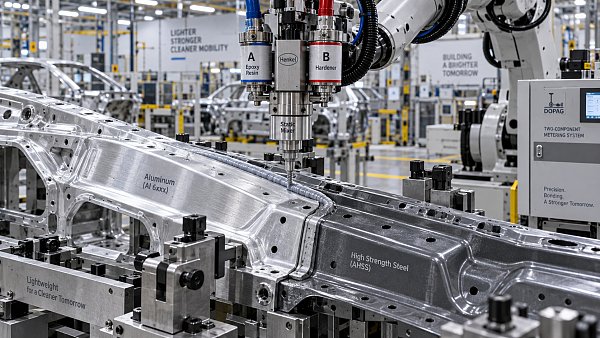
 Jul 04, 2026Structural Bonding for Aluminum: When 2K Epoxy Outperforms Welding and FastenersStructural bonding for aluminum with 2K epoxy can outperform welding and fasteners by reducing distortion, corrosion risk, and weight—see where it delivers stronger ROI.



Editor's Selection
The Archive Newsletter
Critical industrial intelligence delivered every Tuesday. Peer-reviewed summaries of the week's most impactful logistics and market shifts.